Decoding the Misfolded Proteome: The Evolution of RT-QuIC and the Future of Neurodegenerative Diagnostics
The silent epidemic of neurodegenerative disease—spanning from the devastating Creutzfeldt-Jakob disease (CJD) to the widespread prevalence of Alzheimer’s and Parkinson’s—is fundamentally rooted in a singular, microscopic betrayal of biology: protein misfolding. When essential proteins abandon their functional, native conformations to adopt pathological, beta-sheet-rich structures, they aggregate into toxic amyloids. This transformation is not merely a symptom of disease; it is the primary driver of cellular degradation and death.
For decades, the study of these "infectious" proteins, or prions, was hampered by slow, imprecise bioassays. However, the emergence of Real-Time Quaking-Induced Conversion (RT-QuIC) technology has revolutionized the field. By leveraging advanced microplate reader platforms, researchers can now detect, quantify, and analyze the kinetic behavior of these rogue proteins in real-time, opening new frontiers in diagnostics, food safety, and therapeutic discovery.
The Science of Misfolding: Core Facts and Mechanisms
At the heart of prion disease—collectively known as transmissible spongiform encephalopathies (TSEs)—is the conversion of the cellular prion protein (PrPC) into its pathological counterpart, PrPSc. This transition is a self-propagating chain reaction. Once a small "seed" of misfolded protein is introduced, it recruits normal proteins, forcing them into the same aberrant, beta-sheet-heavy conformation.
These aggregates grow into amyloid fibrils, which further fragment into smaller seeds, creating a cycle of exponential amplification. This process, while historically associated with rare diseases like CJD or Bovine Spongiform Encephalopathy (BSE), is now recognized as a universal mechanism of pathology. The same principles of kinetic seeding apply to the amyloid-beta plaques seen in Alzheimer’s disease and the alpha-synuclein aggregates characteristic of Parkinson’s disease.
A Chronological Shift in Diagnostic Methodology
The journey toward modern detection began with the necessity of moving away from traditional, resource-intensive bioassays.
- The Era of Bioassays: Early detection of prion diseases relied on animal inoculation studies, which could take months or even years to yield results. These methods were not only ethically contentious but also prohibitively expensive and slow for high-throughput screening.
- The Development of RT-QuIC: In the early 2010s, the scientific community introduced RT-QuIC. By utilizing intermittent, automated shaking to fragment fibrils and accelerate the recruitment process, researchers found they could "force" the conversion of proteins in vitro.
- Microplate Standardization: The transition to microplate readers, pioneered by the FLUOstar® Omega from BMG LABTECH, turned this lab-bench technique into an international standard. This integration allowed for the precise monitoring of Thioflavin T (ThT) fluorescence—a dye that glows intensely when bound to beta-sheet structures—in real-time.
- Present Day: Today, RT-QuIC is the gold standard for clinical diagnostics and surveillance. It allows for the detection of infinitesimal amounts of protein seeds, providing data that can differentiate between healthy and diseased states with unprecedented sensitivity.
Supporting Data: Kinetic Analysis and Sensitivity
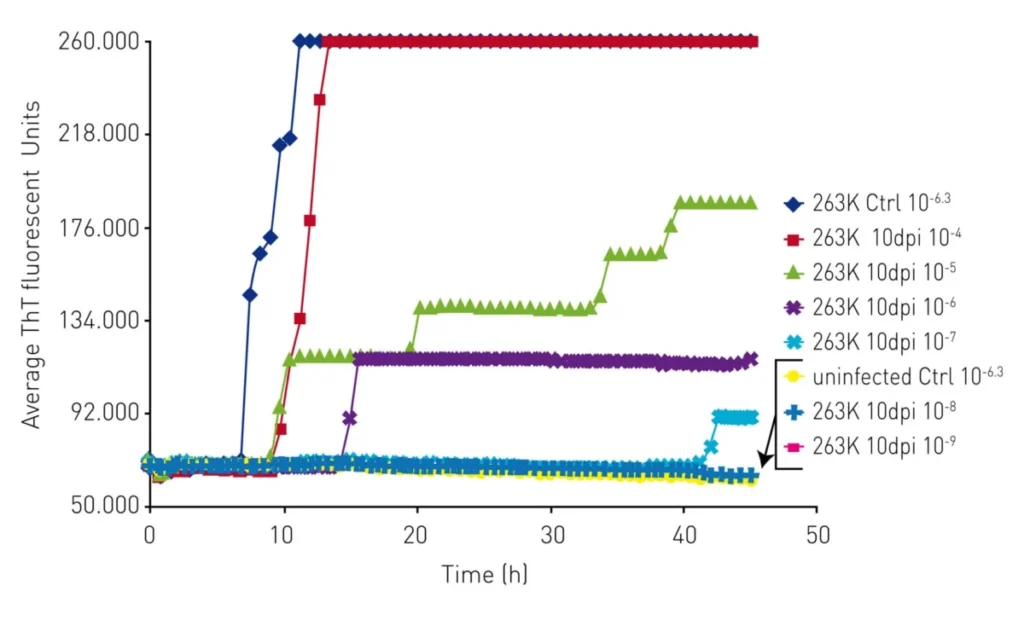
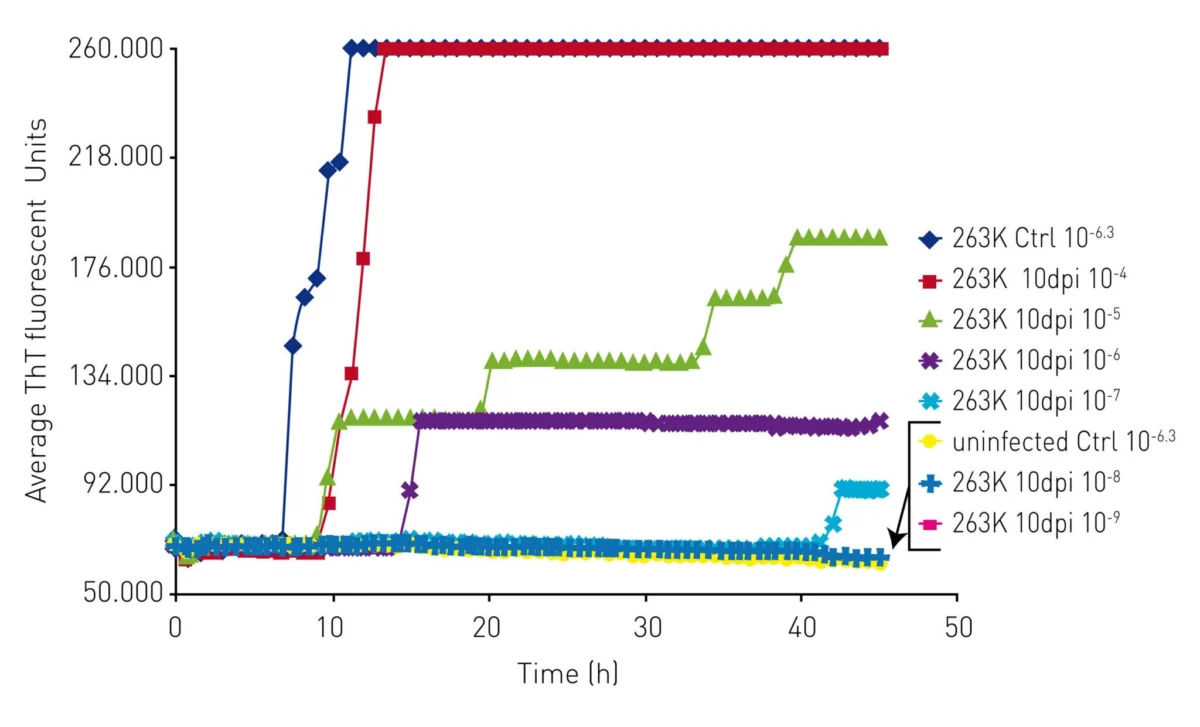
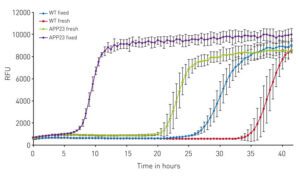
The power of RT-QuIC lies in its ability to generate characteristic amplification curves. These curves provide a wealth of quantitative data, including the lag time before aggregation begins, the rate of exponential growth, and the final plateau of fluorescence.
In experiments involving hamster tissue homogenates, the kinetic profiles demonstrate a clear, inverse relationship between the concentration of the prion seed and the lag time—a hallmark of seed-dependent growth. By measuring the loss of seeding activity at end-point dilutions, laboratories can quantify the prion load with high reproducibility.
Recent studies on amyloid-beta aggregation, such as those utilizing BMG LABTECH’s instrumentation, have confirmed that these platforms can reliably distinguish between wild-type samples and those containing pathological brain homogenates. These signal curves, characterized by a steady rise in fluorescence followed by a saturation plateau, allow researchers to test the efficacy of potential inhibitory compounds in real-time.

Industry Perspective: The Role of Advanced Instrumentation
Leading the technological charge, BMG LABTECH has solidified its position as a critical partner in neurodegenerative research. The company’s focus on long-term, stable incubation and high-performance fluorescence detection has made their microplate readers indispensable for studies spanning multiple days.
Technological Pillars:
- Kinetic Stability: Prion assays require days of continuous, precise shaking. Readers like the FLUOstar Omega and the PHERAstar FSX are engineered for this level of durability, ensuring that the mechanical stress required for fragmentation remains consistent throughout the entire reaction cycle.
- Sensitivity and Flexibility: The introduction of the CLARIOstar Plus and VANTAstar has added a layer of wavelength flexibility and Enhanced Dynamic Range (EDR) technology, allowing researchers to optimize detection even when sample volumes are severely limited.
- Throughput Optimization: For clinical and environmental surveillance, high-throughput screening (HTS) is vital. The PHERAstar FSX serves as the industry’s workhorse, enabling rapid screening of compound libraries to identify drugs that might stabilize the native protein or prevent the initial misfolding event.
Implications for Public Health and Drug Discovery
The implications of these advancements are profound, extending far beyond the laboratory bench into the realms of public health and clinical intervention.
Environmental and Food Safety
Chronic Wasting Disease (CWD) in cervids has become a significant concern for wildlife management and human food safety. RT-QuIC is currently being deployed to screen tissue samples from wild and farmed animals. The ability to perform these tests at scale ensures that the food chain remains secure and provides a powerful tool for monitoring the spread of infectious prions in the environment.
The Search for Therapeutic Breakthroughs
The most significant impact of RT-QuIC lies in the search for disease-modifying therapies. By providing a clear, reproducible way to measure the "seeding activity" of proteins, researchers can now conduct massive screens to find small molecules or antibodies that interrupt the conversion process.
Current clinical trials for Alzheimer’s and Parkinson’s are increasingly incorporating "biomarkers of aggregation." If clinicians can track how a drug impacts the seeding activity in cerebrospinal fluid, they can move from treating symptoms to potentially stopping the progression of the disease at the molecular level.
Integrating AI and Modeling
The future of this field lies in the marriage of kinetic data with artificial intelligence. As models of protein folding become more sophisticated, the vast datasets generated by microplate readers serve as the "ground truth" for AI training. By predicting how different mutations or pharmacological agents influence the lag phase and growth rate of amyloid fibrils, scientists hope to usher in a new era of rational drug design.
Conclusion
The evolution of RT-QuIC, supported by the robust, high-performance capabilities of modern microplate readers, has fundamentally changed the landscape of neurology. What was once an elusive and slow-moving field of study has been accelerated into a high-precision, data-driven discipline.
As we continue to navigate the challenges posed by neurodegenerative disease, the ability to monitor protein misfolding in real-time remains our most potent weapon. Whether it is ensuring the safety of the food supply, tracking the emergence of new prion strains, or identifying the next generation of life-saving therapeutics, the integration of sensitive assays and advanced detection platforms like those offered by BMG LABTECH will remain at the forefront of the fight against the misfolded proteome.
For researchers and laboratories looking to deepen their understanding of prion kinetics or seeking to optimize their own protein misfolding assays, BMG LABTECH provides comprehensive technical support and state-of-the-art instrumentation. For further inquiries, please reach out to their support team or consult their latest application notes on the BMG LABTECH website.