Scaling Performance: How R8 Optimization Supercharges Kotlin Coroutines on Android
In the modern Android ecosystem, Kotlin has transitioned from a preferred alternative to the de-facto standard for mobile development. At the heart of this shift lies kotlinx.coroutines, a robust library that simplifies asynchronous programming through structured concurrency. However, as developers pushed the limits of responsive UI design—particularly with Jetpack Compose—they encountered a surprising performance bottleneck: the overhead of coroutine management.
Recent advancements in the Android Gradle Plugin (AGP) 9.2.0 have introduced a significant architectural breakthrough. By leveraging the R8 compiler to optimize Atomic*FieldUpdater calls into direct Unsafe variants, the Android team has achieved a 2x to 4x performance boost in common atomic operations. This update represents a milestone in bridging the gap between high-level Kotlin abstractions and low-level hardware efficiency.
The Chronology: From Bottleneck to Breakthrough
The story of this optimization began with the evolution of Jetpack Compose. As the Compose team sought to deliver buttery-smooth 60fps (or higher) experiences, they began profiling their codebase to understand why certain UI interactions felt sluggish.
Identifying the Coroutine Tax
The investigation revealed a counterintuitive truth: coroutines, while efficient, were causing overhead in scenarios outside of composition. Specifically, the team found that 80% of the CPU time spent on creating and updating Modifier.clickable was dedicated solely to the lifecycle management of internal coroutines responsible for InteractionSource updates.

In response, the early engineering phase focused on "de-coroutinizing" the default path—essentially delaying initialization until the absolute last moment. While this mitigated the issue, it did not solve the fundamental cost associated with the coroutine engine itself.
The Profiling Phase
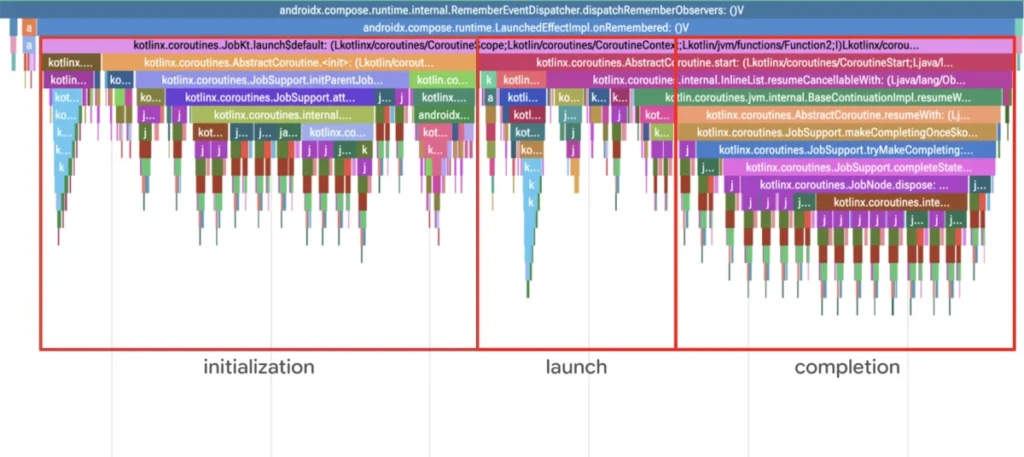
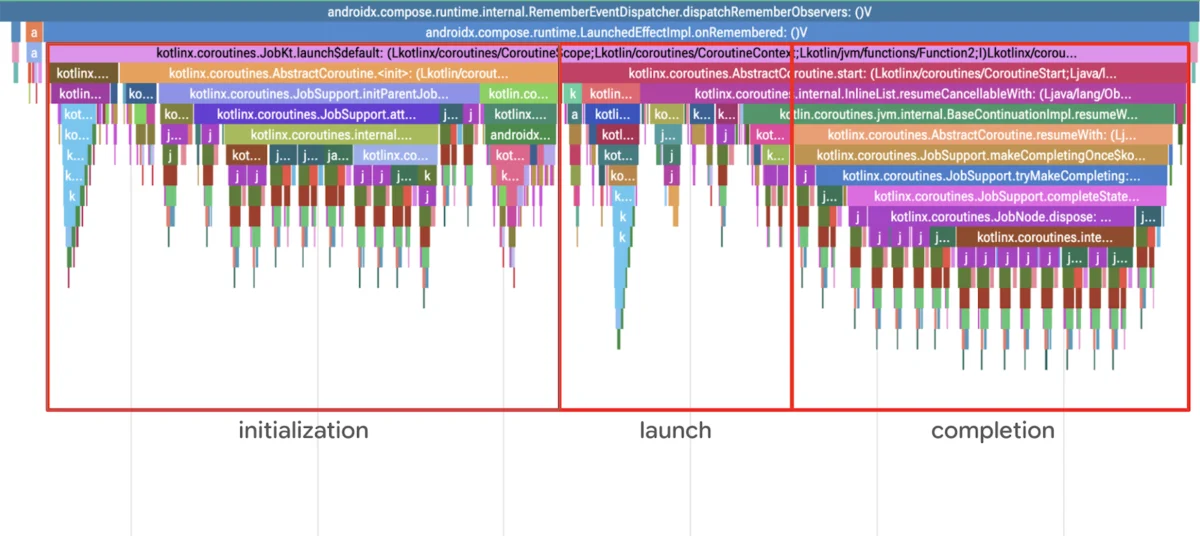
By utilizing Android Runtime (ART) method traces, engineers captured the execution flow of an empty LaunchedEffect call. The resulting visualizations in the Perfetto UI revealed a recurring pattern: frequent, high-frequency calls to java.util.concurrent.atomic.AtomicReferenceFieldUpdater.
While individual calls appeared fast, their cumulative impact was profound. Upon zooming into the trace data, the engineers discovered that the Android Runtime was spending a significant portion of its budget on reflection checks—a mechanism used by AtomicReferenceFieldUpdater to ensure field accessibility and validity at runtime.
The Benchmark Confirmation
To validate their hypothesis, the team constructed a series of benchmarks comparing standard Java AtomicReference with the kotlinx.atomicfu implementation used by coroutines. The results were stark: on a Pixel 5 running API 33, kotlinx.atomicfu operations were approximately 2.7x slower than their java.util.concurrent counterparts. This confirmed that the reflective safety checks were not just a theoretical concern; they were a measurable performance penalty impacting every coroutine launch, suspension, and cancellation.

Supporting Data: Unpacking the Optimization
The challenge for the R8 team was to replace the reflective, safety-checked operations with something more performant without sacrificing the integrity of the code.
The Role of the R8 Compiler
R8, the full-program optimizing compiler for Android, is uniquely positioned to perform this "surgical" optimization. Because it analyzes the entire application graph, it can identify when an AtomicReferenceFieldUpdater is used in a statically predictable pattern.
In many cases, the updater is created as a static final variable. R8 can "see through" this pattern, recognizing that the field name and class are constant and that access is guaranteed. By replacing these reflective calls with direct calls to Unsafe (the internal JVM mechanism that provides low-level memory access), the compiler removes the need for runtime validation.
The Three-Part Optimization Process
The R8 optimization follows a strict, three-stage lifecycle:

- Instrumentation: The compiler introduces new offset fields alongside the existing updater fields. Using
SyntheticUnsafe, it calculates the memory offset of the target field at compile time. - Replacement: The compiler scans the code for call sites—such as
compareAndSet. If the usage meets specific criteria (e.g., the holder is known, the field type is fixed), it replaces the reflective call with a directUnsafe.compareAndSwapObjectcall. - Clean-up: Finally, R8 removes the now-redundant updater objects and initialization logic. By identifying that the instrumented fields are statically valid, the compiler can safely prune the code that previously threw potential exceptions, resulting in a cleaner, faster binary.
Official Perspectives: Impact and Future-Proofing
The engineering teams behind Android Toolkit and the R8 project view this as a transformative shift. According to Andrei Shikov and Jonathan Starup, the primary goal was to ensure that developers do not have to choose between the readability of structured concurrency and the raw performance of manual thread management.
Jetpack Compose as the Primary Beneficiary
The impact on Jetpack Compose has been immediate and quantifiable. Internal benchmarks tracking the performance of LaunchedEffect show a 2x improvement in the time taken to launch and cancel coroutines. This optimization allows developers to use Compose’s high-level state management APIs with greater confidence, knowing that the "coroutine tax" has been significantly reduced.
Parallel Advances in ART
It is important to note that this is not an isolated effort. The Android Runtime (ART) team is simultaneously working to bake these optimizations directly into the VM. Recent updates to the Android runtime have shown a ~15% performance improvement for coroutines simply through JIT (Just-In-Time) compiler enhancements. When combined with the R8 static optimizations, the cumulative effect is a much leaner execution profile for modern Android applications.
Implications: What This Means for Developers
The release of AGP 9.2.0 is more than just a version bump; it is an invitation for developers to revisit their concurrency patterns.

Immediate Performance Gains
For the average developer, the benefits are essentially "free." By simply upgrading to AGP 9.2.0, applications will automatically benefit from these R8 optimizations during the build process. There is no need to refactor existing code, change library dependencies, or adjust minification rules. The compiler handles the complexity of replacing Atomic*FieldUpdater calls, meaning the performance gain is applied across the entire app stack, including third-party libraries that rely on kotlinx.atomicfu.
Best Practices for Future Development
While these optimizations are automatic, developers should still maintain best practices:
- Keep Dependencies Updated: Ensure that
kotlinx.coroutinesand the Android Gradle Plugin are kept up to date to leverage the latest R8 patches. - Use Benchmarking Tools: Developers should continue to utilize the Jetpack Benchmark library to monitor performance in their own apps. Even with compiler-level wins, understanding how your app interacts with the runtime is crucial for maintaining a high-performance profile.
- Embrace Structured Concurrency: With the overhead of coroutine lifecycle management significantly diminished, there is even less reason to avoid structured concurrency in favor of manual thread management.
The Long-Term Vision
This development highlights the ongoing maturity of the Android build toolchain. By moving logic from the runtime to the build-time, Google is effectively shifting the burden of optimization away from the user’s device and into the development environment. This results in apps that consume less battery, execute faster, and provide a more responsive experience—all without adding bloat to the final APK size.
In conclusion, the optimization of Atomic*FieldUpdater is a testament to the power of static analysis in modern mobile development. By solving the "cost of a coroutine," the Android team has ensured that the future of Kotlin development on Android is not only more expressive and readable but also faster than ever before. As we move toward higher-performance UI frameworks and more complex reactive architectures, these low-level compiler optimizations will continue to be the unsung heroes of the Android ecosystem.