Scaling Without Borders: Mastering Enterprise IoT Connectivity Beyond SGP.32
As enterprise Internet of Things (IoT) deployments continue to expand aggressively across countries, regions, and continents, ensuring reliable, secure, and compliant connectivity has emerged as one of the most complex challenges modern organizations face. Scaling an infrastructure to support thousands—or even millions—of distributed, connected devices demands far more than simply selecting the latest communication standard or plugging in off-the-shelf hardware. It requires a holistic, highly resilient strategy built specifically for global scale, addressing intricate regulatory environments, carrier relationships, and long-term device lifecycles.
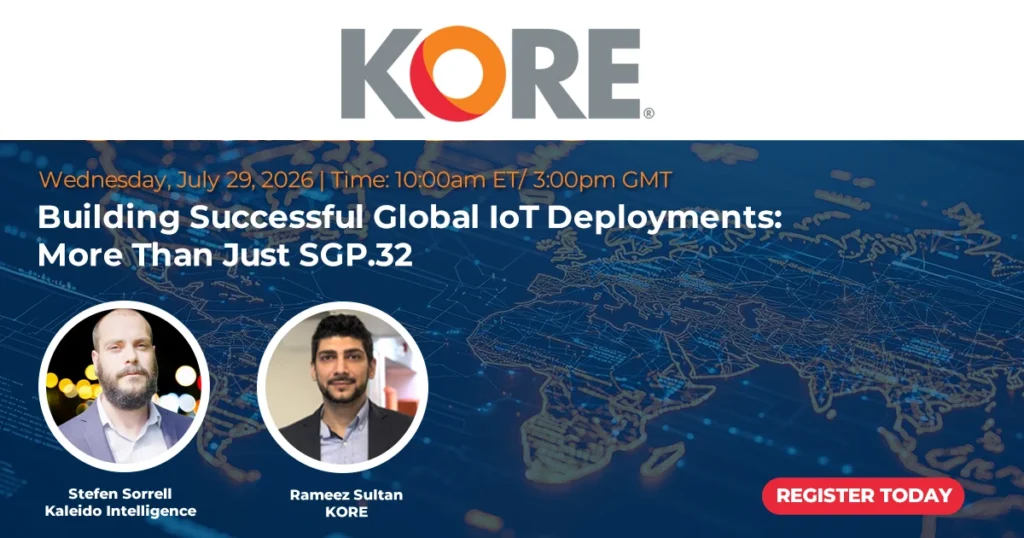
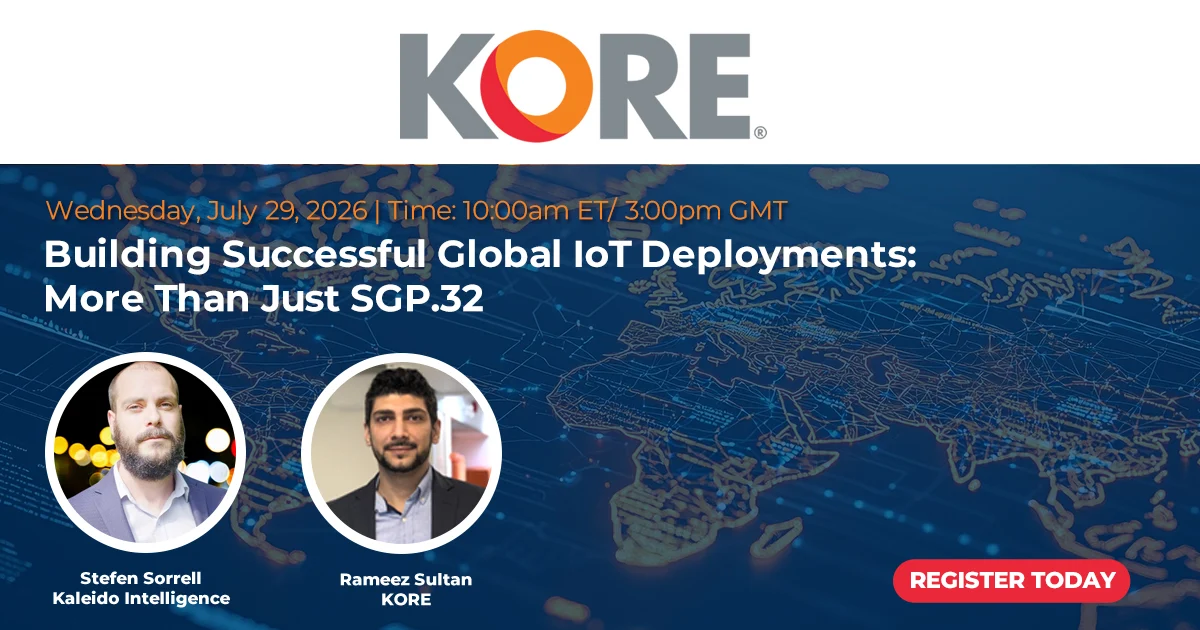
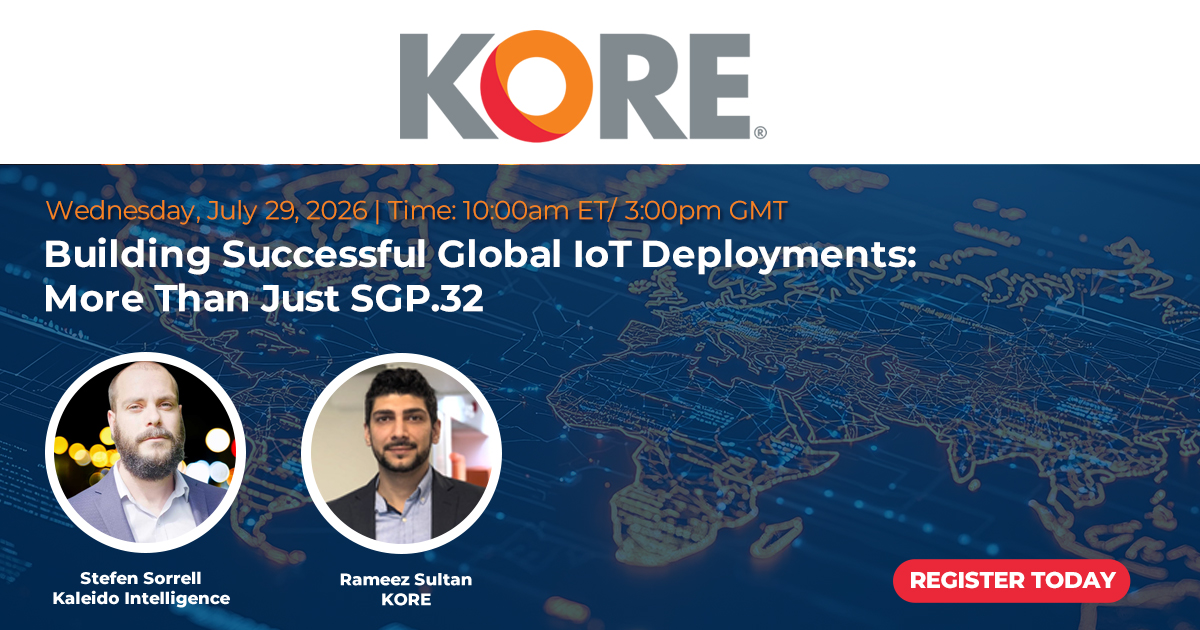
To help enterprises navigate this rapidly evolving landscape, industry leaders KORE and Kaleido are joining forces to host a comprehensive, high-level webinar titled “Building Successful Global IoT Deployments: More Than Just SGP.32.” Scheduled for Wednesday, July 29, 2026, at 10:00 a.m. ET / 3:00 p.m. GMT, this virtual event is designed to give technical and strategic decision-makers the blueprint they need to keep mission-critical devices connected, compliant, and operational anywhere in the world.
Main Facts: The Anatomy of Modern Global IoT Challenges
Managing an international IoT ecosystem is vastly different from running a localized or domestic network. Enterprises today must orchestrate communications across diverse geographic terrains, disparate cellular network architectures, and a constantly shifting patchwork of international telecommunications regulations.
While the introduction of advanced technical specifications—most notably SGP.32 for remote SIM provisioning—has revolutionized how organizations manage eSIM profiles in constrained and headless IoT devices, technology alone is not a silver bullet.
- The Scale Imperative: Enterprises are no longer experimenting with small-scale proofs of concept; deployments routinely involve massive fleets spanning multiple continents.
- The Regulatory Maze: Local data sovereignty laws, permanent roaming restrictions, and carrier compliance mandates vary wildly from one nation to another.
- The Longevity Factor: IoT devices often operate in the field for a decade or more, meaning initial deployment strategies must account for technological evolution, network deprecations (such as 2G/3G sunsetting), and changing business requirements.
- The KORE and Kaleido Collaboration: Bringing together KORE’s deep expertise in managed IoT services and connectivity orchestration with Kaleido’s market-leading research and intelligence, the upcoming webinar bridges the gap between theoretical standards and pragmatic enterprise execution.
Chronology: The Evolution of Global Connectivity and SGP.32
To understand why the upcoming KORE and Kaleido webinar is timely and critical for enterprise strategists, it is helpful to trace the chronological evolution of cellular IoT connectivity and remote SIM management over the past decade.
Phase 1: The Fragmentation Era (Early 2010s – Mid 2010s)
In the early days of enterprise IoT, deploying devices globally meant dealing with a logistical nightmare. Organizations relied heavily on physical SIM cards tied to single mobile network operators (MNOs). If a device was shipped from North America to Europe or Asia, it either operated on expensive and restricted international roaming agreements or required physical technicians to swap out SIM cards locally. This approach was inherently unscalable, costly, and vulnerable to sudden carrier disconnects due to local permanent roaming bans.
Phase 2: The Rise of M2M and Consumer eSIM Standards (Late 2010s)
The telecommunications industry recognized the need for remote provisioning and introduced early eSIM standards (such as SGP.01 and SGP.02 for Machine-to-Machine, and SGP.22 for consumer devices). While these standards laid the groundwork for changing carrier profiles over-the-air (OTA), they were largely designed for smartphones or heavy industrial gateways with user interfaces or abundant power resources. Constrained IoT devices—such as utility meters, asset trackers, and environmental sensors—struggled to adopt these frameworks efficiently.
Phase 3: The SGP.32 Revolution and Modern Enterprise Demands (2020s and Beyond)
Enterprises demanded a solution tailored specifically for IoT devices that lack local user interfaces or rely heavily on battery conservation. Enter SGP.32, the GSMA specification designed to streamline remote SIM provisioning for IoT. SGP.32 empowers enterprises to download, enable, disable, and delete profiles on IoT devices without requiring physical access.
However, as SGP.32 begins to see widespread market adoption in 2026, industry analysts have issued a vital warning: SGP.32 is a powerful tool, but it is merely one component of a much larger puzzle. Organizations that treat SGP.32 as a complete connectivity strategy often find themselves unprepared for the broader realities of international deployment, lifecycle management, and security compliance. This realization forms the core thesis of the upcoming KORE and Kaleido webinar.
Supporting Data: Why Connectivity Strategy Matters Beyond Specifications
Market research from organizations like Kaleido Intelligence consistently highlights a stark disconnect between technology adoption and deployment success. While executives frequently invest heavily in cutting-edge hardware and the newest connectivity protocols, operational failures frequently stem from foundational oversights in strategy rather than hardware or software defects.
- Carrier Flexibility and Vendor Lock-In: Relying on a single MNO or a rigid provisioning pipeline can leave an enterprise vulnerable to sudden carrier rate hikes, coverage gaps, or network shutdowns. A robust global strategy must incorporate multi-network access and seamless fallback mechanisms.
- Compliance and Data Sovereignty: With regulations such as the European Union’s GDPR and localized data localization laws in regions like Asia-Pacific and Latin America, enterprises must ensure that device data handling and telemetry routing comply with local legal frameworks.
- Total Cost of Ownership (TCO): Hidden costs—such as truck rolls for manual troubleshooting, excessive roaming surcharges, and inefficient data consumption—can quietly erode the ROI of an IoT project. Strategic connectivity management directly mitigates these financial drains.
- Lifecycle Management at Scale: Provisioning a device on day one is only the beginning. Enterprises must account for firmware-over-the-air (FOTA) updates, security certificate rotations, and carrier profile migrations over operational lifespans that frequently exceed five to ten years.
Official Perspectives: Industry Insights from KORE and Kaleido
As organizations prepare for the July 29 webinar, leadership figures from both KORE and Kaleido have emphasized the need for a paradigm shift in how companies approach global IoT.
Industry analysts note that while SGP.32 represents a monumental leap forward for remote SIM provisioning—offering unprecedented flexibility and simplified device management—it must be integrated into a broader architectural vision.
"Implementing SGP.32 alone does not solve every connectivity challenge an enterprise will face on a global scale," noted enterprise IoT strategists. "Organizations still need a comprehensive approach that balances carrier flexibility, worldwide coverage footprints, meticulous deployment planning, ironclad security, and long-term operational governance. SGP.32 complements—it does not replace—a complete enterprise connectivity strategy."
Through this collaborative webinar, experts will dissect how businesses can leverage SGP.32 effectively while avoiding the common pitfalls of siloed or short-sighted connectivity planning. Attendees will be guided through real-world scenarios where technical standards intersect with commercial realities, offering a balanced perspective that bridges the boardroom and the network operations center (NOC).

Implications: What You Will Learn and Who Should Attend
Whether an organization is currently mapping out its very first international IoT rollout or actively managing a sprawling, mature global deployment of millions of active endpoints, the insights shared during this session will carry profound operational and strategic implications.
Key Takeaways for Attendees
Participants who tune in on Wednesday, July 29, 2026, at 10:00 a.m. ET / 3:00 p.m. GMT will walk away with actionable guidance, including:
- A Clear Understanding of SGP.32: Deconstructing what the specification is, how it works, and where it fits within your organization’s broader connectivity stack.
- Beyond the Standard Best Practices: Discovering how to build redundancy, carrier diversity, and regulatory compliance into your global architecture from day one.
- Operational Efficiency Gains: Learning how leading global enterprises streamline device management, minimize truck rolls, and reduce the total cost of ownership across distributed fleets.
- Future-Proofing Your Fleet: Preparing your organization for long-term technological shifts, including the deprecation of legacy cellular networks and the evolution of global security standards.
Who Should Attend?
This high-level webinar is specifically tailored for professionals charged with steering enterprise technology, operations, and product strategy, including:
- Chief Technology Officers (CTOs) and Chief Information Officers (CIOs) seeking to align IoT initiatives with overarching enterprise architecture.
- IoT Product Managers and Directors responsible for the commercial success, scalability, and deployment timelines of connected products.
- Network Operations and Telecommunications Leaders managing cellular contracts, carrier relationships, and global connectivity performance.
- Supply Chain and Logistics Executives overseeing the international shipping, provisioning, and tracking of smart devices.
- Compliance and Security Officers tasked with safeguarding device data, adhering to international privacy laws, and mitigating cyber threats across distributed ecosystems.
Secure Your Spot Today
As IoT deployments continue to scale in both volume and geographic complexity, organizations cannot afford to rely on superficial connectivity solutions. Achieving long-term operational resilience requires an integrated strategy designed for the realities of the global marketplace.
Join the industry experts at KORE and Kaleido on Wednesday, July 29, 2026, to uncover how forward-thinking enterprises are successfully architecting global IoT deployments and mastering the true role of SGP.32 in modern connected device management.
Register for the webinar today to secure practical insights that will help simplify your international rollouts, optimize operational efficiency, and guarantee that your connected devices remain reliably online wherever business takes them.