Simplifying Temporal Data Science: A Deep Dive into TensorFlow Decision Forests and Temporian


In the modern landscape of artificial intelligence and machine learning, the ability to process and interpret temporal data is no longer a luxury—it is a foundational requirement. Whether tracking volatile market fluctuations, monitoring atmospheric shifts for climate modeling, or analyzing sub-millisecond heart rate variability for diagnostic medicine, temporal data is the lifeblood of predictive decision-making.
Despite its ubiquity, handling time-stamped, non-synchronized, and highly granular data has historically been a significant bottleneck for data scientists. Enter the collaborative breakthrough between Google and Tryolabs: Temporian. This new open-source Python library, designed to integrate seamlessly with TensorFlow Decision Forests (TF-DF), promises to revolutionize how engineers ingest, aggregate, and prepare temporal datasets for machine learning applications.

The Challenge of Temporal Complexity
Temporal data is rarely "clean." Unlike standard tabular datasets where features are static, temporal records often arrive at irregular intervals, from disparate sources, and across different scales. Traditionally, practitioners have relied on manual, error-prone preprocessing pipelines, often leading to "data leakage"—a common pitfall where information from the future inadvertently leaks into the training set, rendering models useless in production environments.
Most traditional machine learning models require data to be presented in a fixed-size, tabular format. Transforming raw, event-based transaction logs into these structures typically involves complex SQL queries or cumbersome Python loops that struggle with large-scale datasets. Temporian solves this by providing a high-performance, expressive framework for manipulating these "event sets," allowing developers to perform complex windowing, aggregation, and feature engineering with unprecedented ease.

Chronology of Development: A Joint Effort
The development of Temporian represents a multi-disciplinary effort spearheaded by researchers at Google—including Mathieu Guillame-Bert, Richard Stotz, Robert Crowe, and others—alongside the engineering team at Tryolabs. Recognizing that TensorFlow’s existing ecosystem lacked a dedicated, specialized tool for high-level temporal manipulation, the team sought to create a bridge between raw time-series data and robust decision-making algorithms.
The project moved from conceptualization to an open-source release aimed at simplifying the "data-to-model" pipeline. By leveraging the internal expertise of Google’s machine learning infrastructure and the specialized practical experience of the Tryolabs data science team, the resulting library provides a unified API that treats time as a first-class citizen, rather than just another column in a spreadsheet.

Supporting Data: Understanding Event Sets
To understand why Temporian is effective, one must move beyond the classical "time series" definition. While standard time series data is uniformly sampled, real-world data—such as individual retail purchases—is often sporadic.
Temporian introduces the EventSet, a versatile container designed to manage:

- Multivariate time series: Multiple signals tracked over time.
- Event sequences: Non-uniform measurements that don’t align with standard clock ticks.
- Multi-index sequences: Data partitioned by entities (e.g., specific products, individual clients, or geographical zones).
In a practical scenario—such as forecasting weekly sales for an e-commerce platform—a data scientist might have a CSV file containing millions of individual transactions. Using Temporian, this data can be ingested in seconds. By utilizing operators like moving_sum, the library handles the heavy lifting of calculating rolling averages over specific time windows (e.g., 7, 14, or 28 days) without the developer needing to manually manage complex date-time indexing or handle missing values.
The Workflow: From Raw Transactions to Predictions
Step 1: Ingestion and Visualization
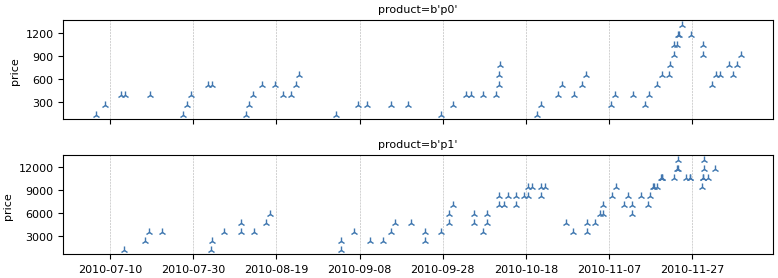
The process begins by loading raw transaction logs into an EventSet. Because Temporian is built for high-performance, it can visualize massive datasets without requiring the developer to downsample or pre-aggregate data manually. A simple call to sales["price"].plot() provides immediate insight into global trends, while adding an index—such as sales.add_index("product")—allows for granular visualization of specific item performance.

Step 2: Feature Engineering
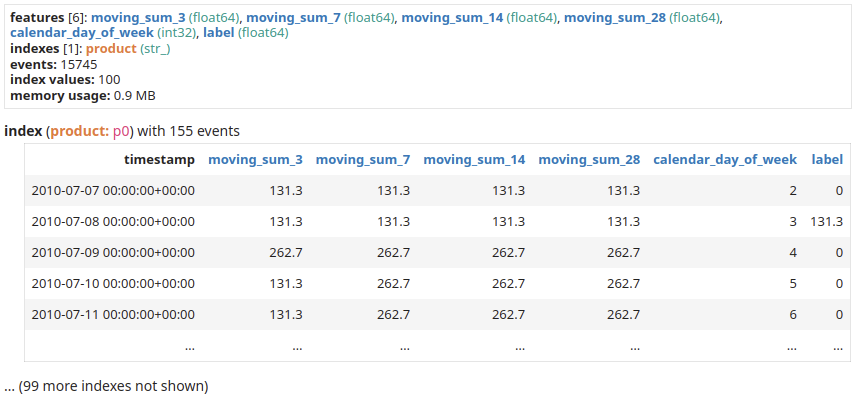
The true power of the library lies in its ability to compute features that are directly useful for predictive models. For instance, calculating the sales performance for each product relative to its own history, or creating calendar-based features (e.g., calendar_day_of_week), is handled through clean, functional API calls.
Step 3: Integration with TensorFlow Decision Forests
Once the features are engineered, they are "glued" into a final dataset. This dataset is then converted into a format compatible with TensorFlow Decision Forests. By using tp.to_tensorflow_dataset(), the transition from raw temporal events to a supervised learning task becomes seamless.

TF-DF is particularly effective here because Random Forests and Gradient Boosted Trees are inherently capable of handling the non-linear relationships often found in temporal data, such as seasonal spikes or product-specific trends, without the extensive data normalization required by deep learning models.
Implications for Industry and Research
The implications of this collaboration are far-reaching. By lowering the barrier to entry for complex temporal modeling, Google and Tryolabs are enabling a broader range of organizations to move beyond basic linear forecasting.
1. Enhanced Anomaly Detection
In cybersecurity, network logs are the definition of "temporal data." Detecting a breach requires identifying subtle deviations in the frequency and volume of events. With Temporian, security teams can easily aggregate traffic patterns and feed them into models that flag anomalous behavior in real-time.
2. Retail and Supply Chain Optimization
The ability to forecast sales with high precision—down to the product level—is the "holy grail" of supply chain management. By using rolling windows of 28 days and incorporating calendar variables, companies can optimize inventory levels, reducing waste and ensuring product availability during peak demand.

3. Predictive Maintenance
In industrial settings, machines emit sensor data at irregular intervals. If a vibration sensor triggers an event, it is vital to contextualize that event within the last hour, day, or week of operations. Temporian allows engineers to build these temporal contexts into their models, predicting failures before they occur.
Official Perspective: The "New Standard"
The contributors emphasize that this library is not meant to replace existing data science stacks but to augment them. By providing a dedicated tool for time-based preprocessing, the team hopes to eliminate the "boilerplate" code that currently occupies 70% of a data scientist’s time.

"Temporian is about giving power back to the developer," says the development team. By focusing on the EventSet abstraction, the library ensures that the user is thinking about temporal relationships rather than data frame manipulation. This shift in focus is likely to result in more robust models, as developers can experiment with different time-window features without needing to rewrite their entire data pipeline.
Future Outlook: Where to Go Next
As the machine learning community continues to adopt these tools, the next phase of evolution will likely focus on real-time streaming data. While current examples focus on batch processing of CSV files, the architecture of Temporian is well-suited for eventual integration with streaming frameworks like Apache Beam or Google Cloud Dataflow.
For those looking to adopt these tools, the transition is straightforward. The documentation for both Temporian and TensorFlow Decision Forests provides extensive tutorials. Starting with simple forecasting projects—like the sales example discussed—allows practitioners to understand the nuances of indexing and windowing before moving to more complex, high-frequency data environments.
In conclusion, the synergy between Temporian and TensorFlow Decision Forests represents a significant leap forward in making temporal machine learning accessible, performant, and reliable. By standardizing the way we handle time, the industry is now better equipped to solve the most pressing predictive challenges of our time.