Streamlining Embedded Design: Ztronics Launches Free Open-Source Browser Tool to Resolve I2C Address Conflicts
By Tech & Engineering Desk
Published: September 2026
Main Facts
For decades, electronics hobbyists, IoT developers, and embedded systems engineers working with microcontrollers have faced a frustrating, repetitive bottleneck: the dreaded I2C address conflict. When assembling complex sensor arrays—whether for an advanced robotics project, a meteorological station, or an automated home environment—developers frequently encounter multiple breakout boards sharing the exact same default hexadecimal address. Because the Inter-Integrated Circuit (I2C) protocol relies on specific addresses to target individual slave devices across a shared two-wire bus, two identical chips cannot peacefully coexist without hardware intervention or address reconfiguration.
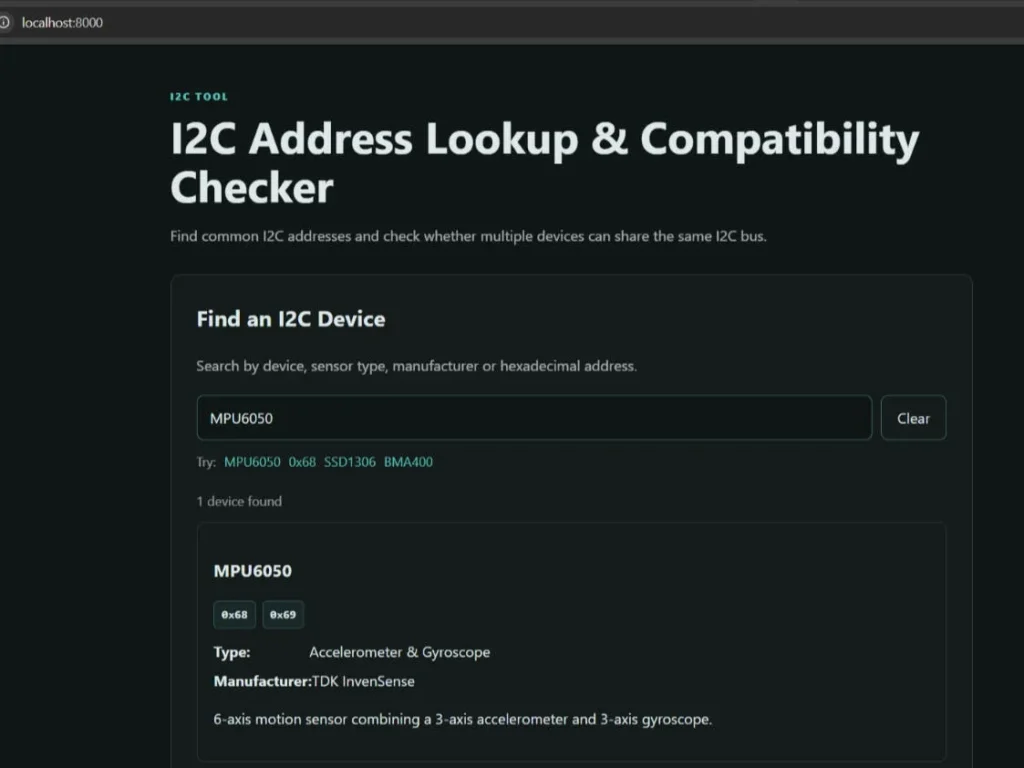
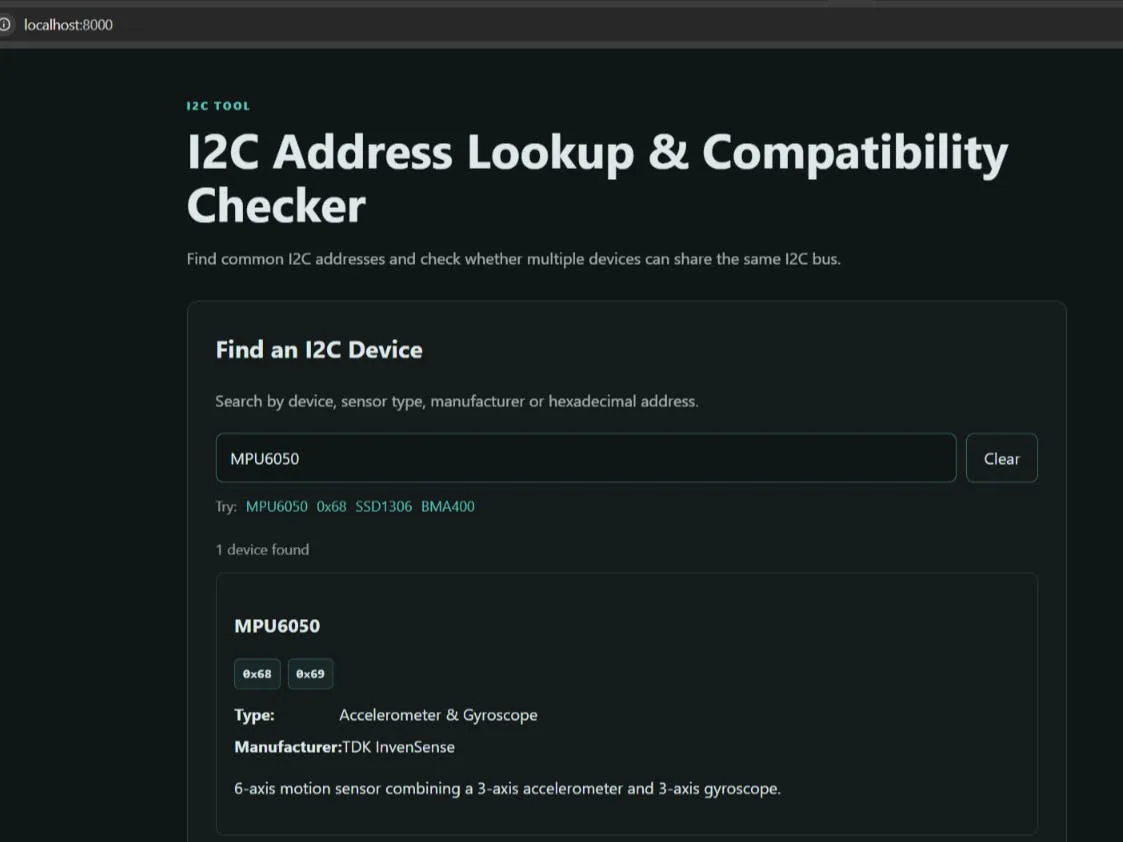
Addressing this persistent engineering hurdle, technology group Ztronics has released a novel, free, open-source web application designed to instantly check I2C address compatibility. Tailored for ecosystems such as Arduino, ESP32, and Raspberry Pi, the browser-based utility allows developers to input a list of intended sensors, search by name, type, manufacturer, or hex address, and instantly verify whether all components can operate harmoniously on a single bus.
Should an initial conflict arise, the application utilizes an advanced backtracking algorithm to automatically cycle through alternative hardware configurations and pin-strapping options—such as those found on the MPU6050 accelerometer or BMA400 sensor. If an overlap proves structurally unavoidable, the utility intelligently suggests practical mitigation strategies, including the integration of I2C multiplexers like the TCA9548A, software-emulated I2C buses, or secondary hardware buses. Completely client-side, lightweight, and operating locally via standard web standards without external tracking or accounts, the tool represents a major step forward in streamlining rapid prototyping for modern electronics developers.
Chronology: The Evolution of I2C and the Birth of the Compatibility Checker
To fully appreciate the significance of Ztronics’ new browser utility, it is helpful to examine the historical trajectory of the I2C protocol and the modern explosion of modular electronics.
1982–1990s: The Birth of a Two-Wire Standard
Originally developed by Philips Semiconductors (now NXP Semiconductors) in 1982, the I2C (Inter-Integrated Circuit) bus was conceived as a simple, low-cost method for connecting peripheral ICs to processors and microcontrollers within television sets and consumer electronics. Utilizing just two bidirectional lines—Serial Data Line (SDA) and Serial Clock Line (SCL)—alongside power and ground, the protocol revolutionized circuit design by drastically reducing the number of physical traces required on printed circuit boards (PCBs).
In its original iteration, I2C operated at a modest 100 kbps using 7-bit addressing, which theoretically allowed for up to 127 unique device addresses on a single bus. As the electronics industry expanded through the 1990s, the standard evolved to support 400 kbps (Fast-mode) and eventually 1 Mbps (Fast-mode Plus), alongside the introduction of 10-bit addressing extensions to accommodate growing sensor networks.
The Maker Movement and Modular Sensor Proliferation
Fast-forward to the 2010s, catalyzed by the explosive growth of the open-source hardware movement, Arduino, and the Raspberry Pi. Suddenly, millions of hobbyists, students, and professional engineers worldwide were prototyping electronic systems using modular breakout boards (such as those popularized by Adafruit, SparkFun, and Seeed Studio).
While this modular approach democratized hardware design, it introduced a glaring architectural flaw: third-party breakout manufacturers often relied on the default factory I2C addresses hardcoded into silicon chips by primary manufacturers (e.g., Bosch, InvenSense, Texas Instruments). Consequently, purchasing three different environmental sensors from three different suppliers could easily result in all three attempting to communicate on address 0x76.
The Manual Troubleshooting Era
For years, developers dealt with this through tedious manual labor. The workflow typically involved:
- Combing through dozens of individual PDF datasheets.
- Cross-referencing hexadecimal address tables in a spreadsheet or notepad.
- Physically inspecting tiny solder jumpers on breakout boards (often labeled
SDO,AD0, orSA0) to see if pads could be bridged with a soldering iron to shift the address. - Writing custom boot-up scripts just to scan the bus (
I2C scannersketches).
2026: The Ztronics Browser-Based Solution
Recognizing that manual datasheet cross-referencing was a needless waste of engineering hours, developers at Ztronics conceptualized and built an automated software solution. Moving away from clunky desktop applications or insecure cloud dependencies, the team engineered a 100% client-side web tool leveraging modern JavaScript, HTML5, and CSS3, backed by an open-source JSON database of common embedded sensors. Released publicly via GitHub, the tool instantly bridges the gap between hardware specification sheets and software layout design.
Supporting Data and Technical Architecture
The technical underpinnings of the Ztronics I2C compatibility checker reflect a careful balance of computational efficiency, user-privacy preservation, and extensibility.
The Backtracking Algorithm in Action
At the heart of the tool’s conflict-resolution engine is a classic computer science concept: the backtracking algorithm. When a user selects a collection of sensors, the application maps out every available address state for each chosen device.
For instance:
- MPU6050 (6-axis Accelerometer/Gyroscope): Supports addresses
0x68and0x69(determined by whether the AD0 pin is pulled HIGH or LOW). - BMA400 (Ultra-low power accelerometer): Supports addresses
0x14and0x15(configured via the SDO pin). - BMP280 (Barometric Pressure Sensor): Typically supports
0x76or0x77(configured via the SDO/SDI pin state).
If a user inputs a combination where two devices default to 0x68, the backtracking algorithm systematically tests alternative valid states for both components. It recursively searches down paths of possible configurations, "backtracking" the moment it encounters a collision, until it arrives at a state where every single component is assigned a strictly unique hex address.
Zero-Server Privacy and Client-Side Architecture
Unlike many modern web-based developer tools that route queries through remote servers, store user session data in cloud databases, or require user account registration, the Ztronics tool operates entirely within the user’s web browser.
- No Backend Infrastructure: The user interface, search logic, and algorithmic solvers execute directly in the browser’s JavaScript engine.
- JSON-Driven Database: The underlying device library is stored as a structured JSON file, making it exceptionally lightweight and human-readable.
- Offline Capability: Once the web page is initially loaded, the application can run completely offline, ensuring that proprietary hardware configurations or schematic plans never leave the user’s local machine.
Extensibility and Open-Source Collaboration
Because the entire repository is hosted publicly on GitHub (webzf/i2c-address-compatibility-checker), the developer community is actively encouraged to contribute. Adding a newly released sensor to the database requires only a simple pull request updating the central JSON schema with the device’s name, manufacturer type, default hex address, and any pin-configurable alternative addresses. Furthermore, the modular nature of the codebase allows educators and enterprise engineering teams to fork the repository and embed the compatibility logic directly into internal company design pipelines or educational lab environments.
Official Perspectives and Industry Implications
The release of the Ztronics utility has triggered widespread discussion across online engineering forums, embedded systems subreddits, and professional hardware design circles.
Reducing Prototyping Friction
In interviews and developer logs accompanying the open-source release, project maintainers emphasized that the primary motivation behind the tool was time-to-market and frustration reduction.
"When you are building a complex IoT node with ten different breakout boards, spending two hours reading datasheets just to realize that Sensor A and Sensor B are permanently locked to the same address is a massive productivity killer," noted lead contributors during the initial rollout. "We wanted a tool that gives you a definitive ‘Yes’ or ‘No’ in three seconds, and if the answer is ‘No,’ immediately tells you whether you need a multiplexer or just a quick solder bridge."
Hardware-Level Alternatives When Software Fails
When an address conflict is fundamentally insurmountable via address re-strapping—such as when dealing with two identical Application-Specific Integrated Circuits (ASICs) that lack configurable pins—the Ztronics tool guides the engineer toward industry-standard physical workarounds:
- I2C Multiplexers (e.g., TCA9548A): The tool explicitly recommends hardware multiplexers/switches. A chip like the TCA9548A takes a single upstream I2C master bus and fans it out into eight downstream, individually selectable I2C channels. This effectively isolates devices, allowing multiple sensors with identical addresses to share the same upstream microcontroller pins by switching channels dynamically in software.
- Software-Emulated I2C (Bit-Banging): For microcontrollers like the ESP32 or Arduino Mega that boast abundant general-purpose input/output (GPIO) pins, the tool highlights the viability of creating software-driven I2C buses on arbitrary digital pins, bypassing hardware bus limitations entirely.
- Secondary Hardware Buses: Many modern microcontrollers feature more than one physical I2C hardware interface (Wire, Wire1, etc.). The utility assists developers in distributing sensor loads evenly across multiple native hardware peripherals.
Implications for the Future of Embedded Systems Design
The introduction of specialized browser tools like the Ztronics I2C compatibility checker points toward a broader trend in electronics engineering: the democratization and automation of tedious pre-design validation tasks.
Bridging Software and Hardware Engineering
Historically, hardware design (schematic capture, pin-mapping, and bus architecture) and software development (firmware writing and register configuration) were treated as largely sequential steps. Tools like this blur the lines, allowing firmware engineers and hardware prototypers to test the viability of physical schematics before soldering a single wire or etching a custom PCB. By shifting conflict detection to the very beginning of the design phase, teams can avoid costly board revisions and lengthy debugging cycles.
Educational Value for STEM Students
Beyond professional engineering labs, the tool holds profound utility for educational institutions. In university engineering departments and high school robotics clubs, students frequently struggle with debugging hardware communication errors that stem from unassigned or overlapping addresses—errors that often manifest simply as unresponsive code or cryptic error messages (NaN values or 0xFF bus reads). By providing an intuitive visual interface to explore how communication buses operate, students gain a deeper intuitive grasp of bus architecture, hexadecimal addressing, and systematic problem-solving.
A Call to Action for IC Manufacturers
Finally, industry analysts suggest that widespread adoption of automated compatibility checkers may exert subtle pressure on integrated circuit manufacturers. As developers increasingly rely on tools that instantly flag hardcoded, unchangeable I2C addresses as design liabilities, semiconductor companies may feel compelled to design future generations of sensor ICs with broader, more flexible pin-configurable address ranges—ultimately making modular electronics friendlier and more interoperable for everyone.
Conclusion
The Ztronics open-source I2C address compatibility checker is more than just a clever coding exercise; it is a practical, deeply needed utility for the modern embedded systems developer. By combining a robust JSON database, a clever backtracking resolution algorithm, and a zero-server, privacy-focused browser interface, it transforms a tedious manual chore into a seamless three-second verification step.
Whether you are an electrical engineer designing a commercial IoT product, a student building your first multi-sensor Arduino project, or a hobbyist tinkering with an ESP32 weather station, this tool promises to save countless hours of frustration. Complete source code, documentation, and contribution guidelines are publicly accessible via the Ztronics GitHub Repository.