Streamlining Temporal Data Preprocessing: A New Era for Machine Learning with TensorFlow and Temporian


In the rapidly evolving landscape of applied machine learning, the handling of time-dependent data has long remained a complex and resource-intensive bottleneck. Temporal data—information that dynamically changes or holds critical value only at specific chronological markers—is omnipresent across industries. From fluctuating financial markets and shifting meteorological conditions to real-time cybersecurity network logs and intricate biometric tracking, time is the ultimate variable.
To address these enduring challenges, Google has collaborated with Tryolabs to introduce Temporian, an open-source Python library designed to simplify the preprocessing and feature engineering of temporal data. When paired with TensorFlow Decision Forests (TFDF), this new ecosystem offers data scientists an end-to-end framework capable of ingesting messy, non-synchronized event streams, extracting rich features, and training high-performance forecasting models with unprecedented ease.

Chronology of a Breakthrough: Bridging the Gap in Temporal ML
The journey toward seamless temporal data preprocessing began with a recognition of the limitations inherent in traditional time-series analysis. For decades, practitioners relied heavily on uniformly sampled time series to model temporal phenomena. While effective for aggregate signals, standard time series often fail to capture the nuanced, asynchronous realities of raw transactional data.
- The Transactional Dilemma: Real-world data—such as e-commerce purchases, credit card swipes, or server requests—arrives irregularly. Forcing this data into uniform time buckets traditionally resulted in significant information loss, stripping away precise timestamps and individual event values.
- The Genesis of Temporian: Recognizing this friction, engineers and researchers at Google and Tryolabs set out to build a tool specifically tailored for "event sets"—multivariate, multi-index time sequences that preserve the exact timing and relationship of individual records.
- Integration with TensorFlow: Once Temporian was engineered to masterfully handle feature extraction and aggregation, the next logical step was seamless integration with robust machine learning backends. TensorFlow Decision Forests emerged as the ideal partner, natively suited to handle tabular and temporal feature interactions without requiring extensive neural network tuning.
Deconstructing the Architecture: How Temporian and TFDF Work
At the core of this new workflow is Temporian’s primary container: the EventSet. Unlike rigid dataframes or basic arrays, an EventSet is purpose-built to represent multivariate time series, time sequences, and indexed data simultaneously.

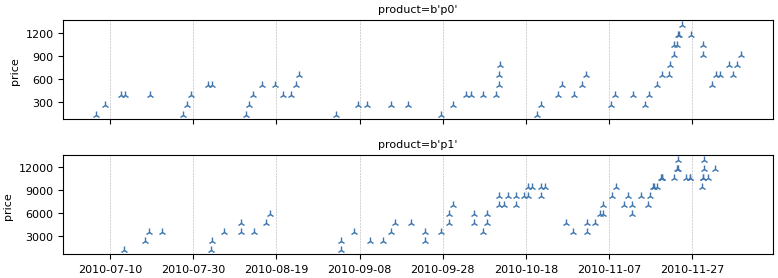
To understand its practical application, consider a fictitious online retail dataset containing individual sales records. Each row captures a precise moment in time, a client identifier, the product purchased, and the transaction price:
timestamp,client,product,price
2010-10-05 11:09:56,c64,p35,405.35
2010-09-27 15:00:49,c87,p29,605.35
2010-09-09 12:58:33,c97,p10,108.99
By loading this data into Temporian, data scientists can bypass manual looping and complex SQL window functions. Computing a moving sum over a rolling seven-day window requires just a single line of code:

import temporian as tp

sales = tp.from_csv("/tmp/sales.csv")
weekly_sales = sales["price"].moving_sum(tp.duration.days(7))
Indexing and Granular Control
In real-world scenarios, global metrics are rarely enough. Businesses need insights segmented by category, user, or product. Temporian allows developers to effortlessly add indexes to an EventSet, ensuring that operators like moving_sum apply independently across distinct subsets of data:
# Index the data by product
sales_per_product = sales.add_index("product")

# Compute the moving sum for each product independently
weekly_sales_per_product = sales_per_product["price"].moving_sum(
    tp.duration.days(7)
)
Furthermore, when preparing data for traditional machine learning models, analysts often need to transition from continuous event logs to uniformly sampled time steps (e.g., daily totals). Temporian achieves this via the tick operator, bridging the gap between raw event streams and tabular machine learning formats.

Supporting Data and Model Training: Predicting Future Sales
The ultimate test of any preprocessing pipeline is its ability to feed downstream machine learning models effectively. Using the processed sales data, developers can construct a comprehensive feature set designed to predict the next day’s sales for individual products.
By leveraging Temporian’s data augmentation capabilities, engineers can generate multiple moving sums across varying window lengths (e.g., 3, 7, 14, and 28 days), incorporate calendar information such as the day of the week, and apply a temporal leak to establish future-oriented labels:

sales_per_product = sales.add_index("product")
daily_sampling = sales_per_product.tick(tp.duration.days(1))

features = []
for w in [3, 7, 14, 28]:
    features.append(sales_per_product["price"]
        .moving_sum(tp.duration.days(w), sampling=daily_sampling)
        .rename(f"moving_sum_w"))

# Incorporate calendar data
features.append(daily_sampling.calendar_day_of_week())

# Establish the prediction label
label = (sales_per_product["price"]
    .leak(tp.duration.days(1))
    .moving_sum(tp.duration.days(1), sampling=daily_sampling)
    .rename("label"))

dataset = tp.glue(*features, label)
Once the dataset is prepared as a Temporian EventSet, converting it into a TensorFlow-compatible format is straightforward. Developers can seamlessly map the dataset and train a Random Forest regressor using TensorFlow Decision Forests:
import tensorflow_decision_forests as tfdf

def extract_label(example):
    example.pop("timestamp")
    label = example.pop("label")
    return example, label

tf_dataset = tp.to_tensorflow_dataset(dataset).map(extract_label).batch(100)

model = tfdf.keras.RandomForestModel(task=tfdf.keras.Task.REGRESSION, verbose=2)
model.fit(tf_dataset)
Official Insights and Expert Perspectives
The collaborative development between Google and Tryolabs underscores a broader industry shift toward specialized, domain-specific preprocessing tools. Mathieu Guillame-Bert, Richard Stotz, Robert Crowe, and Luiz Gustavo Martins from Google, alongside Ian Spektor and the engineering team at Tryolabs, emphasized that feature engineering for temporal data has historically been a fragmented and error-prone endeavor.

"Temporal data is highly discriminative, yet preparing it often forces engineers to write brittle, custom scripts that do not scale," development leads noted in joint technical documentation. "By combining Temporian’s declarative syntax for time-based transformations with TensorFlow Decision Forests’ powerful tabular modeling capabilities, we are providing a unified standard that drastically reduces time-to-production for machine learning engineers."
Official documentation highlights that Temporian’s declarative execution engine is optimized for performance, capable of processing millions of events swiftly without memory bloat. This ensures that even organizations dealing with high-frequency financial tickers or massive IoT sensor streams can implement robust feature engineering pipelines in Python without needing to rewrite logic in low-level languages.
Implications for the Machine Learning Industry
The integration of TensorFlow Decision Forests and Temporian carries profound implications for multiple sectors reliant on predictive analytics:
- Accelerated Development Cycles: Data scientists spend an estimated 60% to 80% of their time on data cleaning and feature engineering. Temporian abstracts away the painful intricacies of windowing, aligning, and resampling asynchronous streams, allowing teams to focus on model architecture and business logic.
- Enhanced Model Interpretability: Because TFDF models (such as Random Forests and Gradient Boosted Trees) provide native feature importance metrics, developers can instantly verify which temporal windows matter most. For instance, analyzing model summaries often reveals that medium-to-long-term indicators (such as 28-day moving sums) hold higher predictive weight than short-term fluctuations, guiding smarter feature selection.
- Broadened Accessibility for Time-Series ML: Historically, advanced forecasting required deep expertise in specialized time-series architectures (like ARIMA, LSTM, or Transformer-based temporal models). By pairing Temporian with user-friendly decision forests, tabular ML practitioners can now tackle complex forecasting, anomaly detection, and churn prediction tasks using familiar workflows.
Next Steps and Future Outlook
As applied machine learning continues to mature, tools that bridge the gap between raw, unstructured event logs and structured model inputs will define the next generation of intelligent systems. The combination of TensorFlow Decision Forests and Temporian represents a major leap forward in making temporal data preprocessing accessible, efficient, and robust.

Developers, data scientists, and engineers interested in exploring this workflow can access the open-source libraries via GitHub and official documentation channels. Whether tackling retail sales forecasting, financial fraud detection, or predictive maintenance, mastering these tools opens up new dimensions of predictive power embedded within temporal data.