By Ruijiao Sun, Google Intern – DTensor Team Published in TensorFlow Tech Updates
Main Facts: Scaling Signal Processing for Massive Datasets
In the rapidly evolving landscape of machine learning and high-performance computing, handling massive datasets often hits a fundamental hardware bottleneck: device memory. Signal processing techniques like the FastFourierTransform (FFT) are critical pillars of modern data pipelines. They are heavily utilized for speeding up convolutions, extracting complex features, and regularizing machine learning models.
However, as computer vision, medical imaging, and climate modeling datasets grow exponentially, individual accelerator memory (whether on a GPU or TPU) struggles to contain the sheer volume of data required for high-resolution processing.
To solve this, Google has officially introduced nativesupport for Distributed Fast Fourier Transform (Distributed FFT) in TensorFlow v2. Powered by DTensor—TensorFlow’s novel distributed computing extension—this feature enables developers to compute Fourier Transforms across massive, image-like datasets that far exceed the local memory capacity of a single accelerator device. By leveraging a Single Program, Multiple Data (SPMD) paradigm, developers can seamlessly scale their existing signal-processing workflows without rewriting core code architectures.
Chronology: The Evolution of Distributed FFT in TensorFlow
The journey toward native Distributed FFT support in TensorFlow v2 is rooted in years of high-performance computing research and architectural refinement.
Phase 1: Foundational Research and TPU Implementations (Pre-v2)
The conceptual groundwork was laid by Google Researcher Tianjian Lu in the seminal paper “Large-Scale Discrete Fourier Transform on TPUs.” Published via IEEE, this research demonstrated that large-scale Fourier transforms could be effectively partitioned and computed across clusters of Tensor Processing Units (TPUs). Following this research, an initial implementation of a Distributed FFT algorithm was engineered specifically for TensorFlow v1 as an isolated, experimental library. While successful in proving the concept, it lacked deep integration into TensorFlow’s core runtime APIs, making it cumbersome for everyday developers to adopt.
Phase 2: The Rise of DTensor and TensorFlow v2
As TensorFlow v2 matured, the engineering teams recognized the need for a unified API capable of handling both traditional data parallelism and complex model parallelism patterns. This realization led to the creation of DTensor. Designed as an extension for synchronous distributed computing, DTensor abstracts away the complexities of device communication by distributing tensors and programs via SPMD expansions.
Phase 3: Native Integration and Public Release
With DTensor establishing a robust framework for distributed execution, the DTensor team—bolstered by Google interns and core contributors—bridged the gap between legacy signal-processing libraries and modern distributed tensors. The result is the newly released native support for Distributed FFT in TensorFlow v2, allowing developers to invoke distributed transformations using standard, familiar syntax such as tf.signal.fft2d.
Technical Deep Dive: How DTensor Powers Distributed FFT
Understanding how Distributed FFT operates under the hood requires examining the intersection of DTensor architecture and tensor sharding.
Understanding DTensor and SPMD
DTensor allows a single block of Python code to execute across a multi-device topology—referred to as a "mesh." Through a procedure known as Single Program, Multiple Data (SPMD) extension, DTensor automatically determines how tensors should be sliced (sharded) and distributed across available CPU, GPU, or TPU cores.
Seamless API Integration
One of the most significant design achievements of the new Distributed FFT feature is its zero-friction API compatibility. Developers do not need to learn a completely new set of mathematical operations to execute distributed transforms.
As demonstrated in the implementation workflow below, the API interface mirrors standard TensorFlow operations. Users simply pass a sharded tensor—a tensor whose data is split across a designated device mesh—directly into existing TensorFlow signal APIs, such as tf.signal.fft2d. The resulting output is automatically managed and returned as a sharded tensor.
import tensorflow as tf
from tensorflow.experimental import dtensor

# 1. Set up and configure local or accelerator devices
device_type = dtensor.preferred_device_type()
if device_type == 'CPU':
    cpu = tf.config.list_physical_devices(device_type)
    tf.config.set_logical_device_configuration(
        cpu[0], [tf.config.LogicalDeviceConfiguration()] * 8
    )
if device_type == 'GPU':
    gpu = tf.config.list_physical_devices(device_type)
    tf.config.set_logical_device_configuration(
        gpu[0], [tf.config.LogicalDeviceConfiguration(memory_limit=1000)] * 8
    )
dtensor.initialize_accelerator_system()

# 2. Create a multidimensional device mesh for distributed computation
mesh = dtensor.create_distributed_mesh(
    mesh_dims=[('x', 1), ('y', 2), ('z', 4)], device_type=device_type
)

# 3. Set up a distributed input Tensor using stateless random normal values
input_tensor = tf.complex(
    tf.random.stateless_normal(shape=(2, 2, 4), seed=(1, 2), dtype=tf.float32),
    tf.random.stateless_normal(shape=(2, 2, 4), seed=(2, 4), dtype=tf.float32),
)
init_layout = dtensor.Layout(['x', 'y', 'z'], mesh)
d_input = dtensor.relayout(input_tensor, layout=init_layout)

# 4. Execute distributed fft2d. DTensor automatically computes the optimal layout.
d_output = tf.signal.fft2d(d_input)
Supporting Data & Performance Analysis
Introducing distributed execution across accelerators unlocks immense capacity, but it is not without engineering trade-offs. Comprehensive profiling experiments conducted on an 8x V100 GPU system illuminate both the capabilities and current bottlenecks of the new feature.
Memory Capacity vs. Computation Speed
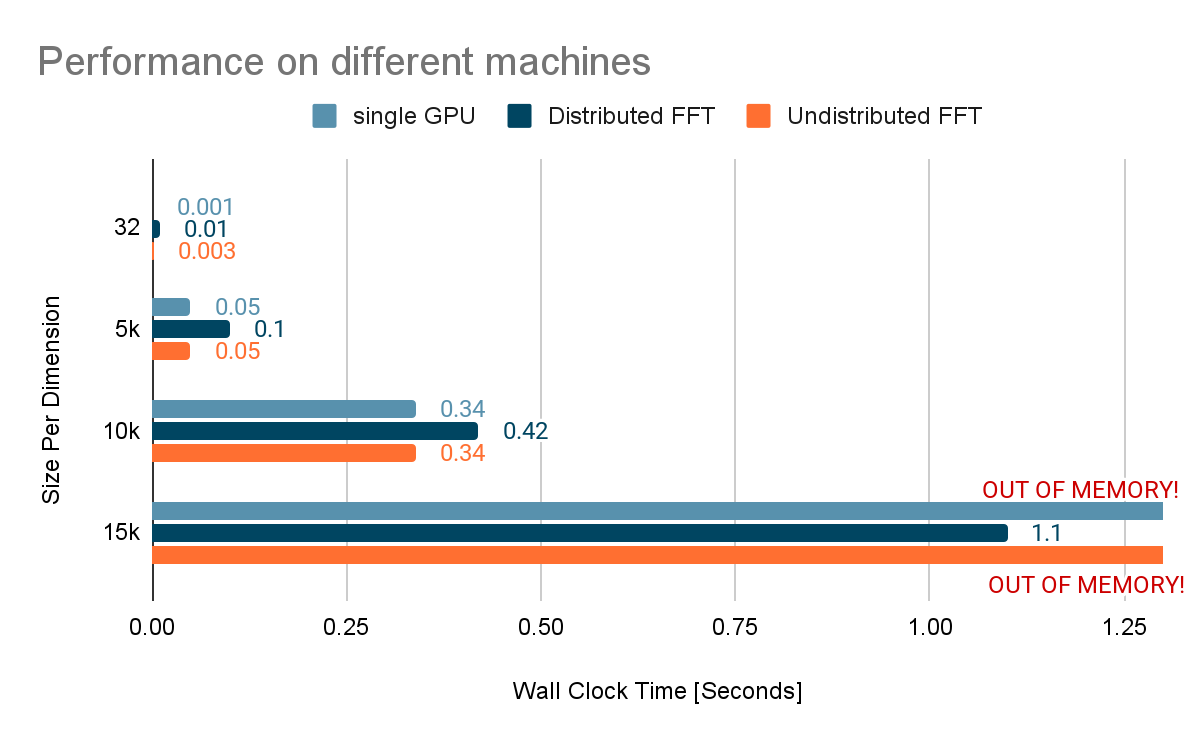
The primary advantage of Distributed FFT is undeniable: it can process datasets that are fundamentally too large to fit into the memory of a single hardware accelerator. By pooling the collective VRAM of multiple devices, models are no longer constrained by individual hardware limits.
However, this capacity expansion comes with a performance trade-off. Distributing the workload requires continuous cross-device communication and data transpositions, which can introduce latency and impact raw calculation speed compared to running smaller datasets locally on a single, highly optimized device.
Profiling a 10K x 10K Distributed FFT Experiment
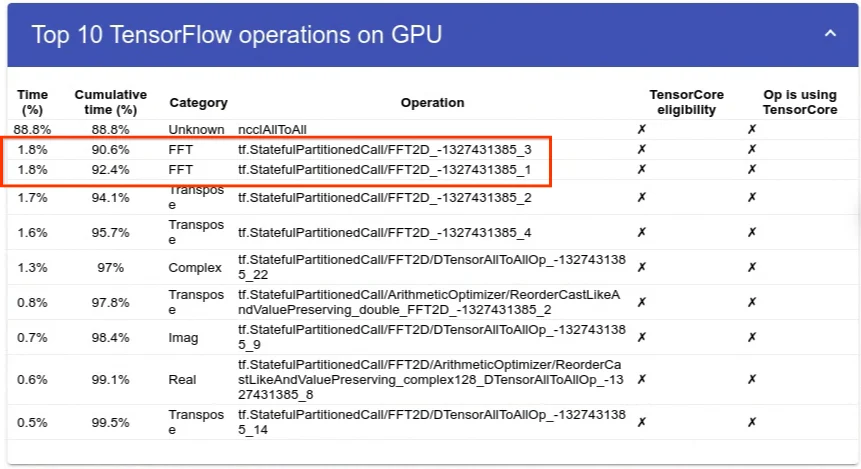
To quantify these performance dynamics, the DTensor team profiled a 10K-by-10K distributed FFT experiment. The current TensorFlow implementation relies on a straightforward "shuffle + local FFT" method—a standard algorithmic approach shared by other mature distributed computing libraries like FFTW and PFFT.
Key takeaways from the profiling data include:
Minimal Compute Time: The actual local Fast Fourier Transform operations accounted for only 3.6% of the total execution time (roughly 15ms). Intriguingly, this local computation phase executed in approximately one-third of the time required by an equivalent non-distributed fft2d call on a single device.
Communication Overhead: The vast majority of the execution wall-clock time was consumed by data shuffling and inter-device communication, heavily dominated by the ncclAllToAll operation.
This data indicates that while the mathematical computation is exceptionally fast, the physical movement of sharded data across device networks remains the primary performance gatekeeper in distributed signal processing.
Official Responses and Engineering Outlook
The rollout of native Distributed FFT in TensorFlow v2 marks a collaborative milestone for the open-source machine learning community and Google’s internal AI infrastructure teams.
Speaking on the release, members of the DTensor core team emphasized that this initial release represents a foundational baseline. By adopting the simplest, most robust distributed FFT algorithm first, the engineering team has established a stable API contract upon which advanced performance optimizations can be built.
"We have deliberately chosen a reliable, baseline distributed FFT algorithm to ensure stability and correctness across diverse hardware topologies," noted contributors on the DTensor development channel. "With this foundation now in place, our focus shifts entirely toward algorithmic fine-tuning, latency reduction, and minimizing communication overhead."
Implications for Developers and the Machine Learning Ecosystem
The arrival of native Distributed FFT via DTensor carries profound implications for researchers, data scientists, and enterprise engineers working at the bleeding edge of AI and signal processing.
1. Democratizing High-Resolution AI Workloads
Fields that rely heavily on multi-dimensional signal processing—such as seismic imaging, ultra-high-resolution computer vision, radio astronomy, and complex fluid dynamics simulations—frequently encounter hardware memory walls. By enabling seamless tensor sharding and distributed FFT execution, TensorFlow v2 lowers the barrier to entry, allowing teams with standard multi-GPU setups to tackle research problems previously reserved for massive supercomputing clusters.
2. A Roadmap for Future Optimizations
Because the current profiling data clearly isolates inter-device communication (ncclAllToAll) as the primary bottleneck, future updates to TensorFlow’s DTensor subsystem will likely focus on:
Overlapping Communication and Computation: Asynchronously hiding data-shuffling latency behind local FFT execution phases.
Advanced Communication Primitives: Leveraging specialized hardware interconnects (such as NVLink and high-speed InfiniBand fabrics) to accelerate tensor transpositions.
Algorithmic Refinements: Exploring multi-dimensional transpose-free or communication-minimized FFT algorithms to reduce the frequency of global data shuffles.
Get Involved and Share Your Feedback
Google and the TensorFlow core maintainers are actively encouraging the global developer community to test out the new distributed FFT feature in their respective pipelines.
Because distributed computing environments vary wildly across enterprise data centers, academic clusters, and cloud providers, user telemetry and real-world feedback are vital. Developers are invited to share their performance benchmarks, feature requests, and bug reports directly on the official TensorFlow Forum.
By collaborating closely with the community, the TensorFlow team aims to transform Distributed FFT from a powerful alternative into an indispensable, ultra-optimized standard for large-scale machine learning and signal processing.