By Ruijiao Sun, Google Intern (DTensor Team) Enriched and Expanded Editorial Report
Executive Summary: Main Facts
In the rapidly evolving landscape of machinelearning and high-performance computing (HPC), handling massive, high-dimensional datasets remains a critical bottleneck. Signal processing methods—particularly the FastFourierTransform (FFT)—are foundational for accelerating convolutions, extracting intricate features, and regularizing complex models. However, as modern deep learning models ingest image-like datasets that far exceed the local memory capacity of a single accelerator device, traditional FFT implementations fail.
To bridge this technological gap, Google has officially announced nativesupport for the Distributed Fast Fourier Transform (Distributed FFT) in TensorFlow v2. Powered by DTensor, TensorFlow’s novel distributed computing API, this integration builds upon earlier groundbreaking research from Google (“Large-Scale Discrete Fourier Transform on TPUs” by Tianjian Lu) which initially introduced Distributed FFT as an external library for TensorFlow v1.
By leveraging DTensor’s Single Program, Multiple Data (SPMD) architecture, developers can now seamlessly execute multi-dimensional Fourier Transforms across clusters of CPUs and GPUs. While this innovation vastly expands the scale of data a model can process, empirical benchmarks reveal important performance trade-offs, highlighting that communication overhead—specifically data transposes and shuffling via ncclAllToAll operations—constitutes the primary computational bottleneck in distributed signal processing.
Chronology: The Evolution of Distributed Signal Processing in TensorFlow
Understanding how native Distributed FFT arrived in TensorFlow v2 requires examining the chronological progression of scaling algorithms and distributed computing frameworks within Google’s ecosystem.
1. The Era of TensorFlow v1 and Early TPU Research
Pre-2021: As deep learning models scaled into billions of parameters, researchers faced hardware limitations when processing large-scale spatial data, medical imaging, and high-resolution geophysical datasets. Standard FFT operations were bound to the physical memory limits of individual accelerators.
June 2021: Google Research published the seminal paper Large-Scale Discrete Fourier Transform on TPUs authored by Tianjian Lu. This work demonstrated that discrete Fourier transforms could be mathematically partitioned and computed across Tensor Processing Units (TPUs) using specialized communication primitives. However, this implementation lived as an isolated library, lacking native integration into the core TensorFlow framework and requiring complex, manual boilerplate code for developers.
2. The Rise of DTensor in TensorFlow v2
2022–2023: Recognizing the fragmentation in distributed machine learning paradigms—where developers had to juggle disparate APIs for data parallelism and model parallelism—the TensorFlow team introduced DTensor.
The SPMD Paradigm: DTensor unified distributed computing by abstracting tensor placement across logical device meshes using a Single Program, Multiple Data (SPMD) model. This laid the structural foundation for integrating complex tensor operations natively.
3. Native Integration and Modern Release
September Update / Current State: Building directly upon DTensor, the TensorFlow team transitioned Distributed FFT from a specialized research library into a fully supported, native feature of TensorFlow v2. Developers can now invoke distributed signal processing tasks using standard, familiar APIs like tf.signal.fft2d, drastically lowering the barrier to entry for distributed HPC and deep learning workflows.
Technical Architecture: Understanding DTensor and Distributed FFT
To comprehend the significance of this release, one must examine the underlying mechanics of DTensor and how it orchestrates distributed tensor transformations.
What is DTensor?
DTensor is an advanced extension designed to facilitate synchronous distributed computing within TensorFlow. Unlike traditional parameter-server or ring-allreduce architectures that abstract cluster management away from the user, DTensor allows developers to explicitly define how tensors are distributed across a virtual multidimensional hardware topology known as a mesh.
Through SPMD extension, a single written Python script is executed across all participating devices (CPUs, GPUs, or TPUs), with DTensor automatically slicing, routing, and re-sharding tensors based on pre-defined layouts. This provides a unified API that harmonizes data parallelism and model parallelism without requiring intrusive rewrites of core model architectures.
Unified API Interface
One of the most user-centric aspects of the new Distributed FFT implementation is its API design continuity. Developers do not need to learn an entirely new syntax to perform distributed Fourier transformations.
By passing a sharded tensor—a tensor whose components are distributed across multiple devices in a mesh—into existing TensorFlow signal processing operators (such as tf.signal.fft2d), the framework automatically routes the computation. The resulting output remains sharded, preserving the pipeline’s distributed state for downstream layers.
import tensorflow as tf
from tensorflow.experimental import dtensor

# 1. Set up devices (Configuring logical devices for an 8-device system)
device_type = dtensor.preferred_device_type()
if device_type == 'CPU':
    cpu = tf.config.list_physical_devices(device_type)
    tf.config.set_logical_device_configuration(cpu[0], [tf.config.LogicalDeviceConfiguration()] * 8)
if device_type == 'GPU':
    gpu = tf.config.list_physical_devices(device_type)
    tf.config.set_logical_device_configuration(gpu[0], [tf.config.LogicalDeviceConfiguration(memory_limit=1000)] * 8)
dtensor.initialize_accelerator_system()

# 2. Create a multidimensional hardware mesh (e.g., x=1, y=2, z=4)
mesh = dtensor.create_distributed_mesh(mesh_dims=[('x', 1), ('y', 2), ('z', 4)], device_type=device_type)

# 3. Set up a distributed input Tensor
input_tensor = tf.complex(
    tf.random.stateless_normal(shape=(2, 2, 4), seed=(1, 2), dtype=tf.float32),
    tf.random.stateless_normal(shape=(2, 2, 4), seed=(2, 4), dtype=tf.float32)
)
init_layout = dtensor.Layout(['x', 'y', 'z'], mesh)
d_input = dtensor.relayout(input_tensor, layout=init_layout)

# 4. Execute distributed fft2d.
# DTensor automatically determines the most efficient layout for d_output.
d_output = tf.signal.fft2d(d_input)
Supporting Data & Performance Analysis
While the ability to process datasets exceeding single-device memory is a monumental win for machine learning engineers, distributed computing invariably introduces hardware and network trade-offs. Google’s engineering team conducted extensive empirical evaluations on an 8x V100 GPU system to analyze these trade-offs.
Memory Capacity vs. Computational Latency
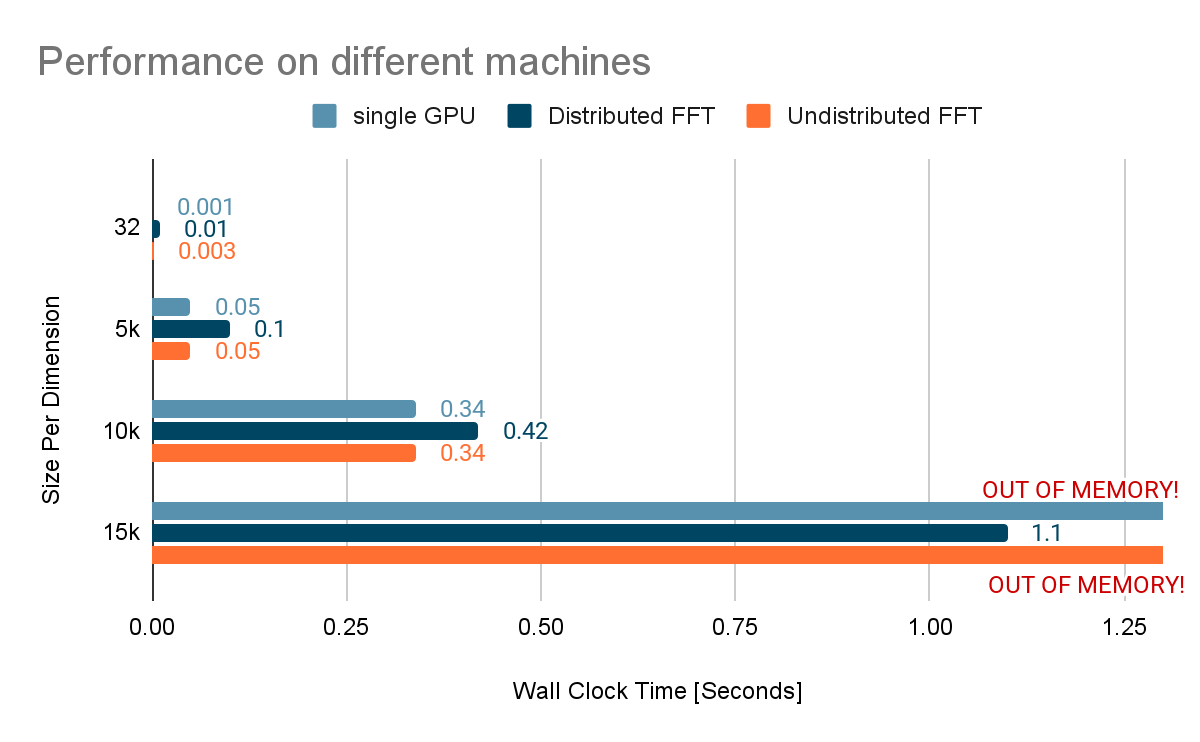
The primary advantage of Distributed FFT is memory augmentation. By distributing tensor shards across multiple accelerators, models can ingest high-resolution inputs that would otherwise trigger out-of-memory (OOM) fatal errors on a single GPU.
However, this memory efficiency comes with a time penalty. Wall-clock time measurements (comparing single-GPU execution, distributed FFT, and undistributed FFT across varying per-dimension sizes) reveal that distributed execution incurs an overhead penalty. This latency stems directly from inter-device communication and data transposes required to align tensor dimensions before and after transformation steps.
Profiling the 10K x 10K Distributed FFT Experiment
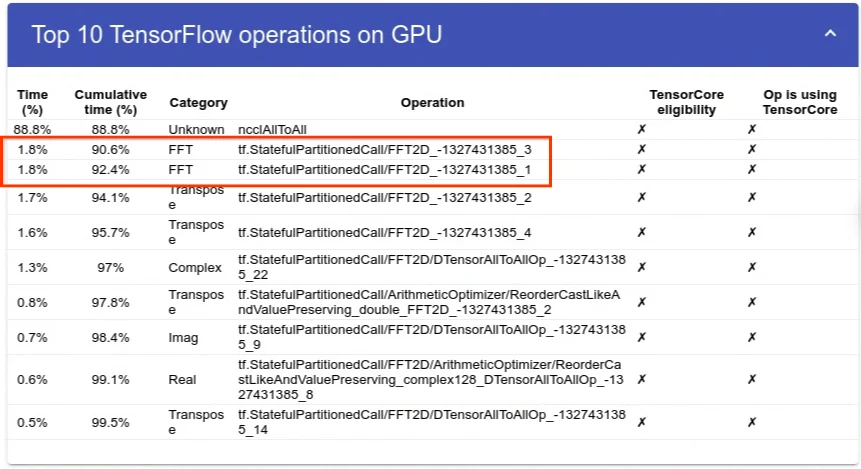
Deep-dive profiling results from a 10,000 by 10,000 matrix distributed FFT experiment shed light on where execution time is actually spent:
Algorithm Parallels: TensorFlow’s current distributed FFT implementation adopts the straightforward shuffle + local FFT methodology—a tried-and-true architectural pattern also utilized by legacy distributed signal processing powerhouses such as FFTW and PFFT.
Local Computation vs. Communication:
In a profiling breakdown of top TensorFlow operations on a GPU cluster, the two local FFT operations consumed a mere 3.6% of the total execution time (approximately 15 milliseconds). Remarkably, this local computation phase ran roughly three times faster than an equivalent non-distributed fft2d call on a single device.
Conversely, the overwhelming majority of execution time was consumed by data shuffling and communication, specifically manifested through the ncclAllToAll collective operation.
This data underscores a vital engineering insight: while local mathematical transformations on modern accelerators are extraordinarily fast, network and interconnect bandwidth remain the ultimate bottleneck in distributed Fourier transforms.
Official Responses and Developer Community Impact
The introduction of native Distributed FFT has generated significant buzz across the artificial intelligence, signal processing, and high-performance computing communities.
In statements accompanying the release, the TensorFlow core team emphasized that this feature represents a philosophy of progressive enhancement. By starting with a clean, baseline implementation (the shuffle-and-local-FFT approach), the team has established a stable, functional baseline upon which the community can iterate.
"We have deliberately adopted the simplest viable distributed FFT algorithm as our starting point," noted Ruijiao Sun on behalf of the DTensor team. "This gives us a rock-solid foundation. However, we recognize that communication overhead via collective operations is our next major frontier. We are actively inviting researchers, systems engineers, and ML practitioners to collaborate on algorithmic optimizations."
The TensorFlow Forum (discuss.tensorflow.org) has already become a hub for preliminary user feedback. Early adopters working in computer vision, seismic imaging, and spectral neural networks have praised the removal of custom boilerplate code, noting that DTensor integration dramatically simplifies pipeline design.
Implications for the Future of Machine Learning and HPC
The deployment of native Distributed FFT via DTensor carries profound implications across multiple technological domains:
Fields such as radio astronomy, climate modeling, medical MRI reconstruction, and computational fluid dynamics rely heavily on multi-dimensional Fourier analysis. By bringing native distributed signal processing into an accessible framework like TensorFlow v2, researchers no longer need to write custom MPI (Message Passing Interface) C++ code to scale their pipelines. They can leverage Python-based frameworks backed by enterprise-grade tensor distribution.
2. Shaping the Next Iteration of Hardware-Software Co-Design
The performance analysis revealing that ncclAllToAll operations consume the vast majority of processing time points directly to future hardware requirements. As AI accelerators evolve—whether through NVIDIA’s NVLink interconnects, Google’s custom TPU interconnect fabrics, or emerging optical switching networks—optimizing all-to-all data exchanges will become the defining metric of high-performance deep learning hardware.
3. Roadmap for Future Optimization
Looking ahead, the TensorFlow team has outlined several pathways to fine-tune and drastically improve Distributed FFT performance:
Overlapping Communication and Computation: Implementing asynchronous execution models where data shuffling for subsequent layers occurs concurrently with current tensor computations.
Algorithmic Refinement: Exploring alternative distributed butterfly communication patterns that minimize global all-to-all shuffles in favor of localized peer-to-peer exchanges.
Advanced Mesh Topologies: Allowing developers to tailor device mesh configurations specifically to the geometric symmetry of their input signals, reducing unnecessary transpose overhead.
Call to Action
The TensorFlow team encourages developers and researchers to test the new Distributed FFT API within their workflows. Feedback, performance benchmarks, and contribution proposals can be shared directly via the TensorFlow Forum. As machine learning models continue to scale into unprecedented dimensions, community-driven optimizations will ensure that signal processing capabilities scale right alongside them.