
TensorFlow v2 Unveils Native Distributed Fast Fourier Transform (FFT) Support via DTensor to Scale Large Image-Centric Machine Learning
By Ruijiao Sun, Google Intern, DTensor Team
Published in partnership with TensorFlow Developer Updates
Executive Summary: Main Facts
In an important step forward for high-performance machine learning, the TensorFlow team has officially announced native support for Distributed Fast Fourier Transform (Distributed FFT) in TensorFlow v2. Powered by DTensor—TensorFlow’s novel extension for synchronous distributed computing—this new capability allows data scientists and machine learning engineers to compute complex Fourier Transforms on massive, image-like datasets that heavily exceed the memory capacities of individual hardware accelerators, such as GPUs and TPUs.
Historically, performing Fast Fourier Transforms on massive datasets posed severe infrastructure bottlenecks. Standard implementations required the target tensor to reside entirely within the local memory of a single accelerator device. When dealing with high-resolution imagery, volumetric data, or complex feature maps, these limitations forced researchers to downsample data or compromise on model architectures.
With the introduction of native Distributed FFT through DTensor, developers can now seamlessly distribute both tensors and execution programs across clusters of hardware accelerators using a Single Program, Multiple Data (SPMD) paradigm. The API interface remains identical to TensorFlow’s native, non-distributed FFT operations (such as tf.signal.fft2d), requiring only a sharded input tensor to unlock multi-device memory pooling.
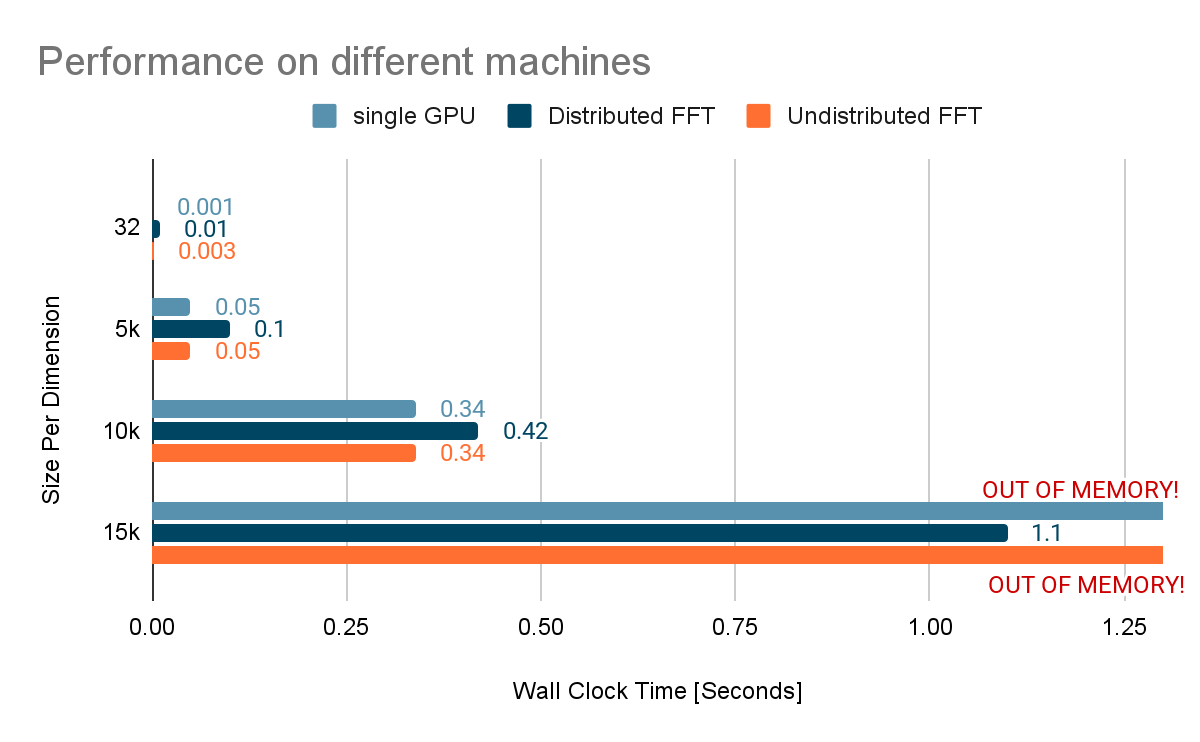
While the new feature dramatically expands the boundaries of tractable dataset sizes, preliminary performance benchmarks reveal a classic distributed computing trade-off: while memory limitations are effectively bypassed by aggregating device RAM, inter-device communication overheads—specifically data transposes and shuffling via ncclAllToAll operations—introduce latency that developers must account for in their pipeline designs.
The Evolution of Distributed Fourier Transforms: A Chronological Overview
To understand the significance of native Distributed FFT in TensorFlow v2, it is helpful to trace the technical evolution of large-scale signal processing within Google’s machine learning ecosystem.
1. The Era of TensorFlow v1 and Custom Libraries
The foundational research underpinning this release originated years prior to the stable rollout of TensorFlow v2. In a seminal Google Research paper titled "Large-Scale Discrete Fourier Transform on TPUs" authored by Tianjian Lu, engineers recognized that specialized hardware accelerators like Tensor Processing Units (TPUs) held immense potential for accelerating heavy signal-processing workloads.
However, TensorFlow v1 lacked unified, high-level abstractions for multi-device tensor sharding. To bridge this gap, Lu and his research team implemented a Distributed FFT algorithm packaged as an independent, external library for TensorFlow v1. While successful in demonstrating the feasibility of scaling Discrete Fourier Transforms across TPU pods, this implementation required specialized, non-standard codebases, steep learning curves, and manual pipeline orchestration, limiting its adoption among the broader machine learning community.

2. The Rise of DTensor in TensorFlow v2
As TensorFlow matured into version 2, Google shifted its focus toward unified distributed paradigms. The introduction of DTensor marked a paradigm shift. Designed to simplify both data parallelism and model parallelism under a single, cohesive API, DTensor abstracts away the complexities of device placement and communication topologies.
Rather than forcing developers to write bespoke communication code for every distributed operation, DTensor utilizes a Single Program, Multiple Data (SPMD) extension model. It allows standard TensorFlow operations to automatically recognize distributed layouts, known as meshes, which map logical tensor dimensions directly onto physical or logical device grids.
3. Integrating Distributed FFT natively into TF v2
Building upon the DTensor foundation, engineering teams set out to transition the experimental TensorFlow v1 FFT libraries into a first-class, natively supported feature of TensorFlow v2. By integrating Distributed FFT directly into the core tf.signal module, developers no longer need third-party wrappers or custom library extensions. Passing a sharded tensor into established functions like tf.signal.fft2d now automatically invokes the underlying distributed routines, marking a major milestone in ease-of-use for high-performance scientific computing and computer vision research.
Technical Architecture and Implementation
At its core, DTensor redefines how tensors are represented across distributed systems. Instead of treating an accelerator cluster as a collection of isolated islands, DTensor views the hardware as a unified Mesh.
Understanding DTensor Meshes and Layouts
A mesh defines the multi-dimensional topology of the available devices (CPUs, GPUs, or TPUs). In the usage example provided by the engineering team:
import tensorflow as tf
from tensorflow.experimental import dtensor

# Set up local logical devices for demonstration
device_type = dtensor.preferred_device_type()
if device_type == 'CPU':
    cpu = tf.config.list_physical_devices(device_type)
    tf.config.set_logical_device_configuration(
        cpu[0], [tf.config.LogicalDeviceConfiguration()] * 8
    )
if device_type == 'GPU':
    gpu = tf.config.list_physical_devices(device_type)
    tf.config.set_logical_device_configuration(
        gpu[0], [tf.config.LogicalDeviceConfiguration(memory_limit=1000)] * 8
    )
dtensor.initialize_accelerator_system()

# Create a multi-dimensional mesh ('x', 'y', 'z')
mesh = dtensor.create_distributed_mesh(
    mesh_dims=[('x', 1), ('y', 2), ('z', 4)], device_type=device_type
)

# Set up a distributed input Tensor
input_tensor = tf.complex(
    tf.random.stateless_normal(shape=(2, 2, 4), seed=(1, 2), dtype=tf.float32),
    tf.random.stateless_normal(shape=(2, 2, 4), seed=(2, 4), dtype=tf.float32),
)
init_layout = dtensor.Layout(['x', 'y', 'z'], mesh)
d_input = dtensor.relayout(input_tensor, layout=init_layout)

# Run distributed fft2d. DTensor automatically determines
# the most efficient layout for the output tensor.
d_output = tf.signal.fft2d(d_input)
In this architecture, tensors are sharded across the mesh dimensions (x, y, z). When tf.signal.fft2d is called on a distributed input (d_input), DTensor intercepts the operation, evaluates the optimal layout for the resulting tensor, executes the necessary transformations, and returns a sharded output (d_output) without requiring manual intervention from the developer.
Supporting Data and Performance Analysis
To rigorously evaluate the capabilities and trade-offs of the new native Distributed FFT, the TensorFlow team conducted extensive benchmarking on an 8x V100 GPU system.
Memory Scaling vs. Communication Overhead
The primary advantage of Distributed FFT is undeniable: it breaks the single-device memory barrier. By pooling the VRAM of multiple GPUs, models can process massive spatial dimensions that would otherwise trigger immediate Out-Of-Memory (OOM) errors on a single accelerator.

However, performance profiling reveals a nuanced operational profile. The current implementation of Distributed FFT in TensorFlow utilizes a classic shuffle-plus-local-FFT methodology—a strategy shared by industry-standard distributed math libraries such as FFTW and PFFT.
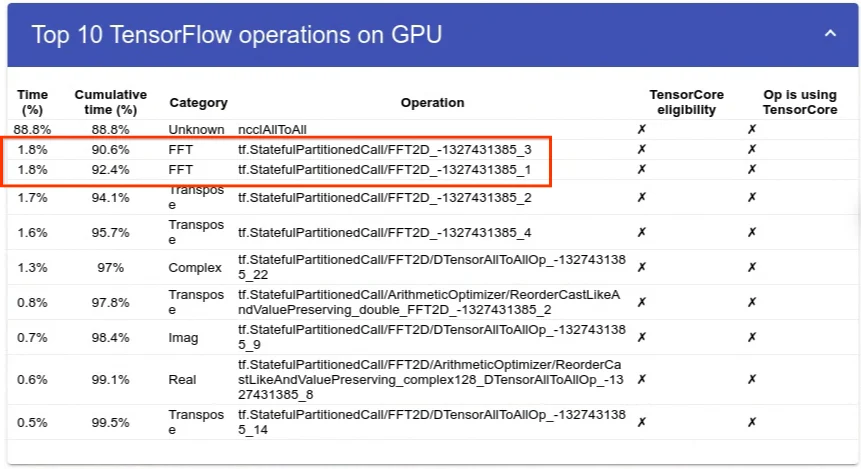
Profiling a large-scale 10K x 10K distributed FFT experiment yielded fascinating insights into where execution time is actually spent:
- Local Computations: The actual execution of the two local FFT operations consumed a mere 3.6% of the total execution time (approximately 15 milliseconds). Remarkably, this local computation phase ran roughly three times faster than a corresponding non-distributed
fft2dcall on a single device. - Communication Overhead: The vast majority of the wall-clock time was consumed not by math calculations, but by data shuffling and transposes—specifically manifested through the
ncclAllToAllcommunication primitives.
+-------------------------------------------------------------------------+
|                  10K x 10K Distributed FFT Breakdown                    |
+-------------------------------------------------------------------------+
| [■■ 3.6%] Local FFT Ops (15ms)                                          |
| [■■■■■■■■■■■■■■■■■■■■■■■■■■■■■■■■■■■■■■■■■■■ 96.4%] NCCL AllToAll Shuffle |
+-------------------------------------------------------------------------+
This data underscores a critical engineering insight: while Distributed FFT successfully scales memory capacity, network and interconnect bandwidth between accelerators becomes the primary performance bottleneck. Systems with high-speed interconnects (such as NVLink for GPUs or dedicated inter-chip links for TPUs) are essential to maximize throughput.
Official Responses and Developer Community Feedback
The release of native Distributed FFT has been met with enthusiastic initial responses from the machine learning and high-performance computing (HPC) communities.
Engineers and researchers who previously had to write convoluted MPI (Message Passing Interface) wrappers or custom C++ extensions to handle large-scale Fourier transformations can now rely on a first-class, Pythonic API integrated directly into TensorFlow.
Google’s DTensor engineering team emphasizes that this initial release represents a foundational milestone rather than a final destination. In official statements released alongside the update, the team noted:
"This feature is entirely new, and we have deliberately adopted the simplest, most robust distributed FFT algorithm for our initial rollout. Our priority was correctness, seamless API integration, and establishing baseline stability via DTensor. We recognize that inter-device communication currently represents the dominant performance cost, and we are actively looking toward algorithmic refinements to optimize data shuffling."
The team has opened formal communication channels on the TensorFlow Forum (discuss.tensorflow.org), actively soliciting bug reports, use-case profiles, and optimization proposals from enterprise users, academic researchers, and independent developers.
Implications for Industry and Future Roadmap
The introduction of native Distributed FFT via DTensor has profound implications across multiple technological domains:
1. Advancements in Computer Vision and Medical Imaging
High-resolution medical imaging (such as 3D MRI and CT scans), satellite remote sensing, and seismic data processing frequently rely on frequency-domain transformations for filtering, convolution acceleration, and feature extraction. By removing single-device memory limits, researchers can train and evaluate models on raw, uncompressed high-resolution volumes without resorting to aggressive downsampling that discards vital diagnostic details.
2. Scientific Machine Learning (SciML)
Physics-informed neural networks (PINNs) and spectral methods used in fluid dynamics, weather forecasting, and climate modeling often solve partial differential equations (PDEs) in the spectral domain. Native distributed FFT support positions TensorFlow as a more competitive framework for heavy scientific computing workloads traditionally dominated by specialized Fortran or C++ MPI libraries.
3. Future Roadmap and Optimization Strategies
To address the communication bottlenecks identified in the V100 benchmarking phase, the TensorFlow core team has outlined several prospective optimization vectors for upcoming releases:
- Algorithmic Refinement: Exploring alternative communication-avoiding FFT algorithms that minimize the frequency and volume of
ncclAllToAlldata transposes. - Overlapping Computation and Communication: Asynchronous execution pipelines that overlap local FFT math operations with ongoing inter-device data transfers.
- Auto-Tuning Layouts: Enhancing DTensor’s compiler heuristics to automatically select optimal mesh sharding strategies based on the hardware topology and input tensor shape.
Conclusion
TensorFlow v2’s integration of Distributed FFT through DTensor marks a significant evolution in scalable machine learning infrastructure. By bridging high-level deep learning abstractions with distributed computing primitives, Google has democratized access to large-scale spectral analysis.
While communication overhead remains an inherent challenge in distributed signal processing, the ability to effortlessly scale model memory across multiple accelerators opens new frontiers for computer vision, medical imaging, and scientific computing. Developers and researchers are encouraged to test the new feature, review the documentation on the TensorFlow guide, and contribute their findings and feedback to the official TensorFlow Forum to help shape the future of distributed AI infrastructure.







