The Future of Intelligent Mobile: Orchestrating Autonomous Agentic Workflows on Android
By: Editorial Staff, Android Developer Relations
As the mobile ecosystem evolves from static applications to fluid, intelligent experiences, the challenge for developers has shifted. It is no longer just about building a feature-rich app; it is about building an agentic experience that understands, anticipates, and acts on behalf of the user. In the latest installment of our "Build Intelligent Android Apps" series, we explore the transition from simple device-bound tasks to sophisticated, cloud-orchestrated autonomous workflows.
Main Facts: The Shift to Cloud-Orchestrated Intelligence
Modern mobile applications often face a "complexity ceiling." When a user attempts to complete a multi-step, long-running task—such as planning a complex holiday itinerary involving flights, hotel bookings, museum entries, and restaurant reservations—the constraints of a mobile device become apparent. Mobile sessions are volatile; a user might switch apps, encounter a network timeout, or simply close the interface, causing the loss of critical progress. Furthermore, managing sensitive API credentials and coordinating state across multiple service providers directly on a phone is both insecure and architecturally fragile.

The solution, as explored by Senior Developer Relations Engineer Jolanda Verhoef, lies in decoupling the "agentic brain" from the "user interface." By leveraging a custom, self-hosted backend powered by the Agent Development Kit (ADK), developers can offload complex orchestration to the cloud. The Android app acts as a reactive window into this process, visualizing progress and surfacing interactive components only when user input is strictly necessary. This architecture provides three primary advantages: persistence of state, simplified security management, and the ability to run heavy, multi-agent reasoning models that would otherwise drain device battery or exceed local compute capabilities.
Chronology: From Static UI to Dynamic Agentic Systems
The evolution of the "Jetpacker" application—a reference project used to demonstrate these concepts—illustrates the rapid pace of this technological shift.
- Phase 1 (Introduction): The project began with a focus on high-level integration, establishing the basic Jetpack Compose architecture and the vision for an AI-native app.
- Phase 2 (On-Device Intelligence): The team implemented privacy-first features using Gemini Nano and ML Kit, focusing on local processing for tasks like itinerary summarization and receipt parsing.
- Phase 3 (Hybrid Reasoning): Developers integrated Firebase AI Logic, allowing the app to ground LLM responses in real-world data from Google Maps and live web contexts.
- Phase 4 (System Integration): The team introduced AppFunctions, bridging the gap between the app’s internal logic and the Android OS’s intelligence system.
- Phase 5 (The Current Frontier): We now arrive at the implementation of autonomous, cloud-based agentic workflows. By utilizing the AG-UI (Agent-User Interaction) and A2UI (Agent-to-User Interface) protocols, the app has moved beyond a simple chatbot interface into a fully dynamic, UI-driven agentic system.
Supporting Data: The Architecture of Interaction
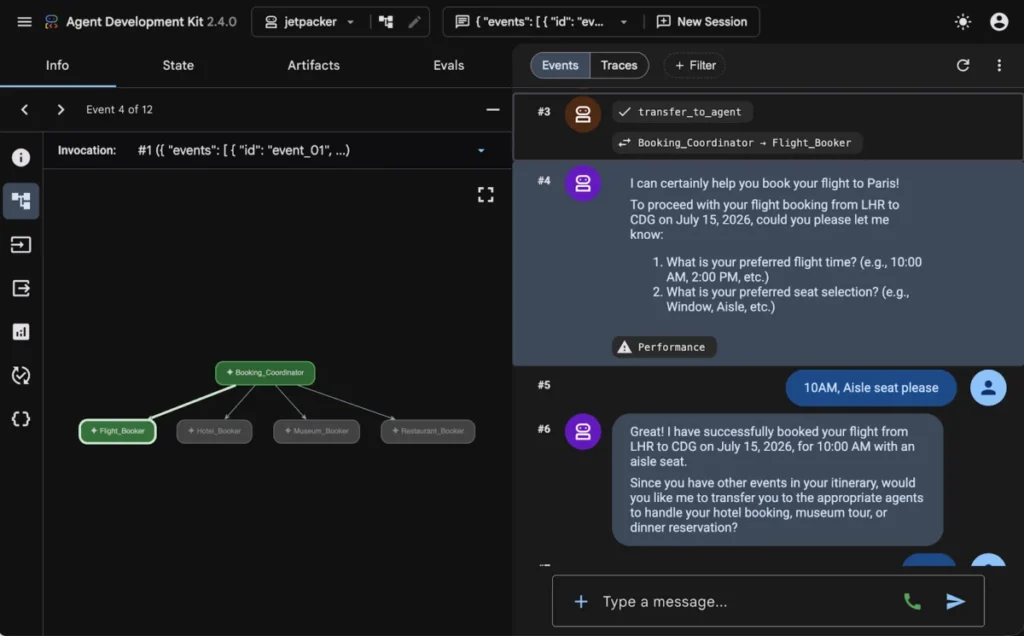
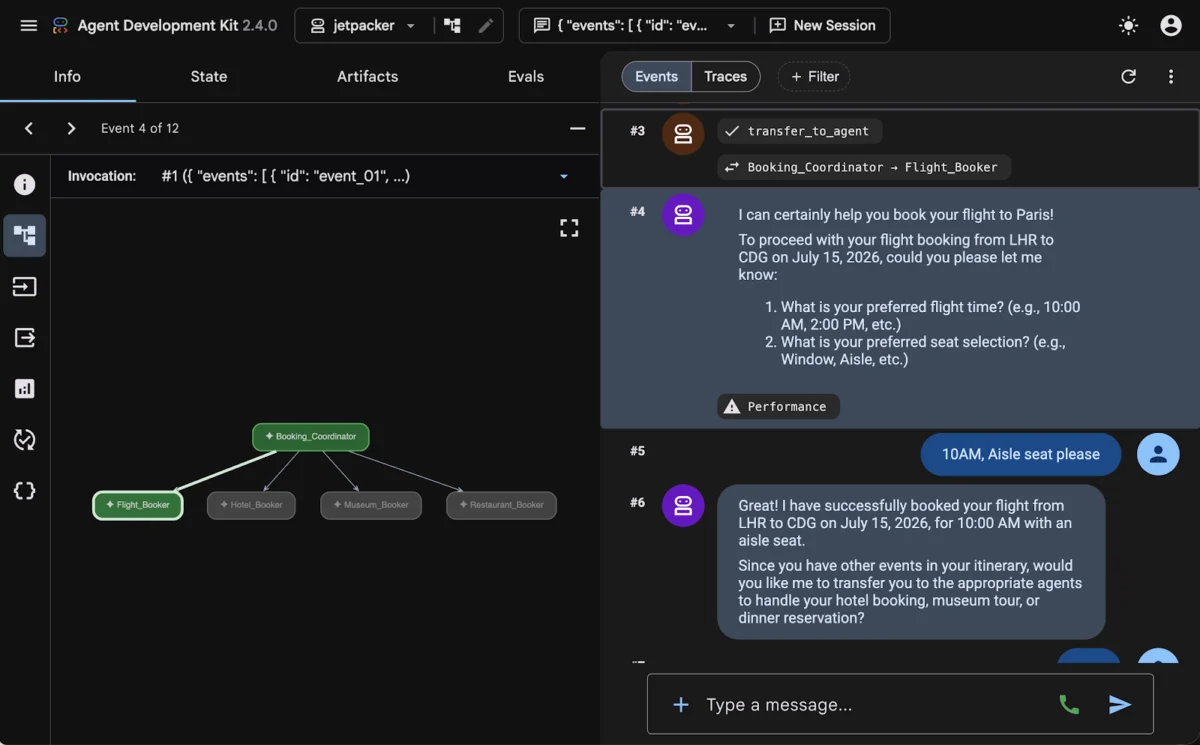
The core of this new paradigm is a multi-agent system where a "coordinator" agent manages sub-agents. For example, a "Flight Booker" sub-agent can be equipped with specialized Python tools to search databases and execute reservations.

Powering Workflow with the ADK
The Agent Development Kit (ADK) simplifies the backend heavy lifting. Instead of managing complex web sockets or custom REST endpoints, developers use the InMemoryRunner to handle the orchestration flow. The ADK automatically tracks the conversation context and routes messages between the user, the model, and the tools.
# Defining a specialized agent using the ADK
flight_agent = Agent(
    name="Flight Booker",
    model="gemini-3.1-flash-lite",
    instruction="Help the user search for flights and book a reservation.",
    tools=[FunctionTool(search_flights), FunctionTool(reserve_flight, require_confirmation=True)]
)
Bridging the Gap: AG-UI and A2UI
To ensure the backend agent can communicate with the Android frontend, two protocols serve as the connective tissue:
- AG-UI (Transport Layer): A bidirectional protocol that standardizes messages between the agent and the client. It enables real-time streaming of text, lifecycle events, and tool calls using Server-Sent Events (SSE).
- A2UI (Interface Layer): Perhaps the most revolutionary component, A2UI allows the backend agent to describe the UI it wants to display. Instead of sending raw text, the server sends JSON payloads that the Android app renders into native Jetpack Compose components. This effectively decouples the app’s design from the agent’s logic.
Official Responses and Strategic Implications
The implications for the developer community are profound. By adopting the A2UI protocol, teams can iterate on their user experience without requiring a full app store update. If a developer wants to change the layout of a "Seat Selection" screen or add a new interaction type, they simply update the JSON schema on the backend. The app, which declares a catalog of supported components, automatically adapts to the new instructions.

"We are moving toward a world where the interface is as dynamic as the conversation," says the development team. "By utilizing androidx.a2ui.compose libraries, we can transform an agent’s JSON payload into high-fidelity, native Material 3 components. This creates a seamless experience where the AI isn’t just ‘talking’ to the user—it is actively shaping the user’s workspace in real-time."
Technical Implications
- Decoupling: The backend orchestration logic is entirely separated from the client-side presentation, allowing for faster experimentation.
- Consistency: By utilizing a unified
A2uiCatalog, developers ensure that the backend agent and the Android app are always in sync regarding what components are available and how they should behave. - Maintainability: The use of
material3-a2uiprovides ready-to-use, accessible components, significantly reducing the boilerplate code required to build complex agentic UIs.
The Road Ahead
As demonstrated in the "Jetpacker" source code, the implementation of these workflows requires a disciplined approach to schema management. Developers must ensure that the A2uiSchemaManager is correctly configured to generate system prompts that guide the LLM. By including specific instructions for component usage—such as telling the model to use InteractiveOptionPicker for choices—the model is grounded in the reality of the app’s capabilities, preventing the generation of "hallucinated" UI elements.
For developers looking to adopt these practices, the transition involves three distinct steps:

- Backend Migration: Move orchestration logic to an ADK-powered server.
- Protocol Implementation: Integrate the AG-UI transport layer to handle real-time streaming and state management.
- Frontend Adaptation: Utilize the Jetpack Compose A2UI library to map backend-driven JSON payloads to native UI components.
As we look toward the future of Android development, the line between "application" and "agent" will continue to blur. The tools provided through the ADK and the A2UI protocol are not just incremental updates; they represent a fundamental shift in how we conceive of mobile interaction. By empowering agents to act autonomously in the cloud while maintaining a rich, native interface on the device, developers can provide the personalized, proactive experiences that modern users demand.
For those eager to dive into the technical details, the full source code for the Jetpacker application is available on GitHub, providing a comprehensive template for building the next generation of intelligent Android apps. As the ecosystem matures, these agentic workflows will likely become the standard for any application that handles complex, multi-step user tasks. The era of the "smart" app is ending; the era of the "agentic" app has begun.