The Maze of Power: Unraveling the Complexity of the NEMA Connector Ecosystem
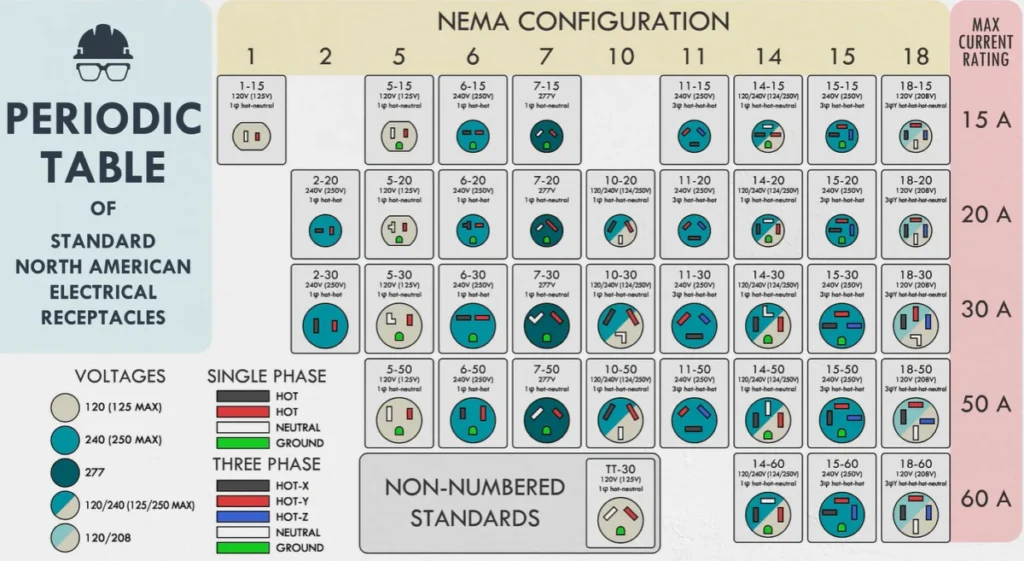
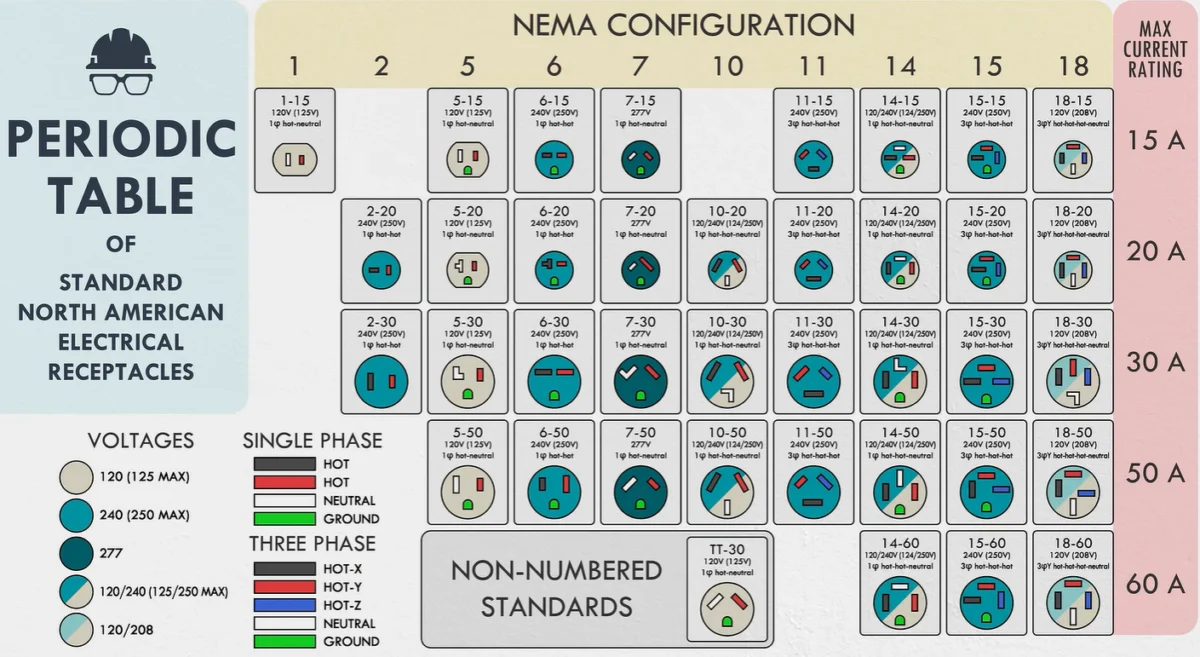
To the average North American consumer, the electrical grid is a background utility defined by simplicity: two vertical slots, sometimes a grounding pin, and a standard 120-volt current. However, beneath this veneer of uniformity lies a sprawling, complex, and often bewildering "zoo" of standardized interfaces governed by the National Electrical Manufacturers Association (NEMA). A recent deep dive by the popular engineering channel Practical Engineering has brought this often-overlooked architectural complexity into the spotlight, mapping the vast array of NEMA connectors into a comprehensive, periodic-table-style visual guide that reveals how much—and how little—of this catalog is actually in daily use.
Main Facts: The Logic of the NEMA Catalog
The primary goal of NEMA is to prevent the "plug-and-play" disaster that would occur if high-voltage industrial equipment could be plugged into a standard residential outlet. NEMA connectors are designed with a specific philosophy: a unique physical shape for every distinct combination of voltage, amperage, and grounding configuration.
This design methodology, while arguably user-friendly in a safety context, has resulted in an overwhelming number of physical standards. Each NEMA connector is categorized by a alphanumeric code (such as 5-15, L6-30, or 14-50), where the numbers denote the current-carrying capacity, the presence of a ground, and the specific voltage threshold. Because these connectors are polarized—meaning they only fit into a socket in one orientation—they effectively force the end-user to respect the intended safety parameters of the circuit. This is a marked departure from the non-polarized Type C "Europlug" or the reversible Type F "Schuko" connectors common in Europe, which place the responsibility of managing AC polarity onto the internal circuitry of the device itself.
Chronology: A Century of Standardization
The story of the NEMA standard begins in 1926, the year the association was founded as a trade organization. In the early 20th century, the United States suffered from a fragmented landscape of proprietary plugs that varied wildly between manufacturers and regional power companies.
- 1926: NEMA is established, providing a unified body to standardize electrical manufacturing. The goal was to reduce industrial hazards and simplify the supply chain for electrical contractors.
- Mid-20th Century: As the post-war housing boom demanded rapid infrastructure expansion, NEMA solidified the 5-15 (the standard household three-prong outlet) as the bedrock of residential electrical design.
- 1960s-1970s: The standardization of grounding requirements led to a massive expansion of the NEMA catalog to include locking (twist-lock) connectors, intended for industrial environments where vibration or accidental disconnection could lead to safety incidents or equipment damage.
- Modern Era: While the core residential standards remain frozen in time, the rise of electric vehicles (EVs) and high-density computing has forced a renewed interest in the "heavy-duty" end of the NEMA catalog, such as the 14-50 connectors often found in laundry rooms and now repurposed for EV charging.
Supporting Data: The Diversity of Power
The NEMA catalog is not a static list; it is a living index of technical requirements. When examining the data provided by the association, one observes a clear stratification:
- Residential/Light Commercial (125V): Dominated by the 1-15 (non-grounded) and 5-15/5-20 (grounded) standards. These are the workhorses of the North American grid.
- Specialty Appliance (250V): These outlets, such as the 6-15 or 6-20, are commonly found behind window-unit air conditioners or larger workshop tools.
- Industrial/High-Voltage: This sector features a massive array of connectors, including the "L" series (locking) and those designed for three-phase power. These connectors often utilize complex geometries—curved blades, varied pin placements, and locking mechanisms—to prevent cross-compatibility.
A significant hurdle in global electrical engineering is that while countries like Canada, Mexico, and Japan utilize NEMA-style plugs, they are not universally compatible. A Japanese 1-15 plug may physically fit into a US 1-15 outlet, but the underlying grid frequency (50Hz vs. 60Hz) or local voltage tolerance can lead to equipment failure, overheating, or fires.
Official Responses and Industry Perspectives
NEMA, representing a collective of manufacturers, maintains that their standards are not merely suggestions but vital safety protocols. In official documentation, the association emphasizes that the "one connector, one application" rule is the primary defense against electrical fires caused by overloading circuits.
However, critics and independent researchers—such as those at Practical Engineering—point out that the system is prone to "legacy bloat." Many of the designs listed in the NEMA catalog are rarely used, yet they remain as active standards, confusing contractors and consumers alike. There is also the issue of safety flaws in legacy designs; for instance, the ubiquity of the 5-15 connector has been criticized for being susceptible to the "penny challenge," where exposed metal objects can cause short circuits if inserted alongside a plug. While newer, tamper-resistant receptacles (TRRs) have been mandated in recent National Electrical Code (NEC) updates to mitigate this, the sheer volume of legacy hardware currently in use remains a significant safety concern.
Implications for the Modern Consumer and Industry
The implications of this complex ecosystem are far-reaching, affecting everything from international trade to the transition toward renewable energy.
The Problem of National Exceptionalism
The world remains deeply divided on electrical standards. While the EU has largely converged on the Schuko and Europlug systems, other regions continue to design proprietary national connectors. This "national exceptionalism" in plug design is often marketed as a safety feature, but it creates significant friction for global commerce. A manufacturer designing a device for the US market cannot simply ship that same unit to Thailand or Brazil without significant hardware modifications, increasing costs and resource consumption.
The EV Charging Challenge
Perhaps the most pressing modern implication is the role of NEMA connectors in the EV transition. As home charging becomes the standard, many EV owners have turned to existing 240V NEMA 14-50 outlets. However, these outlets were originally designed for intermittent use (like electric clothes dryers or stoves) rather than the constant, high-heat draw of an EV charger. This has led to a spike in reported outlet failures, highlighting that while NEMA standards are robust, they are not always sufficient for the evolving demands of modern electrical loads.
Future Outlook: Toward Rationalization
Looking ahead, there is a quiet push for a more unified approach. While the US is unlikely to undergo a massive overhaul of its residential grid to accommodate a universal plug, there is an increasing trend toward the "appliancization" of power delivery. We are seeing more devices move toward universal, low-voltage standards (like USB-C Power Delivery) for small electronics, effectively bypassing the NEMA outlet for everything except high-draw appliances.
The "zoo" of NEMA connectors will likely persist for decades, anchored by the massive investment in existing building infrastructure. However, the work of educators and engineers in demystifying these standards is crucial. By understanding that each connector is not just a piece of plastic, but a specific electrical contract between a device and the grid, users can better navigate the dangers and the capabilities of the power they tap into every day.
In conclusion, the NEMA catalog stands as a testament to both the brilliance of 20th-century safety engineering and the limitations of legacy systems in a globalized world. As we move toward a future of electrified transportation and high-efficiency homes, the humble outlet—and the complex, sprawling standards that govern it—will remain the silent, vital pulse of modern civilization. Whether this system will eventually be simplified or simply become more complex remains the central question for the next generation of electrical infrastructure planners.