The Pocket-Sized Time Machine: How Tiny386 is Revolutionizing Retro-Computing on Microcontrollers
We are currently living in a golden age of embedded systems. For decades, the divide between "microcontrollers"—those humble, low-power chips tasked with turning on lights or reading sensors—and "full-fat" computing systems was absolute. If you wanted to run a desktop operating system, you needed a microprocessor with a complex architecture, significant RAM, and a sophisticated power management system.
Today, that barrier has effectively dissolved. The latest generation of microcontrollers, available for the price of a cup of coffee, are pushing into performance tiers that were once the exclusive domain of workstation-grade hardware from the 1990s. At the forefront of this shift is tiny386, an ambitious emulation project that is breathing new life into the 386 architecture by porting it onto modern, low-cost silicon.
The Genesis of Tiny386: Emulating the 90s
The project, known as tiny386, began as a specialized emulator designed to run on the ESP32 platform. By providing a 386 PC environment with a strategic inclusion of 486 and 586 (Pentium) instructions, the project successfully bridged the gap required to boot a modern Linux kernel. While the ESP32 port was a proof-of-concept triumph, it was often constrained by the architectural limitations of the chip, leading to a user experience that was functional but notably sluggish.
The narrative took a significant turn recently with the introduction of the RP2350—the latest high-performance microcontroller from the Raspberry Pi foundation. The RP2350, with its dual-core ARM Cortex-M33 and Hazard3 RISC-V processors, offers a massive leap in raw clock speed and instruction-per-clock (IPC) efficiency compared to the ESP32. Developers have quickly recognized this, leading to ports for both the FRANK emulation platform and the Waveshare Pi Zero-form-factor boards.
Chronology of Development: From ESP32 to RP2350
To understand the significance of this shift, one must look at the progression of hardware emulation in the hobbyist space:
- The Early Phase (The ESP32 Era): Early iterations of tiny386 proved that it was possible to pack the complexities of a 32-bit x86 processor into a chip designed for IoT devices. This period was defined by intense optimization; developers had to carefully prune kernel requirements to fit within the limited memory footprint of the ESP32.
- The Optimization Phase: As the community grew, so did the instruction set support. By adding 486 and 586 opcodes, the emulator became capable of running more stable versions of Linux and more robust DOS applications. However, the ESP32 hardware struggled with the VGA emulation overhead.
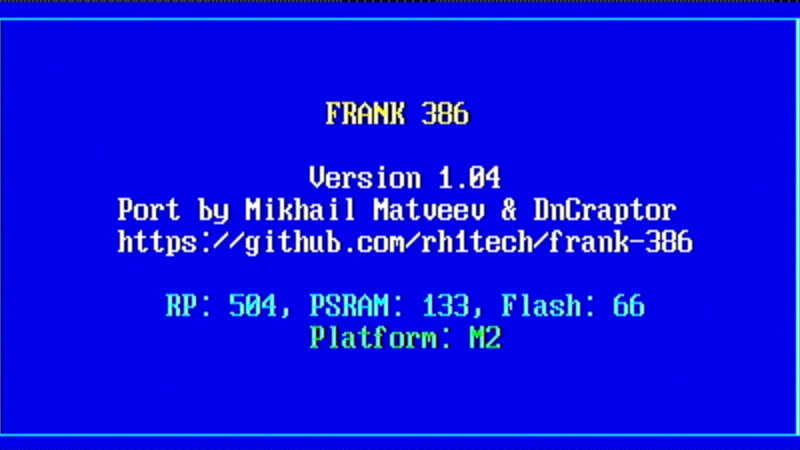
- The Current Breakthrough (The RP2350 Era): The arrival of the RP2350 changed the math. With faster bus speeds and more flexible I/O, the tiny386 emulator could finally leverage DVI and HDMI output, transforming a bare PCB into a functional desktop computer. The integration with the FRANK hardware project—an open-source emulation platform—has turned a once-niche software project into a tangible hardware product.
Supporting Data: Why the 386 Architecture Matters
The 386 processor, introduced by Intel in 1985, was the first x86 chip to support 32-bit computing. It serves as the "lowest common denominator" for a vast ocean of software. By emulating this architecture, tiny386 unlocks:
- Legacy Software Libraries: Thousands of DOS games, professional productivity suites like WordPerfect 5.1, and early graphical user interfaces (GUIs) become playable again without the need for aging, volatile capacitors and failing CRTs.
- Educational Value: Understanding how an emulator works—the translation of x86 instructions into ARM or RISC-V equivalents—provides a masterclass in computer architecture.
- Efficiency Metrics: Unlike a real 386 machine, which draws significant power and requires active cooling, these emulated setups operate on milliwatts. They can be powered by a small lithium-ion battery for hours, a feat that would have been impossible in 1992.
The Technical Hurdle: Emulation vs. Virtualization
It is important to distinguish what tiny386 is doing. This is not hardware-level virtualization, which requires the host hardware to share the same instruction set as the guest. This is full-system emulation. Every time the "guest" Linux kernel tries to write to a register or perform a memory read, the tiny386 emulator must intercept that call, simulate the action in the host’s memory, and update the virtual VGA buffer.
The transition to the RP2350 is critical because of its "PIO" (Programmable I/O) blocks. These allow the RP2350 to offload the heavy lifting of video signal generation and peripheral communication. In the ESP32, the main CPU was often bogged down by the sheer effort of keeping a display signal active. With the RP2350, the CPU can focus on the emulation of the 386 instructions, leading to a much smoother, "snappier" user experience.
Official Perspectives and Community Responses
The developer community surrounding tiny386 and FRANK has been overwhelmingly positive. On platforms like GitHub and various retro-computing forums, users are documenting their own builds.
"The goal isn’t to replace your modern workstation," says one lead contributor on the FRANK project. "The goal is to provide a portable, persistent environment where 90s computing feels native again. You don’t need a bulky beige tower to run Windows 3.1; you just need a board the size of a credit card and a HDMI cable."
However, there are skeptics who point to the "full-fat" Linux limitation. While the emulator can run a lean Linux kernel, it is not meant to run a modern, bloat-heavy distribution like Ubuntu or Fedora. The software must be carefully curated. As one developer noted, "This is about running the software of the era, not trying to force modern tools onto a 30-year-old architectural framework."
Implications: The Future of Retro-Computing
The implications of this technology are profound for both the preservation of digital history and the future of hobbyist computing.
1. Digital Preservation
Hardware dies. Capacitors leak, traces corrode, and mechanical hard drives suffer from "stiction." By moving the logic of these systems onto modern, robust, and easily replaceable microcontrollers, we are ensuring that the software of the 1990s can continue to function well into the 21st century.
2. General-Purpose Computing in the Palm of the Hand
There is an undeniable allure to the concept of "90s computing in your pocket." For many, the 386/486 era represents the peak of user-accessible, understandable computing. There were no hidden cloud services, no telemetry, and no complex driver dependencies. A system like the FRANK board with tiny386 offers a return to that simplicity—a device that does exactly what it is told, nothing more, nothing less.
3. A Challenge to Traditional Retro-Hardware
Historically, if you wanted to experience a 386, you had to buy a 386 laptop. These are becoming increasingly expensive, unreliable, and difficult to repair. The tiny386 project offers a superior alternative:
- Cost: The development boards cost a fraction of a vintage laptop.
- Maintenance: No proprietary parts. If the board breaks, you swap it for another $10 unit and flash the firmware.
- Peripherals: Through the magic of emulation, these boards can use modern USB keyboards and HDMI monitors, bypassing the need for expensive vintage signal converters.
Conclusion: The Road Ahead
The evolution of tiny386 from a struggling ESP32 project to a vibrant, high-performance platform on the RP2350 serves as a microcosm of the current state of embedded development. We are entering an era where the hardware is finally catching up to our nostalgia.
While we should not expect these boards to render 3D-heavy modern games or browse the modern, JavaScript-laden web, they offer something far more valuable: a perfectly preserved, high-performance window into the past. Whether you are a developer looking to understand the intricacies of 32-bit architecture or a hobbyist looking to relive the days of Windows 95, the synergy between the tiny386 emulator and the new wave of microcontrollers is a development worth watching.
For those interested in embarking on their own journey into the 90s, the resources are now more accessible than ever. The tiny386 codebase is available for those who want to dig into the assembly, and the FRANK boards provide a ready-to-use hardware platform for the less soldering-inclined. As the project matures, we can only expect more performance gains, more peripheral support, and perhaps even a standard "retro-PC-on-a-chip" specification that will define the next decade of retro-computing.
In the final analysis, tiny386 is more than just an emulator; it is an act of defiance against the planned obsolescence of the digital age. It proves that with enough ingenuity, the machines of our past don’t have to be relegated to the landfill—they can live on in our pockets, running faster and more reliably than their designers ever dreamed possible.