The Rocket Science of Artificial Intelligence: Why Machine Learning Systems Engineering is Tech’s Most Critical Missing Link
By Jason Jabbour, Kai Kleinbard, and Vijay Janapa Reddi (Harvard University)
In the fast-paced world of artificial intelligence, a pervasive industry mantra captures a glaring operational imbalance: "Everyone wants to do the modeling work, but no one wants to do the engineering."
Across startups and trillion-dollar tech conglomerates alike, the allure of training dazzling generative AI models, fine-tuning massive neural networks, and chasing state-of-the-art benchmarks routinely overshadows a vital, unglamorous reality. Models do not exist in a vacuum. Without robust systems engineering, the most brilliant algorithm is nothing more than expensive code trapped on a local drive—unable to scale, prone to high latency, and financially unsustainable to deploy.
To borrow an apt aerospace metaphor: if machine learning developers are the astronauts exploring uncharted frontiers, ML systems engineers are the rocket scientists designing and building the heavy-duty propulsion systems that make those journeys possible. Without meticulous systems engineering, even the most adventurous spacefarers remain permanently grounded.

Main Facts: The Core Divide in AI Development
At its core, the friction in modern AI development stems from a fundamental educational and cultural disconnect. Machine learning has historically been taught through the lens of data science, statistics, and optimization theory. Practitioners learn how to extract patterns from data, minimize loss functions, and architect deep neural networks.
However, as models grow exponentially in size—exemplified by the massive parameter counts of contemporary Large Language Models (LLMs)—the bottleneck has shifted. The primary challenges are no longer purely algorithmic; they are infrastructural. Training times that span weeks, skyrocketing cloud computing costs, and sluggish inference speeds are symptoms of a deep-seated neglect of systems-level thinking.
Recognizing this gap, a collaborative initiative born out of Harvard University—spearheaded by courses like CS249r Tiny Machine Learning and programs via HarvardX—has produced a groundbreaking open-source resource: MLSysBook.ai. Designed to demystify the end-to-end infrastructure of machine learning, the platform provides a comprehensive framework that connects high-level ML concepts directly to real-world hardware and systems deployment.
Chronology: The Evolution of ML Systems Education
The journey toward bridging the gap between theoretical machine learning and practical systems engineering has been marked by several pivotal milestones over the past decade:

- The Pre-Deep Learning Era (Early 2010s): Machine learning models were relatively lightweight. Systems engineering was largely viewed as an afterthought handled by traditional DevOps or software engineers after a data scientist finished training a model in scikit-learn or R.
- The Deep Learning Boom (Mid-to-Late 2010s): The resurgence of neural networks necessitated specialized hardware (GPUs and TPUs). Frameworks like TensorFlow and PyTorch emerged, tightly coupling software libraries with hardware accelerators. Despite these tools, educational curricula remained heavily slanted toward model architecture rather than infrastructure optimization.
- The Rise of Edge AI and TinyML (2020–2022): Harvard University introduced pioneering courses in Tiny Machine Learning (TinyML), teaching students how to run ML models on resource-constrained microcontrollers. This initiative proved that systems constraints—such as strict memory limits and low-power operations—were universal, applying equally to tiny edge devices and massive server clusters.
- The Birth of MLSysBook.ai (2023–Present): What began as course materials for Harvard’s CS249r evolved into an open-source, community-driven "textbook" addressing the neglected infrastructure side of machine learning. The project integrated advanced AI learning assistants like SocratiQ to transform passive textbook reading into an interactive educational experience.
Supporting Data and the ML Systems Lifecycle
Building a successful, production-grade machine learning solution requires an unbroken chain of interconnected phases. According to frameworks outlined in MLSysBook.ai, an efficient ML system relies on a rigorous, multi-stage lifecycle:
- Data Engineering: The foundational layer. Raw data must be ingested, cleaned, and organized at scale. Tools within ecosystems like TensorFlow Data play a vital role in ensuring data pipelines can feed high-throughput training loops without becoming bottlenecks.
- Model Development: The creation and algorithmic refinement of neural networks tailored to specific business or research objectives.
- Optimization: A critical bridge between software and hardware. Techniques such as quantization (e.g., shifting from 32-bit floating-point numbers down to 8-bit integers like INT8 for edge devices, or utilizing FP16 for data centers) drastically reduce model size and memory footprints while preserving predictive accuracy.
- Deployment & Scaling: Transitioning models from experimental notebooks into real-world production environments. Here, models must integrate seamlessly with existing enterprise IT infrastructure, handling fluctuating request volumes with minimal latency.
- Monitoring and Maintenance: The lifecycle does not end at deployment. Continuous monitoring ensures that models do not suffer from data drift, performance degradation, or hardware failures over time.
While MLSysBook.ai focuses primarily on universal systems principles rather than specific software implementations, mapping these concepts to established ecosystems—such as the TensorFlow ecosystem—illustrates how industry practitioners translate theory into practice. Whether deploying models on cloud-based server clusters or resource-constrained IoT hardware, the underlying engineering fundamentals remain remarkably consistent.
Official Responses and Innovations: Introducing SocratiQ
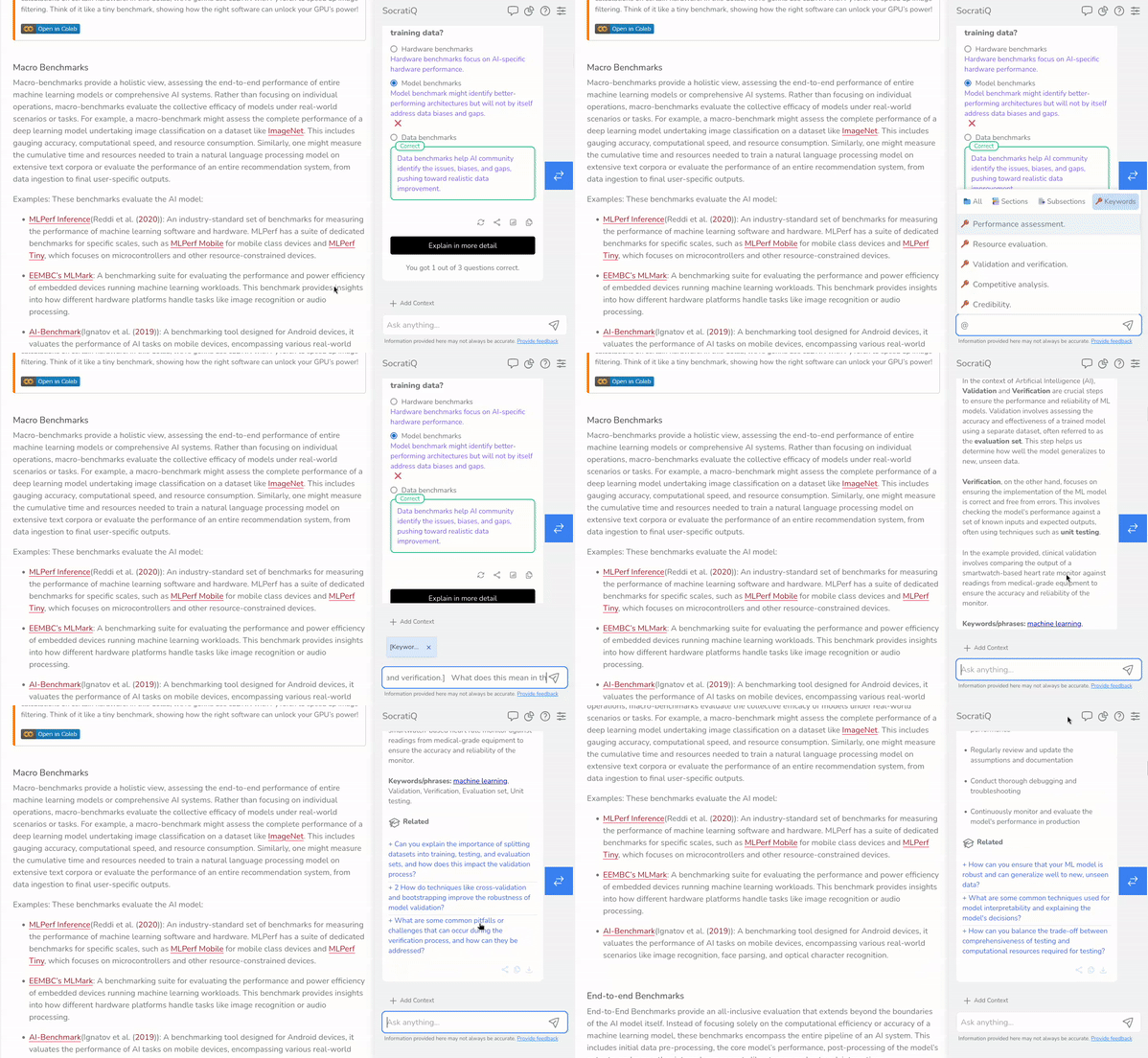
One of the most noteworthy innovations accompanying the expansion of MLSysBook.ai is the integration of SocratiQ, an AI-powered generative learning assistant. Designed to revolutionize how technical literature is consumed, SocratiQ leverages Large Language Models to transform static reading into an interactive, personalized educational journey.
Rather than forcing students to passively digest dense chapters on memory bandwidth, hardware acceleration, or distributed training, SocratiQ acts as a dynamic co-pilot. It offers real-time conversational explanations, dynamically generates custom quizzes based on the reader’s comprehension level, and tracks performance through intuitive dashboards.

Crucially, the creators designed SocratiQ to respect the primacy of the core text. The AI assistant subtly integrates into the reading flow, stepping in to clarify complex engineering principles when requested and stepping back to allow uninterrupted immersion. Future updates planned for the platform include automated research lookups and interactive case studies, turning the textbook into a living, breathing educational ecosystem.
Implications for the Future of AI Careers and Education
The implications of the growing emphasis on ML systems engineering are profound for both individual practitioners and the broader tech industry.
As artificial intelligence matures past the initial "gold rush" phase of simply scaling parameter sizes, companies are facing severe economic and environmental pressures. Training and running massive models is exorbitantly expensive and power-hungry. Consequently, organizations are actively seeking professionals who understand how to write code that is not only mathematically sound but also computationally efficient.
Engineers who bridge the gap between machine learning algorithms and systems architecture are rapidly becoming some of the most valuable assets in the tech sector. Investing time in mastering hardware optimization, distributed computing, and deployment pipelines yields compounding returns over the course of a career.

How the Community Can Support ML Systems Education
The growth of MLSysBook.ai relies heavily on open-source collaboration. The project’s maintainers have introduced a unique, impact-driven initiative: Every GitHub star counts.
Thanks to generous corporate sponsors, every "star" added to the MLSysBook.ai GitHub repository translates directly into financial donations. These funds support students and underrepresented minorities globally by financing research scholarships and empowering the next generation of innovators to drive breakthroughs in machine learning systems research.
Conclusion
The historic chasm between high-level machine learning modeling and low-level systems engineering is finally beginning to close. As artificial intelligence continues to reshape industries worldwide, the demand for holistic engineers who comprehend both algorithmic design and infrastructural execution will only accelerate.
Whether you are a seasoned industry veteran or a student taking your first steps into artificial intelligence, mastering the principles of ML systems engineering is no longer optional—it is the prerequisite for building impactful, scalable, and sustainable AI solutions.

To dive deeper into the mechanics of machine learning infrastructure, explore MLSysBook.ai, listen to the companion NotebookLM-generated podcast, and consider supporting the project on GitHub. Because when it comes to launching the future of AI, even the most brilliant astronauts rely on world-class rocket scientists.
Acknowledgments: The authors extend their gratitude to Josh Gordon for his invaluable suggestions and encouragement regarding how MLSysBook.ai could best serve the broader developer and engineering community.