Tiny AI, Big Impact: How Needle 2 Brings Lightning-Fast Function-Calling to the Raspberry Pi 5
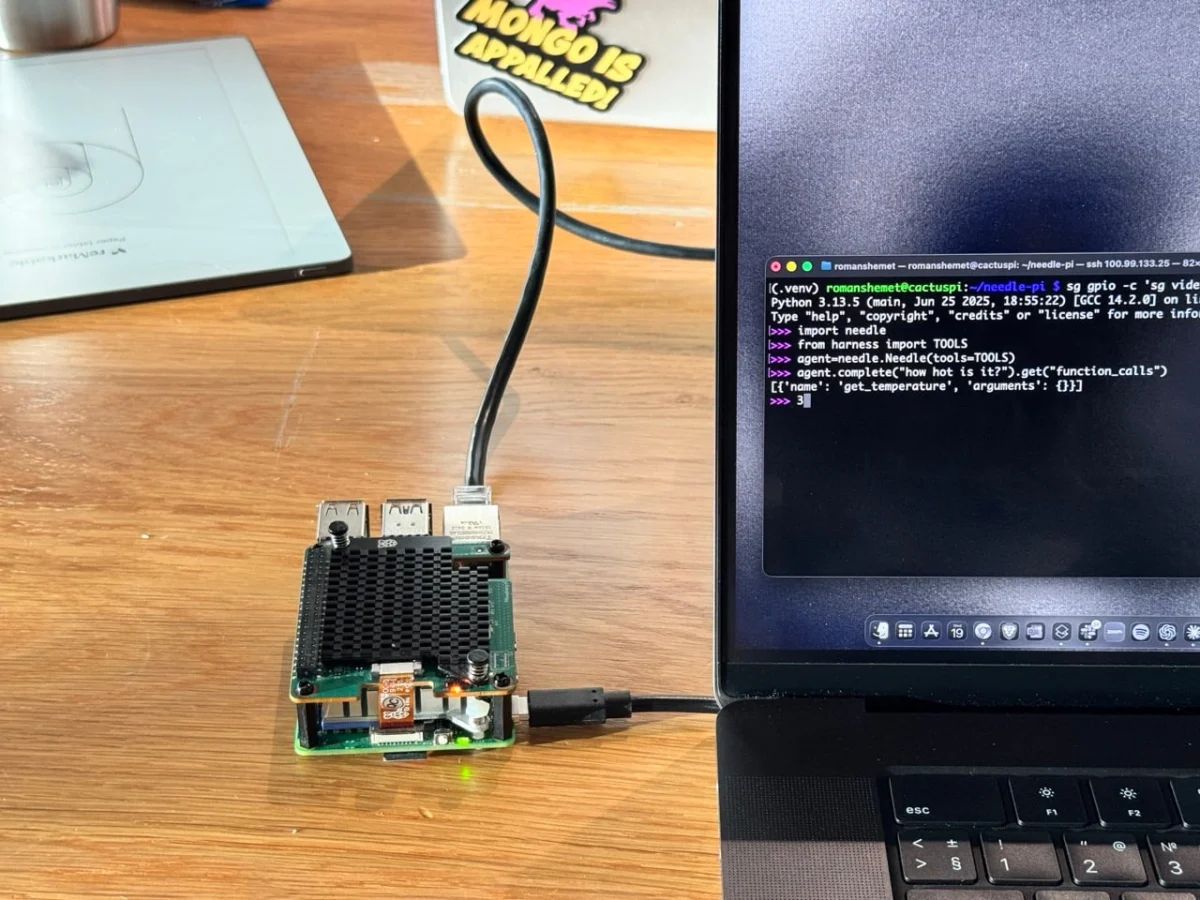
In the rapidly evolving landscape of artificial intelligence, the industry’s gaze has traditionally been fixed on the horizon of massive, cloud-based data centers. Training models with trillions of parameters demands sprawling server farms, liquid-cooled racks, and megawatts of electricity. Yet, a quiet revolution is happening at the absolute opposite end of the computing spectrum—the edge.
Edge computing has long sought to bring machine learning intelligence directly to low-power devices, but developers have routinely hit a brick wall. Large language models (LLMs) are notoriously bloated, requiring expensive GPUs, specialized neural accelerators, or dedicated AI HATs (Hardware Attached on Top) to achieve usable performance. For standard single-board computers like the ubiquitous Raspberry Pi, running an intelligent agent locally has often felt like trying to park an 18-wheeler in a residential garage.
Enter Cactus Compute and their latest creation: Needle 2.
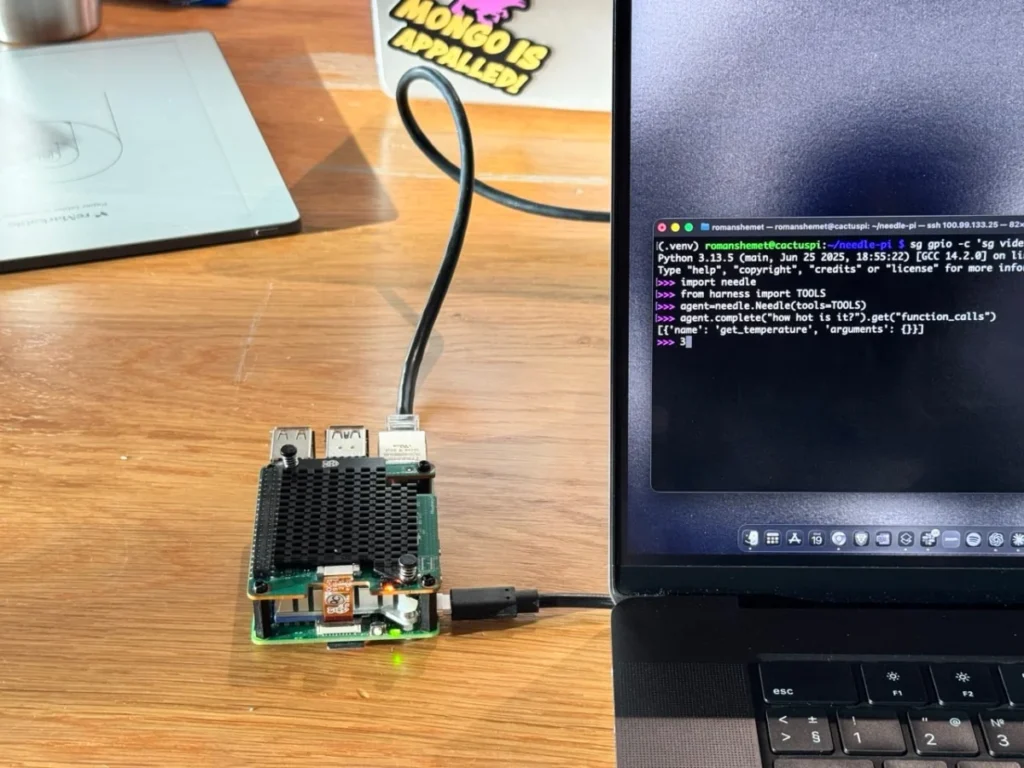
Weighing in at a featherlight 14 megabytes, Needle 2 is a specialized function-calling model that redefines what is possible on minimal hardware. Operating entirely on the CPU of a standard Raspberry Pi 5 without any dedicated AI acceleration hardware, Needle 2 translates plain English into precise local system actions in mere milliseconds. Hailed by Raspberry Pi CEO Eben Upton as "rather excellent," this tiny model proves that when it comes to artificial intelligence, bigger is not always better.
Main Facts: What is Needle 2?
To understand the breakthrough that Needle 2 represents, one must first understand what the model is not. Needle 2 is explicitly not a conversational chatbot. It will not write poetry, debug complex legacy codebases, or debate philosophy with you. It has been painstakingly engineered for one singular, highly focused purpose: reliable, structured, on-device action execution.
Developed by the engineering team at Cactus Compute, Needle 2 bridges the gap between human intent and local machine execution. The core mechanics of the system are refreshingly straightforward. Developers write standard Python functions and decorate them using @needle.tool. The model analyzes the function names, docstrings, and type annotations to dynamically build its tool schema. When a user issues a command in plain English, Needle 2 determines which function to invoke and accurately extracts and formats the necessary arguments.
Key Technical Specifications:
- Model Size: 14MB (with a native session size hovering around 28MB).
- Memory Footprint: Complete Python process peaks between 43MB and 46.4MB, including the Python interpreter.
- Hardware Requirement: CPU only (tested extensively on a standard Raspberry Pi 5, 8GB model running Raspberry Pi OS).
- Dependencies: Zero cloud APIs, zero internet connection required after initial download. Runs entirely offline.
- Licensing: Released under the permissive Apache 2.0 open-source license.
By stripping away the conversational bloat that bogs down general-purpose LLMs, Cactus Compute has created a razor-sharp tool that executes specific tasks with astonishing speed.
Chronology of Development and Testing
The journey toward local, lightweight edge intelligence has been iterative. The initial iterations of on-device function calling often struggled with latency, hallucination, or excessive memory consumption that overwhelmed embedded systems. Cactus Compute’s approach with the Needle series was to dramatically constrain the problem space. Instead of attempting to make a model know everything about the world, they taught it how to navigate a specific set of tools provided by the developer.
With the release of cactus-needle version 2.0.7, the framework reached a maturity level capable of seamless integration with standard single-board computer environments.
The Implementation Timeline in Action
The installation process on a Raspberry Pi 5 is designed to take mere minutes using standard Python virtual environments:
python3 -m venv needle-env
source needle-env/bin/activate
python -m pip install cactus-needle
Once installed, developers can immediately begin defining custom tools. For instance, creating a system that logs local notes and checks hardware telemetry requires only a few lines of Python code:
from pathlib import Path
import subprocess

notes_path = Path("needle-notes.txt")

@needle.tool
def save_note(text: str):
    """Append a note to a local text file."""
    with notes_path.open("a", encoding="utf-8") as notes:
        notes.write(text + "n")
    return "text": text, "path": str(notes_path)

@needle.tool
def get_temperature():
    """Return the current CPU temperature of this Raspberry Pi in Celsius."""
    out = subprocess.check_output(["vcgencmd", "measure_temp"], text=True)
    return "temperature_c": float(out.split("=")[1].split("'")[0])

agent = needle.Needle(tools=[save_note, get_temperature])
When a user prompts the agent with a command like "Save a note that says the cooler is working", Needle 2 processes the string, executes the prefill and decode phases, and outputs a structured JSON tool selection:
  "type": "call",
  "function_calls": [

      "name": "save_note",
      "arguments":  "text": "the cooler is working"

  ]
The run() method then executes the underlying Python function, returning the verified results to the application layer. Crucially, if the model encounters a prompt that falls outside the scope of its provided tools—such as asking for the capital of France—it correctly recognizes its limitations and returns an empty function call array, refusing to hallucinate an answer.
Supporting Data and Benchmarking
Performance metrics on edge devices are often where theoretical AI models falter. However, Cactus Compute’s rigorous benchmarking of Needle 2 on a standard, unaccelerated Raspberry Pi 5 reveals exceptional efficiency.
The following performance data was recorded on a Raspberry Pi 5 (8GB RAM) running Raspberry Pi OS using cactus-needle 2.0.7 on the CPU alone:
| Prompt | Selected Tool | Prefill (tok/s) | Decode (tok/s) | Time Taken (ms) |
|---|---|---|---|---|
| Turn the LED on. | set_led |
488 | 296 | 78 |
| How hot is this Raspberry Pi? | get_temperature |
487 | 303 | 149 |
| Blink the LED 2 times. | blink_led |
475 | 314 | 83 |
| Take a photo. | take_photo |
461 | 248 | 76 |
| Save a note that says the cooler is working. | save_note |
475 | 305 | 107 |
| What is the capital of France? | (none) | 470 | 297 | 92 |
Note: Prefill and decode represent Needle’s internal session token processing speeds. The "Time Taken" column reflects the absolute wall-clock time for a single complete() call to parse the intent and select the correct function before the underlying Python logic executes.
With response times consistently landing between 75 and 150 milliseconds, Needle 2 operates well within the threshold of human perception for instant feedback. Turning on an LED or capturing an image via rpicam-still happens nearly instantaneously, eliminating the frustrating lag associated with routing simple IoT commands through external cloud servers.
Official Responses and Industry Reception
The release of Needle 2 has drawn significant attention from both hobbyist communities and industry leaders alike. Because edge computing has long struggled with the trade-off between intelligence and resource consumption, a tool that bridges this gap so efficiently has immediate appeal.
Eben Upton, CEO of Raspberry Pi, offered a succinct endorsement of the technology, noting that "Needle 2 is rather excellent."
This praise highlights a strategic alignment between Raspberry Pi’s hardware evolution—which has steadily increased CPU performance, thermal management, and memory capacity with each generation—and the software innovation required to leverage that hardware. For years, developers utilizing Raspberry Pi boards for home automation, robotics, and edge AI projects had to rely on cumbersome rule-based parsers, rigid regular expressions, or heavy external API calls to interpret natural language commands. Needle 2 introduces a localized, flexible semantic layer that allows devices to understand colloquial human instructions without sacrificing system performance or tying the device to an active internet connection.
Implications for Developers and the Future of Edge AI
The implications of Needle 2 extending deep into the development ecosystem are profound. By lowering the barrier to entry for local function-calling, Cactus Compute has effectively democratized edge intelligence.
1. Enhanced Privacy and Security
Because Needle 2 runs entirely offline, sensitive telemetry, voice commands, or environmental data never leave the local device. In industrial monitoring, smart home automation, and healthcare applications where data privacy is paramount, an air-gapped AI agent that requires no cloud connectivity is a massive architectural advantage.
2. Resilience and Reliability
Cloud-dependent smart devices are notoriously vulnerable to internet outages, server deprecation, and API rate limits. A Raspberry Pi running Needle 2 embedded within a localized robotic arm, weather station, or security system remains fully functional even in remote environments or during total network blackouts.
3. Extensibility via Familiar Tooling
Developers do not need to learn specialized machine learning frameworks or complex prompt-engineering paradigms to utilize Needle 2. If a developer already knows how to write standard Python functions—such as utilizing the GPIO Zero library for hardware control—they can instantly transform those functions into an intelligent agent by simply applying the @needle.tool decorator. Furthermore, developers looking to tailor the model for highly specialized industrial domains can fine-tune Needle 2 locally on a standard laptop.
4. Broad Open-Source Availability
In an era where many foundational AI models are locked behind proprietary enterprise walls or expensive subscription APIs, Cactus Compute has released both the model weights and the underlying source code under the open Apache 2.0 license. Developers, researchers, and hobbyists can freely inspect, modify, and deploy the code for commercial or personal projects.
Conclusion
Needle 2 is a masterclass in purposeful engineering. By refusing to chase the generalized capabilities of multi-billion-parameter chatbots, Cactus Compute has carved out a vital, highly efficient niche in the AI ecosystem.
Running comfortably within a 45MB memory footprint on a standard Raspberry Pi 5 CPU, Needle 2 transforms plain English into immediate, local actions with sub-150ms latency. Whether you are building an automated home garden monitor, a local voice-controlled robotics system, or an offline data-logging utility, Needle 2 proves that powerful, intelligent automation no longer requires a data center. It can live right on your desk, running quietly on a credit-card-sized computer.
The model weights and source code are available now for developers eager to experiment at Hugging Face and GitHub.