Unlocking the Data Lake: AWS Revolutionizes Metadata with Amazon S3 Annotations
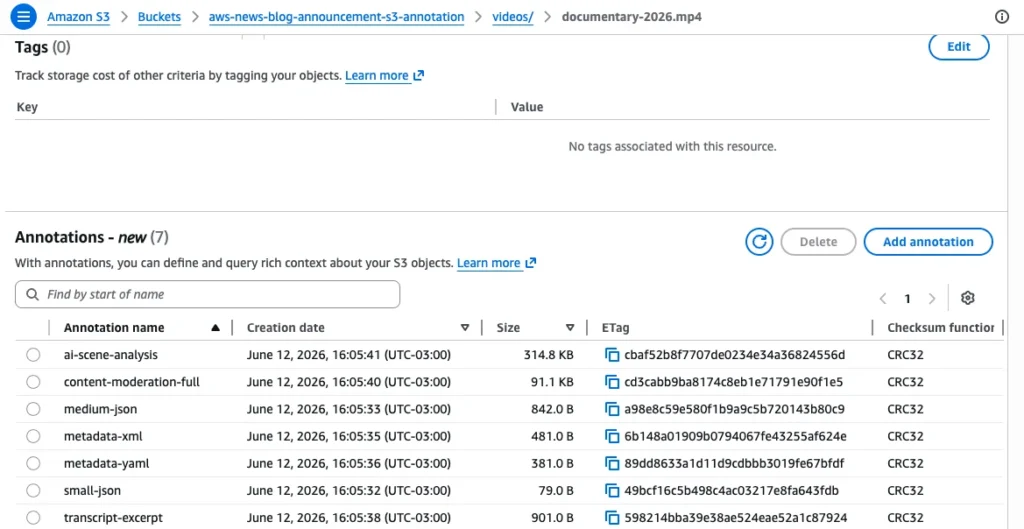
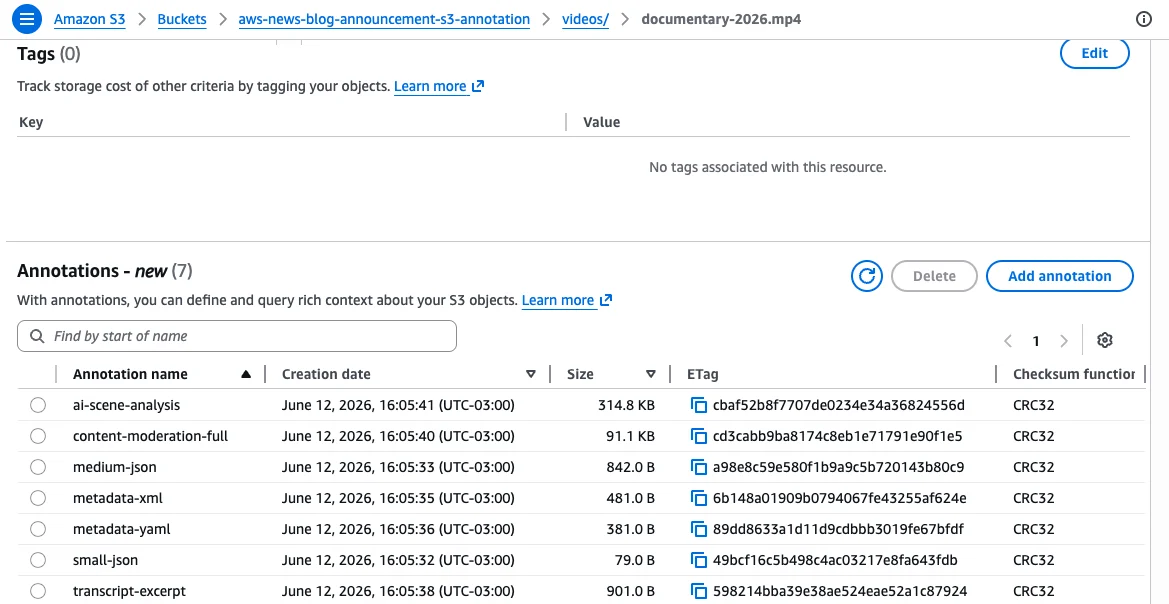
In a landmark development for cloud architecture and artificial intelligence, Amazon Web Services (AWS) has officially unveiled "Annotations"—a powerful new metadata capability for Amazon Simple Storage Service (Amazon S3). This launch marks a fundamental shift in how organizations manage the contextual data surrounding their petabyte-scale object storage, moving away from fragmented, external databases toward a unified, natively queryable ecosystem.
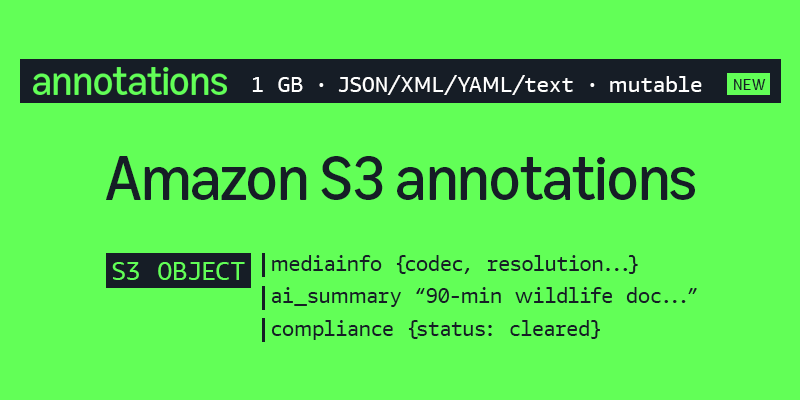
For years, the "data lake" has often suffered from a metadata disconnect. While data was stored securely in S3, the "context"—the business logic, AI-generated summaries, or technical specifications—frequently resided in disparate sidecar files or external databases. This separation created significant operational overhead, high synchronization costs, and bottlenecks for autonomous AI agents. With the introduction of S3 Annotations, AWS is effectively enabling objects to "carry their own story," allowing for up to 1 GB of flexible, mutable context directly attached to individual objects.
Main Facts: What Are S3 Annotations?
At its core, S3 Annotations allow users to attach rich, structured, or unstructured metadata to any S3 object. Unlike previous metadata limitations, which were largely restricted by small header sizes or rigid, immutable structures, Annotations provide a scalable, high-performance solution for modern data management.
The Technical Specifications
- Capacity: Users can attach up to 1,000 named annotations per individual object.
- Size Constraints: Each annotation can be as large as 1 MB, allowing for up to 1 GB of cumulative metadata per object.
- Flexibility: Annotations support multiple formats, including JSON, XML, YAML, and plain text, catering to diverse application needs.
- Mutability: Unlike standard S3 object tags or user-defined metadata, Annotations are fully mutable. They can be updated, modified, or deleted without the need to re-write or re-upload the parent object.
- Lifecycle Awareness: Annotations are "sticky." When an object is copied, replicated, or moved across regions, the associated annotations follow the object automatically. If the parent object is deleted, the annotations are purged as well, ensuring clean data hygiene.
The Chronology of Metadata Evolution
To understand the gravity of this release, one must look at the progression of object storage metadata within the AWS ecosystem.
The Early Era: Rigid Constraints
In the early days of cloud computing, metadata was an afterthought. System-defined metadata (creation time, storage class) was immutable and opaque to the user. As storage needs grew, AWS introduced user-defined metadata—a 2 KB limit on headers—which was sufficient for simple flags but woefully inadequate for modern machine learning workflows.
The Tagging Revolution
The introduction of S3 Object Tags provided a way to manage operational tasks like cost allocation and access control. While vital for governance, tags were limited in scope (only 10 per object) and lacked the capacity for descriptive, business-centric context.
The Present: The "Agentic" Era
As organizations pivoted toward building autonomous AI agents, the "metadata bottleneck" became a critical failure point. Agents needed to "understand" data without constant human intervention or the latency involved in querying external databases. The arrival of Annotations serves as the final piece of this puzzle, enabling an architecture where metadata is not just a label, but a queryable part of the object’s identity.
Supporting Data: Why Annotations Outperform Existing Methods
The following table illustrates the paradigm shift introduced by the Annotations feature:
| Capability | Max Size | Mutable? | Best For |
|---|---|---|---|
| System-defined | Fixed | No | Object properties (size, class) |
| User-defined | 2 KB | No | Small key-value pairs |
| Object Tags | 10 tags | Yes | Access/Lifecycle management |
| Annotations | 1 GB (1,000 x 1 MB) | Yes | Rich business/AI context |
The ability to query these annotations using Amazon Athena transforms S3 from a passive storage bin into an active, searchable database. By enabling "Annotation Tables," S3 automatically indexes this metadata into Apache Iceberg tables. This means that data scientists and AI models can query specific fields—such as "audio_tracks" in a video file or "sentiment_score" in a text document—across billions of objects without the latency of retrieving the objects themselves.
Implications for Industry and AI
Transforming Media and Entertainment
For a media company managing massive libraries, the implications are immediate. Rather than maintaining a separate SQL database to track video codecs, resolutions, and AI-generated content ratings, companies can now store this data directly with the video file. If a file is updated, the annotation is updated instantly. This streamlines workflows, reduces synchronization costs, and ensures that the metadata is always "close" to the source of truth.
Empowering AI Agents
The most profound impact of S3 Annotations lies in the realm of Artificial Intelligence. Modern AI agents require "context-aware" data. With the integration of the S3 Tables MCP (Model Context Protocol) server, AI agents can interact with S3 objects using natural language.
- Example: An agent can be prompted to "find all PG-rated movies with Spanish subtitles from 2023."
- Performance: Because the metadata is indexed in an annotation table, the agent can retrieve this information in seconds, a process that previously might have required traversing multiple fragmented systems and scanning raw object data.
Cost Efficiency and Operational Simplicity
By eliminating the need for "sidecar" databases, AWS is lowering the total cost of ownership for data-intensive projects. Organizations no longer need to pay for the compute and storage required to maintain synchronization between an object and its metadata. Furthermore, because annotations are queryable via Athena, companies can perform deep analysis on their metadata without triggering expensive data retrieval or "restore" operations from cold storage classes like Glacier.

Official Responses and Strategic Vision
In his announcement, Daniel Abib, a key figure in the AWS storage ecosystem, emphasized that this feature is a direct response to the "agentic" nature of modern software development. "Organizations are building AI agents and autonomous workflows that need to find, understand, and act on data without human intervention," Abib stated. By providing a scalable, queryable, and mutable metadata layer, AWS is effectively providing the "brain" for the vast, petabyte-scale storage "bodies" that enterprises maintain.
The strategic vision is clear: AWS aims to make S3 the central nervous system of the enterprise data stack. By allowing developers to attach structured JSON or YAML files directly to objects, AWS is standardizing how metadata is handled, reducing the reliance on custom, brittle in-house metadata solutions.
Getting Started: A Practical Guide
Adopting S3 Annotations is designed to be seamless for developers familiar with the AWS CLI.
Step 1: Permissions
Before using the feature, administrators must ensure that IAM policies include s3:PutObjectAnnotation and s3:GetObjectAnnotation.
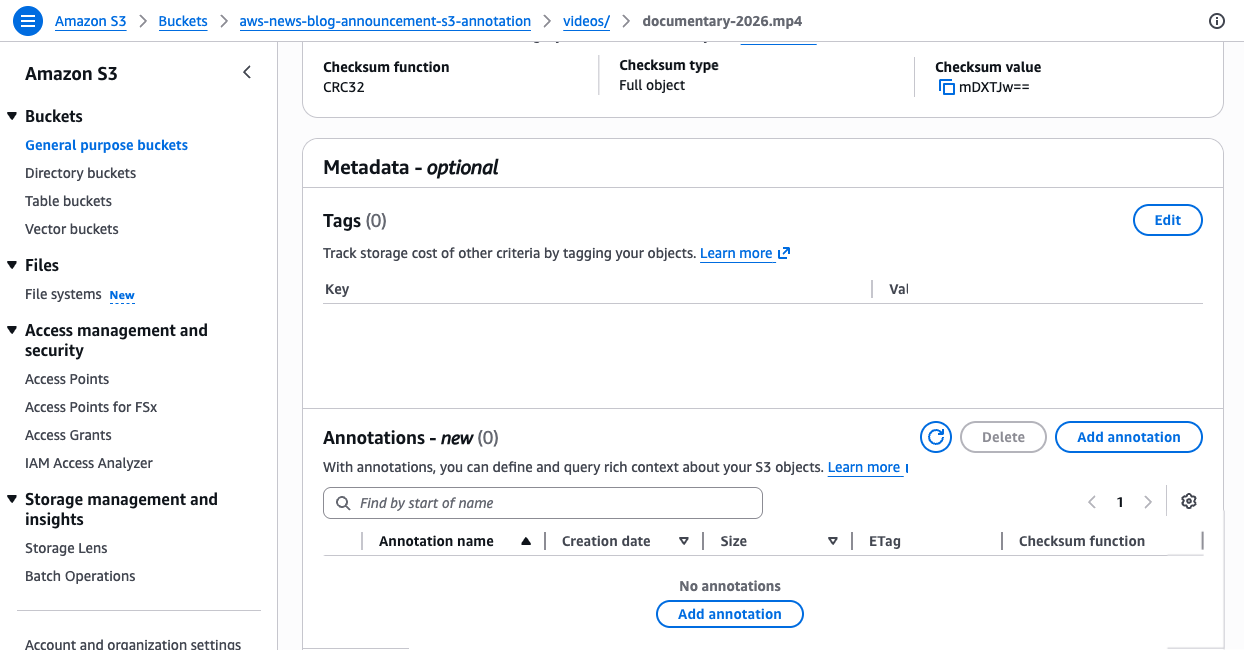
Step 2: Attaching Data
Using the AWS CLI, attaching context is as simple as:
aws s3api put-object-annotation
  --bucket my-media-bucket
  --key videos/documentary-2026.mp4
  --annotation-name ai_summary
  --annotation-payload ./ai_summary.txt
Step 3: Enabling Queryability
To truly unlock the potential, users should enable the "Annotation Table" via the S3 console or API. This triggers a background process that indexes all annotations into an Apache Iceberg table. Once enabled, the data is instantly available for SQL-based analysis via Amazon Athena.
Future Outlook: The Death of the Sidecar
The introduction of S3 Annotations signals a broader industry trend toward "intelligent storage." As data volumes continue to explode, the ability to query metadata independently of the raw data will become the primary differentiator for cloud storage providers.
By removing the barriers to rich metadata, AWS has enabled a new class of applications. We are likely to see a surge in "metadata-first" applications where the primary interaction with the storage layer is via natural language queries of annotation tables. For developers and architects, this is a clarion call to re-evaluate their current data architectures. If you are currently maintaining a secondary database just to track the properties of your S3 objects, the time to migrate that context into the object itself has arrived.
The era of the "dumb" data lake is over. With S3 Annotations, AWS has ensured that the future of data storage is not just about keeping bytes safe, but about making them discoverable, understandable, and actionable for the next generation of artificial intelligence.