Fire and Code: The Maker Who Married a 19th-Century Stirling Engine to a Modern IoT Microcontroller
By Global Technology & Innovation Desk
Published: October 24, 2023
Main Facts
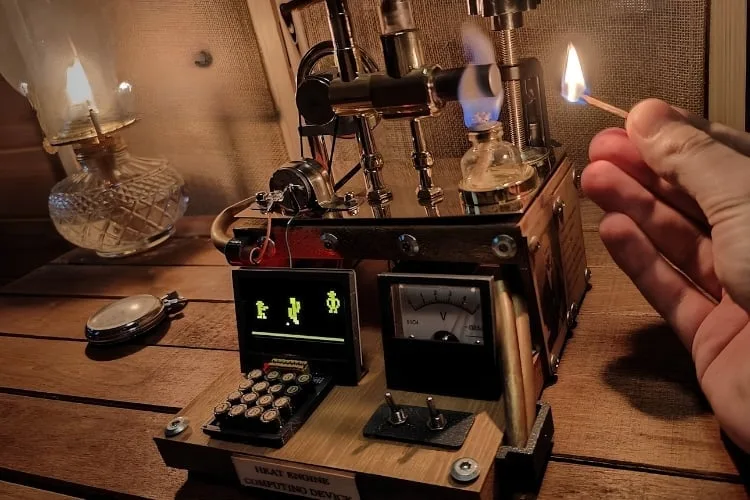
In a remarkable display of cross-disciplinary engineering that bridges more than two centuries of human innovation, a creator behind the YouTube channel PickentCode has successfully constructed a fully operational, programmable computer powered entirely by an 1816-patented Stirling engine. Fired by a simple alcohol (ethanol) lamp, this thermal-to-electrical generator sustains a modern, low-power computing architecture capable of executing vintage retro video games and custom assembly programs.
The system defies conventional electronics design by entirely omitting wall outlets, lithium-ion battery packs, and traditional power supplies. Instead, it relies strictly on external combustion and thermodynamic principles. At the heart of the apparatus is a miniature Stirling engine—a closed-cycle regenerative heat engine originally patented by Scottish clergyman Robert Stirling over two hundred years ago. As the alcohol lamp heats the base of the engine, internal air expands and contracts, driving power and displacer pistons while a meticulously balanced flywheel maintains mechanical momentum.
This mechanical kinetic energy is harvested and converted into electricity, which is fed directly into a modern ESP32-C3 microcontroller. The processing unit is wired to a crisp 2.42-inch monochrome OLED display and a 16-key tactile keypad. Rather than running a resource-heavy contemporary operating system, the machine utilizes CHIP-8, a lightweight interpretive programming language originally developed in the mid-1970s for 8-bit microcomputers. The integration allows users to write raw opcodes directly on the device via an onboard code editor, load programs on the fly, and play classic games—all powered by nothing more than an open flame.
Chronology of the Build: From Concept to Flame-Powered Computation
The conceptualization and execution of the fire-powered computer did not happen overnight. It represents the culmination of iterative prototyping, energy budgeting, and the harmonization of disparate technological eras.
Phase 1: The Thermodynamic Foundation
The project began with the acquisition and testing of a miniature hobbyist Stirling engine. PickentCode recognized that while these engines are typically used as desk toys or educational physics demonstrations, their mechanical output, though modest, could theoretically be coupled to a small dynamo or alternator. The initial phase involved optimizing the temperature differential: ensuring the hot side of the cylinder received consistent heat from an ethanol burner while the cooling fins effectively dissipated ambient heat to maintain the necessary pressure gradient within the closed chamber.
Phase 2: Electrical Conversion and Stabilization
Generating raw mechanical motion was only the first hurdle. Stirling engines produce variable rotational speeds and intermittent torque, which translates into fluctuating electrical output. To prevent voltage spikes or brownouts that would instantly crash a digital processor, the creator integrated a stabilization circuit. An analog voltmeter was wired into the rig to provide immediate, real-time visual feedback of the generated voltage. This allowed the maker to fine-tune the flame height and mechanical linkage before introducing sensitive silicon components to the circuit.
Phase 3: Selecting the Silicon Architecture
With a stable, albeit fragile, electrical trickle established, the next challenge was matching the energy budget to the processing requirements. Modern multi-core processors were immediately ruled out. The creator selected the ESP32-C3 SuperMini module. Built around a 32-bit RISC-V single-core processor, the ESP32-C3 is celebrated in the maker community for its ultra-low-power sleep modes, high energy efficiency, and integrated wireless capabilities (Wi-Fi and Bluetooth), making it the ideal candidate for scavenging meager energy sources.
Phase 4: Human-Machine Interface and Software Integration
To make the device a computer rather than merely a powered microcontroller, input and output peripherals were required. PickentCode selected a 2.42-inch monochrome OLED display. Because monochrome displays only illuminate active pixels and do not require a power-hungry backlight, their energy consumption is exceptionally low.
For input, a 16-key matrix keypad was implemented. This directly mirrored the native 16-key input scheme required by CHIP-8, a retro virtual machine created in the 1970s by Joseph Weisbecker. CHIP-8 was specifically chosen because its interpreters require minimal RAM and CPU cycles, perfectly aligning with the constraints of a flame-powered power grid. Furthermore, the creator programmed a custom opcode editor into the system, enabling users to write, debug, and execute programs directly on the hardware without needing to cross-compile code on an external laptop or desktop workstation.
Supporting Data & Technical Specifications
To fully comprehend the engineering triumph of the PickentCode Stirling computer, it is necessary to examine the technical specifications and operational metrics of its constituent components. The system operates on a razor-thin power margin where every milliamp matters.
Component Breakdown and Energy Profiles
| Component | Function | Power Characteristics / Specifications |
|---|---|---|
| Stirling Engine | Thermal-to-mechanical conversion | External combustion (ethanol/alcohol lamp), patented design (1816). |
| Dynamo / Generator | Mechanical-to-electrical conversion | Micro-generator coupled to the Stirling flywheel via drive belt/gears. |
| ESP32-C3 SuperMini | Central Processing Unit | 32-bit RISC-V single-core, low-power active modes, Wi-Fi/BLE capable. |
| Display Panel | Visual Output | 2.42-inch monochrome OLED; near-zero idle power consumption for unlit pixels. |
| Keypad | User Input | 16-key matrix, maps 1:1 with CHIP-8 instruction set and movement controls. |
| Software VM | Operating Environment | CHIP-8 interpreter; ultra-low memory footprint, 4KB RAM allocation. |
| Diagnostic Tool | Power Monitoring | Analog voltmeter providing real-time visual feedback on generation stability. |
Thermodynamic and Computing Metrics
- Temperature Differential ($Delta T$): Maintained via an ethanol flame reaching approximately 200°C to 300°C on the expansion cylinder, contrasted against ambient room temperature (approx. 20°C) on the compression cylinder.
- Instruction Set Architecture: CHIP-8 utilizes 36 distinct opcodes, each two bytes long, making it remarkably compact and straightforward for manual bytecode entry via the onboard editor.
- Grid Independence: 100% off-grid capability. Zero reliance on chemical batteries, supercapacitors with external charging infrastructure, or alternating current (AC) mains electricity.
Official Responses and Community Reception
The revelation of the fire-powered computer on YouTube and subsequent coverage across engineering forums such as Circuit Digest sparked an immediate and enthusiastic response from the global maker, retro-computing, and thermodynamics communities.
Makers and educators praised the project not merely as a whimsical novelty, but as a brilliant pedagogical tool. In an era where computing has become increasingly abstract—shrouded behind layers of cloud infrastructure, silicon fabrication nodes invisible to the naked eye, and energy-dense lithium batteries—this project makes the physics of computation tangible once again.
Speaking on maker forums, engineering educators highlighted how the build bridges the gap between mechanical engineering and computer science:
"When students look at a smartphone, they see magic. When they look at PickentCode’s machine, they see physics. You can trace the energy line with your eyes: from the chemical bonds in the ethanol, to the thermal expansion of air in the Stirling cylinder, to the mechanical spin of the flywheel, down to the electrons shifting state inside the RISC-V gate arrays to draw a pixel on an OLED screen. It is a complete masterclass in systems engineering."
Retro-computing enthusiasts similarly lauded the choice of CHIP-8. By avoiding modern resource bloat, the creator proved that meaningful, interactive computing—complete with classic games and programmatic logic—does not require gigahertz processors or gigabytes of RAM. The ability to sit at a workbench, strike a match, light a lamp, and watch a virtual machine boot up from raw opcodes entered on a physical keypad tapped directly into a deep nostalgia for the dawn of the personal computing era, all while invoking the aesthetics of the industrial revolution.
Implications: The Future of Low-Power and Off-Grid Computing
While PickentCode’s Stirling-powered computer is unlikely to replace modern desktop workstations or data centers, its underlying ethos carries profound implications for experimental engineering, low-power computing paradigms, and off-grid technology philosophy.
1. Rethinking Energy Scavenging and Edge Computing
As the Internet of Things (IoT) expands, deploying sensors and edge-computing devices into remote environments—such as deep-forest ecological monitoring stations, volcanic research outposts, or outer-space probes—often relies on solar panels or radioisotope thermoelectric generators (RTGs). This project underscores the viability of external combustion energy scavenging. In environments where solar energy is intermittent or unavailable (such as subterranean caves or prolonged polar winters), waste heat or small-scale biological/chemical burners could theoretically sustain environmental sensors indefinitely using micro-Stirling technology.
2. The Aesthetic and Educational Renaissance of "Slow Tech"
In direct opposition to the tech industry’s relentless push for hyper-fast, disposable, and opaque consumer electronics, the Stirling computer represents a growing counter-movement known as "Slow Tech" or artisanal engineering. These projects encourage users to understand, repair, and intimately know every layer of the technology they interact with. By merging 19th-century thermodynamics with 1970s software architecture and 2020s microcontrollers, the project demonstrates that technological progress does not always mean discarding the past; rather, it can involve synthesizing the best engineering principles of every epoch.
3. Sustainability and Grid Independence
On a philosophical level, the machine serves as a poignant reminder of the energy costs associated with digital life. Every digital keystroke, video stream, and cloud computation requires massive energy generation infrastructure. By distilling the entire computational cycle down to a flickering ethanol flame and a mechanical piston, the project forces a re-evaluation of energy literacy. It proves that computation is fundamentally a physical process—a transformation of energy from one state to another—reminding engineers and consumers alike that fire and logic have more in common than modern society cares to admit.
For those interested in replicating the build, detailed schematics, software repositories, and assembly walkthroughs can be found documented on PickentCode’s official YouTube channel and associated maker community write-ups.