The Impossible Port: Running Duke Nukem 3D on the RP2350 Microcontroller
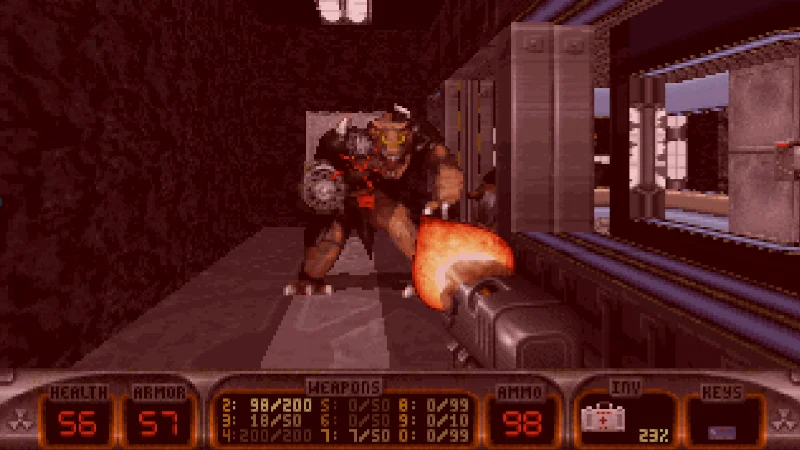
In the annals of gaming history, few titles possess the enduring, irreverent legacy of Duke Nukem 3D. Released in 1996 by 3D Realms, it served as a defiant, wisecracking response to the stoic, demon-slaying intensity of id Software’s DOOM. Now, nearly three decades after its debut, the legendary shooter has found a new, unlikely home. Developer [PicoPlus-devel] has successfully ported the engine to the Raspberry Pi RP2350 microcontroller, proving that the cutting-edge hardware of the mid-90s can now be comfortably contained within a chip the size of a fingernail.
The Evolution of the 90s First-Person Shooter
To understand the magnitude of this achievement, one must first appreciate the rapid, breakneck pace of technological advancement during the 1990s. When id Software unleashed DOOM in 1993, the gaming industry was forever altered. It was the "Big Bang" of the first-person shooter (FPS) genre, demanding a 386 processor and a modest 4 MB of RAM. It was a game designed to run on the ISA bus architecture, utilizing basic VGA graphics that, while revolutionary at the time, were relatively primitive by later standards.
However, the three-year gap between DOOM and Duke Nukem 3D was an eternity in terms of computing history. By 1996, the industry had shifted gears. Duke Nukem 3D utilized the Build engine, which introduced features that DOOM could only dream of, such as room-over-room architecture, sloped surfaces, and interactive environments. To run Duke Nukem 3D at the time, a gamer needed at least a 486DX2 processor and 8 MB of RAM—a significant leap in requirements. The game moved beyond the simple, flat-plane constraints of its predecessor, pushing the hardware toward the requirements of later titans like Quake.
Running a game that once required a substantial desktop tower on a modern microcontroller is not merely a novelty; it is a testament to the immense efficiency of modern embedded systems and the relentless ingenuity of the open-source community.
Chronology: From the Build Engine to the Pico
The journey of Duke Nukem 3D from the PC to the RP2350 did not happen in a vacuum. It follows a long lineage of "portability projects" that seek to push the boundaries of low-power hardware.
- 1996: Duke Nukem 3D is released by 3D Realms, utilizing Ken Silverman’s Build engine. It becomes an instant cultural phenomenon, cemented by its protagonist’s sharp-tongued humor and the game’s innovative level design.
- 2003: 3D Realms releases the source code for the Build engine, allowing enthusiasts to begin the long process of reverse-engineering and optimizing the game for non-PC platforms.
- 2021: The Raspberry Pi Pico (RP2040) is released. Almost immediately, the maker community begins testing its limits, porting classic games like DOOM and Wolfenstein 3D.
- 2024: The release of the RP2350, the successor to the original Pico, introduces a higher clock speed, more memory, and improved architecture.
- Late 2024: [PicoPlus-devel] releases
pico-duke3D. This project utilizes the RP2350’s enhanced capabilities to handle the increased complexity of the Build engine, successfully bringing Duke Nukem 3D to a DVI-equipped Pico clone.
Supporting Data: Why the RP2350 Matters
The RP2350 represents a significant milestone in microcontroller technology. Unlike its predecessor, the RP2040, the 2350 features dual-core ARM Cortex-M33 processors, which provide the necessary overhead to manage the complex calculations required by the Build engine.
Hardware Specifications Comparison
| Metric | 1996 PC Minimum | Raspberry Pi RP2350 |
|---|---|---|
| CPU | 486DX2 (approx. 66MHz) | Dual-core ARM Cortex-M33 @ 150MHz |
| RAM | 8 MB | 520 KB internal SRAM + external PSRAM support |
| Storage | HDD (approx. 20MB install) | Flash Memory (External) |
| Graphics | VESA/PCI Graphics Card | DVI Output via Bit-banging/PIO |
The RP2350’s ability to output via DVI is the "secret sauce" of this project. By utilizing the Pico’s Programmable I/O (PIO) blocks, the developer was able to generate a video signal that is compatible with modern displays, effectively bypassing the need for bulky, legacy VGA hardware. The controller support—which extends to both Super Nintendo Entertainment System (SNES) controllers and modern USB peripherals—transforms this into a compact, dedicated "Duke Nukem console."
Official Responses and Developer Insights
While 3D Realms has not released a formal statement regarding this specific port, the project has been met with widespread acclaim within the hobbyist and developer communities. The open-source nature of the Duke Nukem 3D source code release has always been a point of pride for the company, and the fact that it continues to find new life on platforms that didn’t exist when the game was born is a point of pride for the original creators.
In technical forums, the developer [PicoPlus-devel] has noted that the port relies heavily on optimizing the Build engine’s rendering pipeline. Because the RP2350 lacks a dedicated GPU, the heavy lifting of rendering sprites and floor textures must be performed in software by the Cortex-M33 cores. This requires meticulous management of the cache and memory bandwidth to ensure a stable frame rate, even during the game’s more chaotic firefights.
The Implications: A New Era for Embedded Retro-Gaming
The success of pico-duke3D has significant implications for the future of retro-computing. It signals that we have reached a point where the distinction between "embedded system" and "gaming console" is becoming increasingly blurred.
1. The Preservation of Gaming History
As physical hardware from the 90s continues to degrade (suffering from capacitor leakage and failing hard drives), these microcontroller-based ports offer a form of "digital taxidermy." They allow the software to survive on modern, readily available, and inexpensive silicon.
2. Educational Potential
Projects like this serve as a masterclass in computer science. They require developers to understand memory management, hardware interrupt handling, and graphics rendering at a level that high-level application development rarely demands. For students and aspiring engineers, the pico-duke3D codebase is a treasure trove of optimization techniques.
3. The Future of "Micro-consoles"
With the RP2350, we are seeing the birth of a new category of homebrew consoles. The ability to play full-featured, complex games on a device that draws less than a watt of power is an incredible feat of engineering. One has to wonder: if Duke Nukem 3D is possible, what is the next frontier? As hinted by the developer, Shadow Warrior—a game built on an even more advanced version of the Build engine—seems like the logical next step.
Conclusion
The port of Duke Nukem 3D to the RP2350 is more than just a clever technical exercise. It is a bridge between the wild, experimental days of the mid-90s PC industry and the streamlined, ultra-efficient era of modern microcontrollers. It reminds us that when you strip away the massive operating systems and bloated software stacks of modern computing, you are left with the raw, exhilarating fun of the game itself.
As we look toward the future, one thing remains clear: whether it’s on a 486DX2 or a dual-core Cortex-M33, Duke Nukem will always have a place on our screens. "Hail to the king, baby"—and long may he reign on the RP2350.