AWS Launches "Continuum": A New Era of Automated Code Vulnerability Remediation and Threat Context
SEATTLE — In an era where malicious actors leverage artificial intelligence to transform public vulnerability disclosures into weaponized exploit code within minutes, enterprise security teams face an unprecedented deluge of alerts. Modern application scanners frequently flood security operations centers (SOCs) with thousands of daily notifications, the vast majority of which prove to be unreachable, unexploitable, or already neutralized by existing runtime controls.
To combat this "alert fatigue" and bridge the dangerous latency gap between vulnerability discovery and patch deployment, Amazon Web Services (AWS) has officially announced the general availability of AWS Continuum for code vulnerabilities.
Designed to fundamentally transform how organizations detect, prioritize, and remediate software flaws, AWS Continuum moves beyond traditional static scanning. By intelligently synthesizing context from code repositories and live cloud infrastructure, the service automatically validates exploitability, ranks issues by true business impact, and delivers ready-to-merge remediation patches directly to engineering teams.
Main Facts: What is AWS Continuum?
AWS Continuum is an advanced, automated cloud security service engineered to identify, verify, and resolve application code vulnerabilities. Unlike traditional vulnerability management tools that rely exclusively on generic CVSS (Common Vulnerability Scoring System) severity ratings, Continuum introduces a context-driven validation engine.
The core capabilities of the service include:
- Automated Exploit Verification: Continuum goes beyond theoretical risk by testing whether a finding is actually exploitable in the target environment, utilizing static analysis and isolated sandbox reproduction.
- Context Graph Mapping: By aggregating data from code repositories (such as GitHub or Amazon S3) and live AWS resource configurations (via AWS Config and network topology), the service builds a holistic relationship map of the application estate.
- Business Impact Ranking: Issues are prioritized based on how close their attack paths run to high-value corporate assets, such as customer databases, payment processing pipelines, and authentication backends.
- Automated Pull Request Generation: For confirmed vulnerabilities, Continuum generates targeted code patches, dependency upgrades, or configuration adjustments, delivering them straight to connected repositories as pull requests.
- Human-in-the-Loop Governance: Every remediation requires explicit human authorization. Engineers review and merge patches, ensuring that development teams retain absolute control over code changes while drastically reducing manual investigation overhead.
At launch, AWS Continuum for code vulnerabilities is available immediately in the US East (N. Virginia) and US West (Oregon) AWS Regions.

Chronology: The Evolution of Cloud Vulnerability Management
The journey toward automated, context-aware remediation has accelerated rapidly over the last several years, driven by the weaponization of software development life cycles (SDLC) by threat actors.
- The Era of Static Analysis (Late 2000s–2010s): Organizations relied heavily on Static Application Security Testing (SAST) and Software Composition Analysis (SCA) tools. While effective at finding syntax and dependency issues, these tools generated massive volumes of false positives, lacking any awareness of whether code was actually exposed to a network.
- The Rise of Cloud-Native Security (2018–2023): Cloud Security Posture Management (CSPM) and Cloud Workload Protection Platforms (CWPP) emerged to monitor cloud environments. However, a persistent silo remained between application-layer findings (code) and infrastructure-layer realities (runtime and networking).
- The Generative AI Threat Multiplier (2023–2025): The proliferation of frontier AI models changed the threat landscape entirely. Bad actors began using AI to automate the conversion of Common Vulnerabilities and Exposures (CVE) write-ups into active, scalable exploit code in minutes. Security teams found themselves structurally outpaced.
- October 2026 — The Launch of AWS Continuum: Recognizing that traditional, manual triage processes were failing under the weight of AI-driven threats, AWS engineered Continuum. By uniting code repositories and live AWS resource configurations into a unified context graph, AWS bridged the gap between vulnerability identification and verified remediation.
Supporting Data: The Mechanics of Context and Risk Assessment
The defining characteristic of AWS Continuum is its ability to replace generic severity scores with empirical evidence. Traditional tools might rate a vulnerability in an isolated developer utility and a core payment microservice identically if both share the same underlying software library. Continuum shatters this ambiguity through rigorous data collection and behavioral analysis.
The Context Graph Architecture
To operate effectively, Continuum constructs a dynamic context graph derived from two primary data streams:
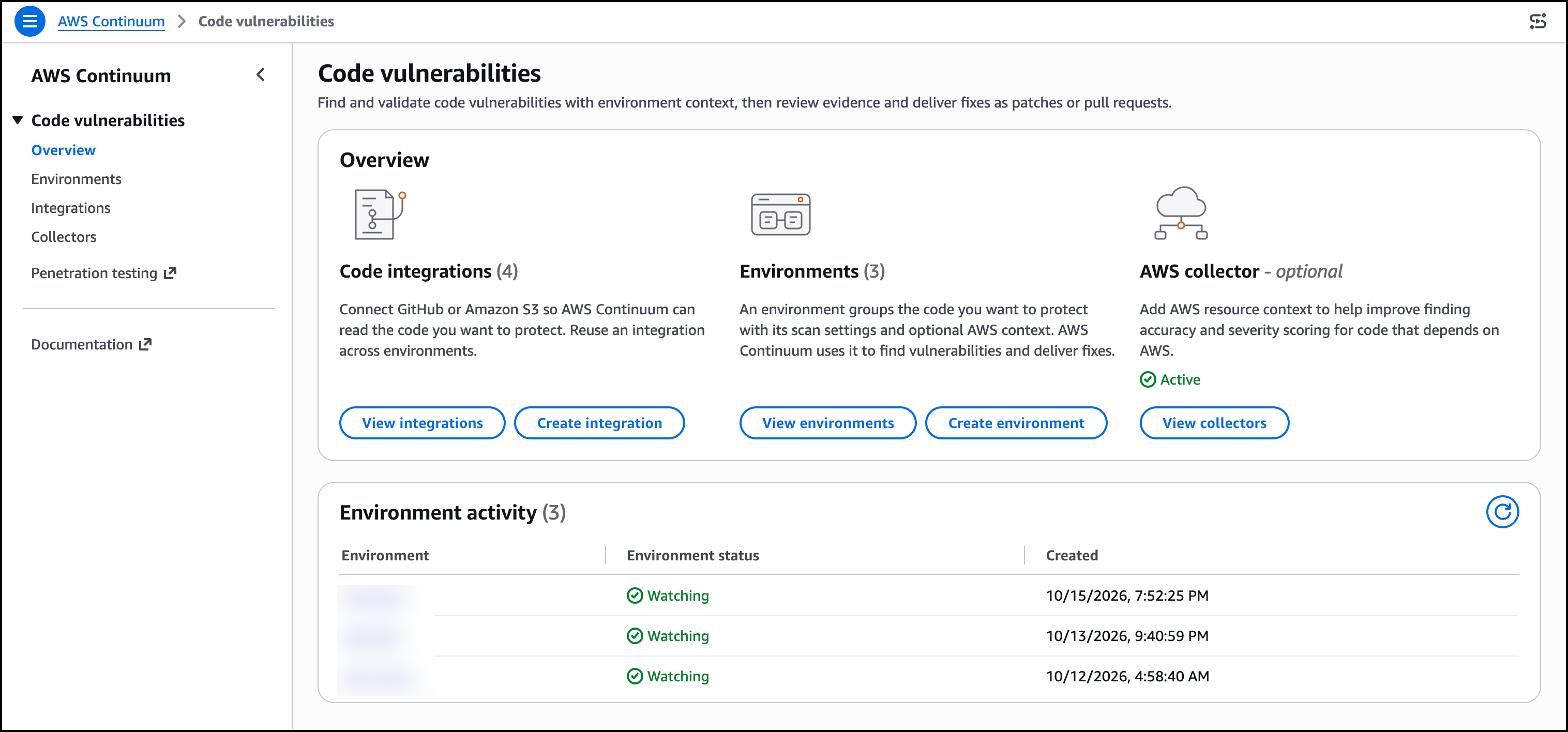
- Code Repositories: Integrated via GitHub or Amazon S3 buckets, providing deep visibility into source code, application logic, and dependency trees.
- AWS Infrastructure Collectors: Deployed within specific AWS accounts and Regions, these collectors poll AWS Config and network routing configurations to map out active resources, security groups, and ingress/egress points.
By combining these streams, the service answers critical security questions instantly: Is this service reachable over the public internet? Does it require authentication? What downstream databases or payment pipelines can an attacker reach if this component is compromised?
Evidence Levels and Verdicts
When Continuum analyzes a finding, it assigns a granular evidence level. If an issue is reproducible, the service executes the exploit within an isolated sandbox environment, generating concrete proof-of-concept code, reproduction steps, and an explicit attack path.
The evaluation framework assesses three primary pillars:
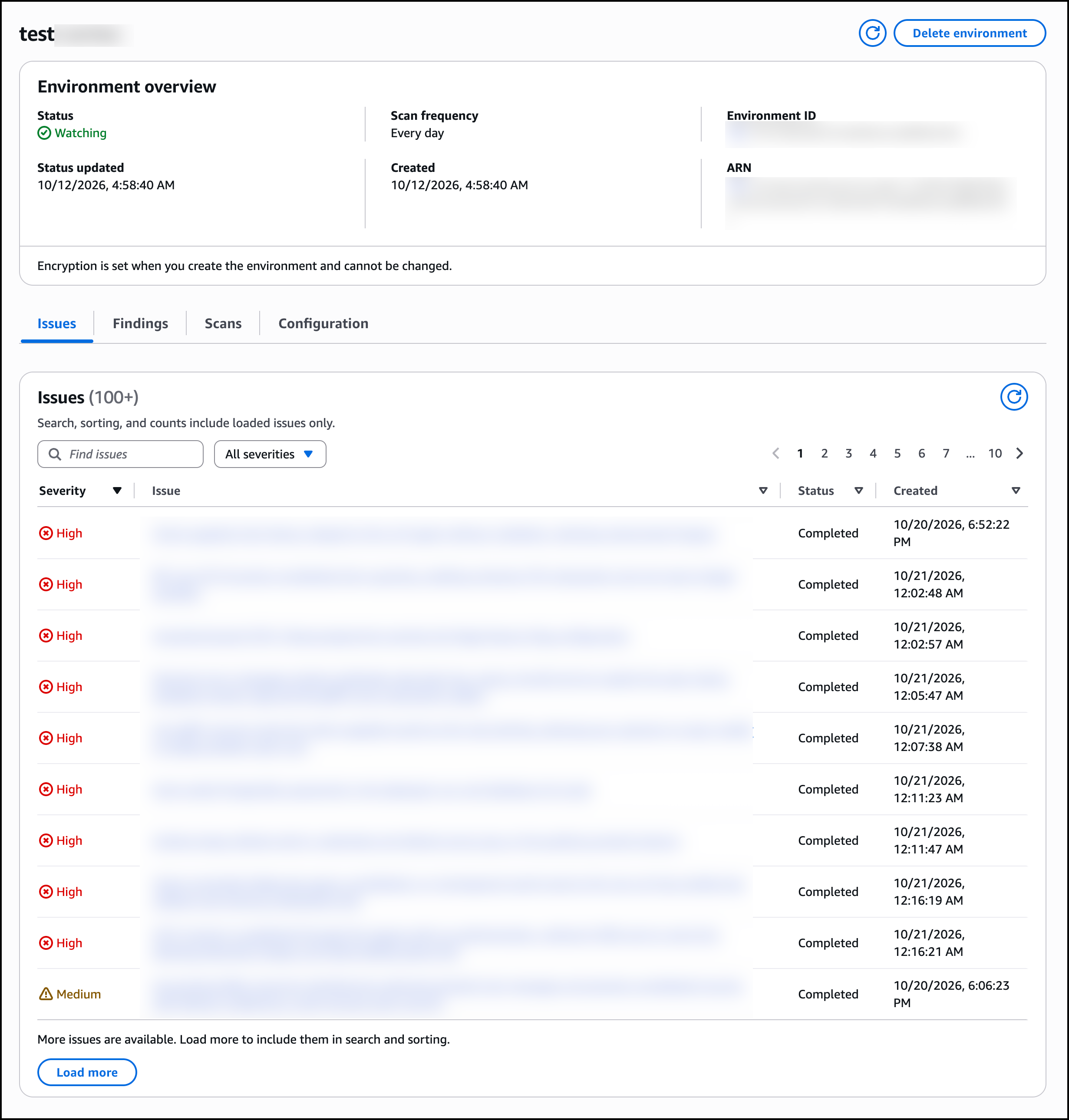
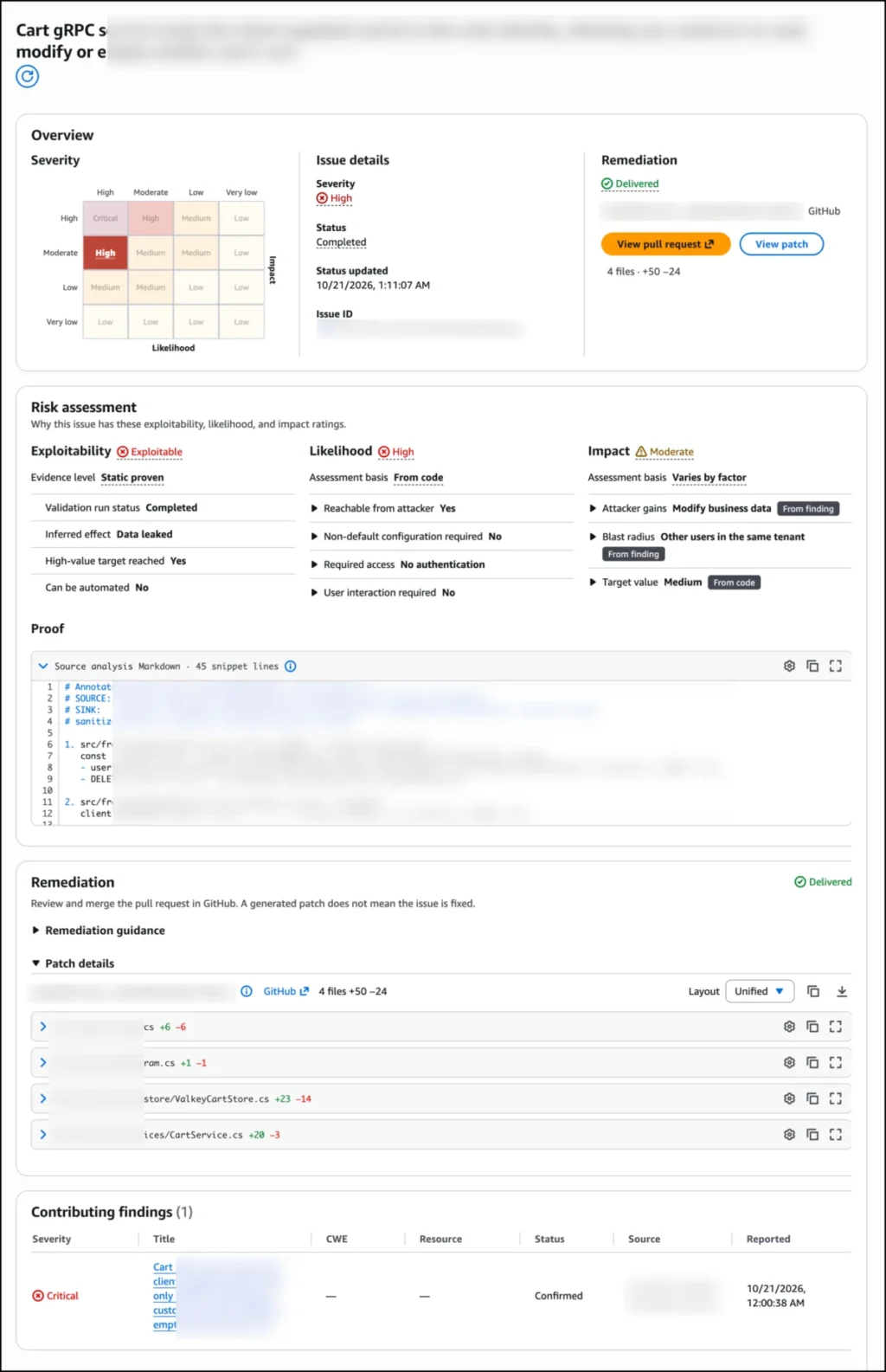
- Exploitability: Evaluated via static proven analysis and sandbox execution validation.
- Likelihood: Measured by network reachability, authentication requirements, and user interaction dependencies.
- Impact: Determined by potential data modification capabilities and the blast radius across tenant boundaries.
Streamlined Remediation Workflow
Through the AWS Management Console, security professionals can monitor their environment health via a centralized Overview dashboard. The workflow transitions seamlessly from raw scanner data to validated issues:
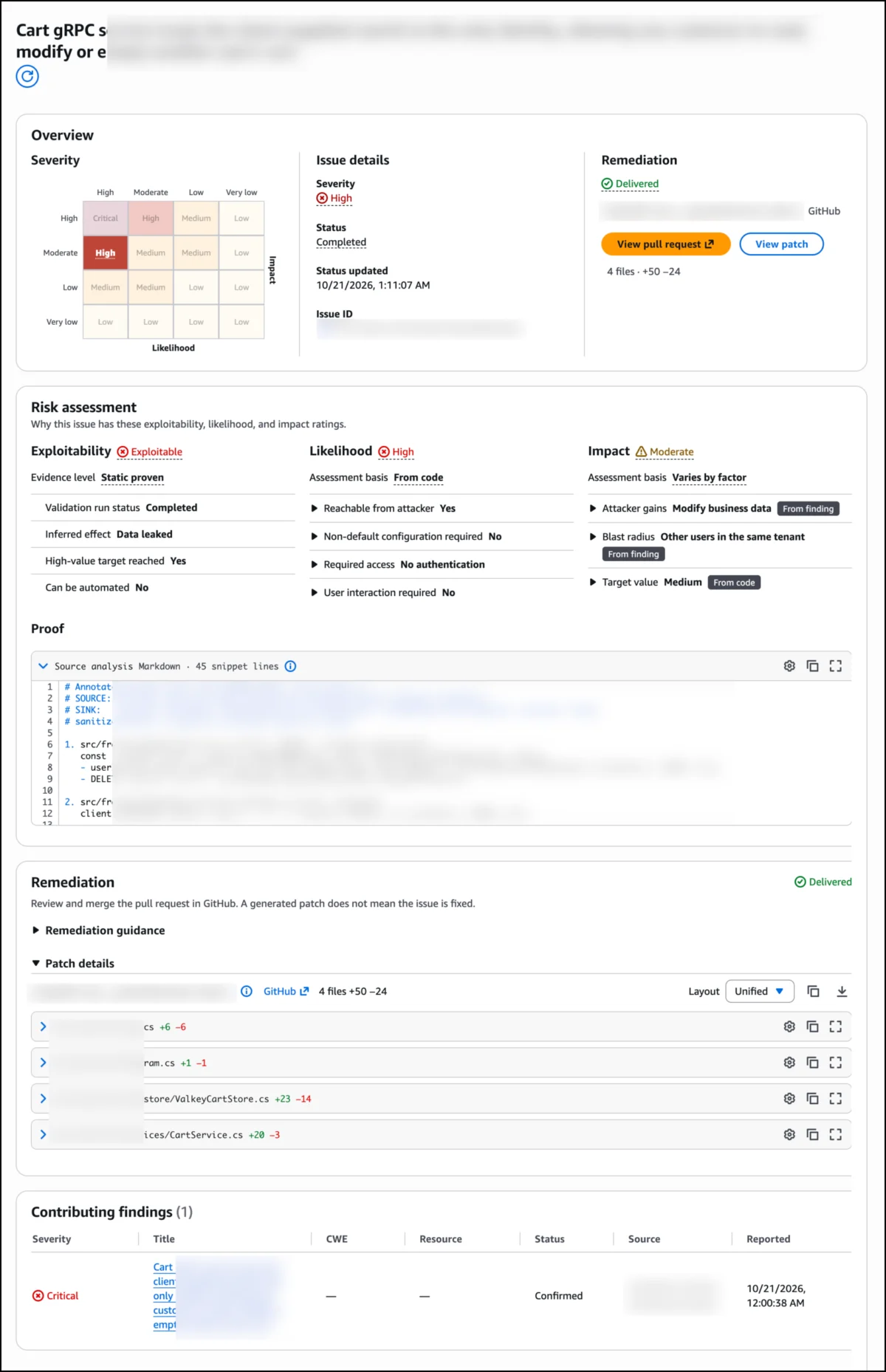
- The Issues Tab: Displays prioritized, high-confidence vulnerabilities with clear exploit status badges (e.g., "Exploitable," "Static proven").
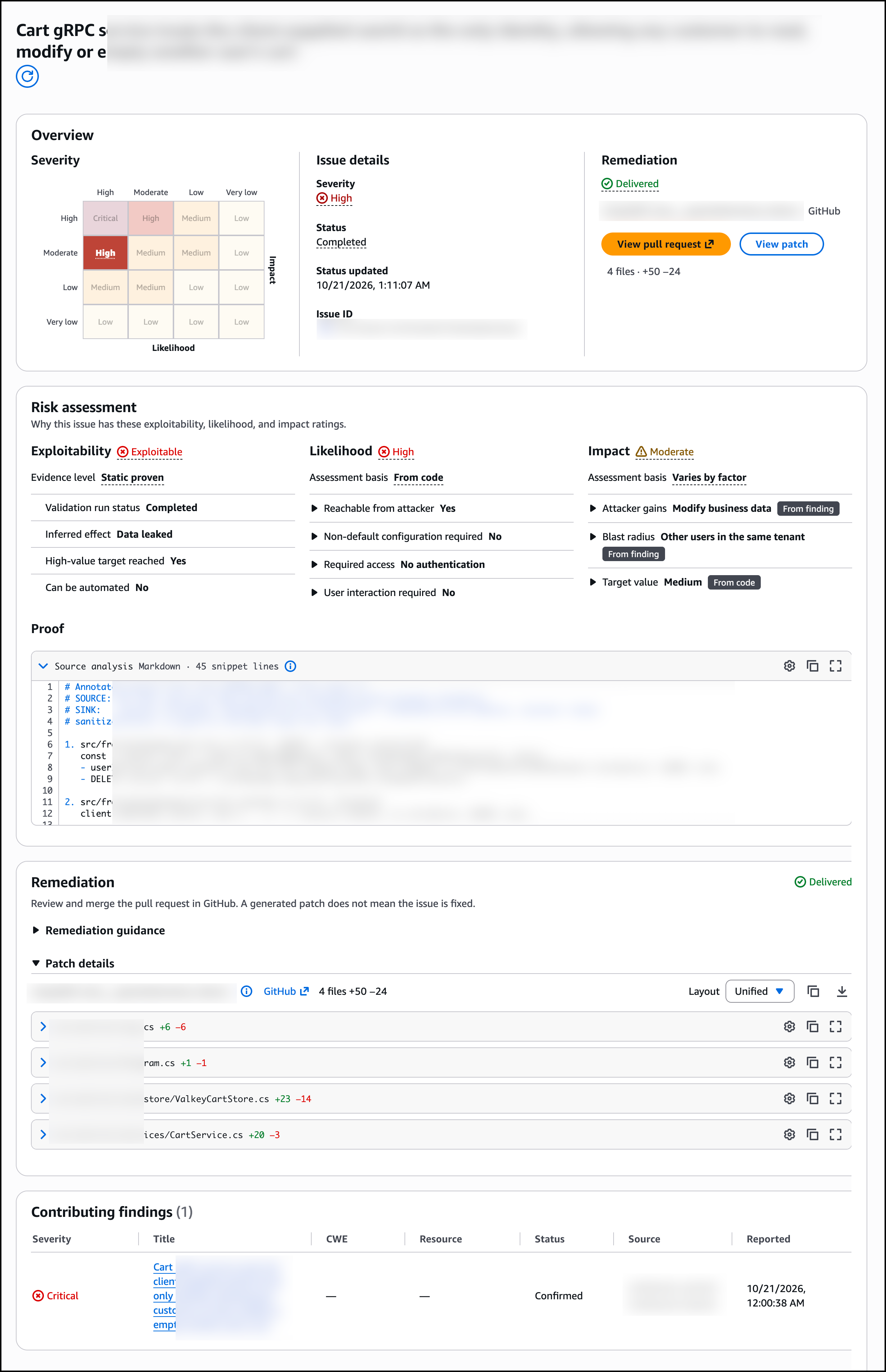
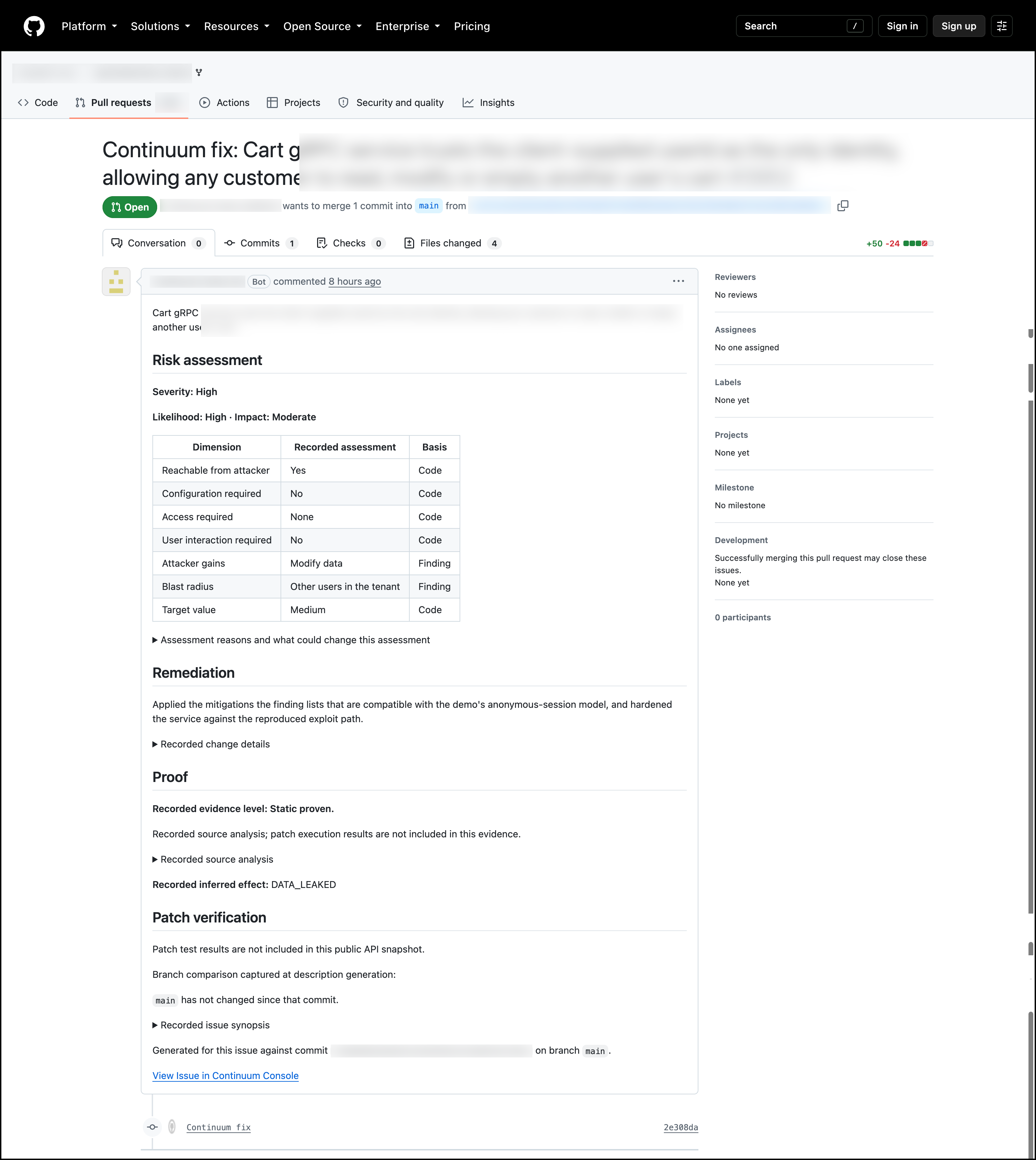
- The Remediation Section: Details the precise modifications made—such as altering 50 lines across four files in a microservice cart dependency—and opens a standardized pull request titled "Continuum fix" in GitHub.
- Workflow Integrity: The pull request description mirrors the rich risk assessment, evidence trail, and proof gathered in the AWS console, allowing reviewers to evaluate the patch directly within their native developer workflows without context-switching.
Official Responses and Strategic Vision
AWS leadership emphasizes that the philosophy behind Continuum is not to replace human engineering judgment, but to empower security and development teams with actionable intelligence that eliminates administrative friction.
"In the past, confirming whether a finding was exploitable took hours of manual investigation, and shipping a fix with confidence took days of coordination across security, infrastructure, and application teams," noted product representatives during the service rollout. "The blast radius of a change is notoriously hard to assess without deep business context. Continuum closes that gap by proving exploitability upfront and bounding the risk of every proposed fix."
While the service currently operates strictly in a human-approved mode—where every patch requires manual review and merging by a developer—AWS has signaled a clear roadmap toward fully autonomous remediation. In future updates, organizations will be able to define custom guardrails and confidence thresholds (such as strict test coverage bounds and historical success rates) allowing Continuum to apply verified remediation classes automatically.
Industry Implications: What AWS Continuum Means for Enterprise Security
The introduction of AWS Continuum marks a philosophical pivot in cloud security: moving away from alert generation toward remediation velocity.
1. The Death of Alert Fatigue
Security operations have long suffered from diminishing returns caused by endless streams of low-priority or unreachable alerts. By filtering out noise through network and runtime reachability checks, Continuum ensures that security teams only spend cognitive energy on vulnerabilities that pose genuine, provable threats to the business.
2. Breaking Down Silos Between Dev, Sec, and Ops
Historically, security teams found vulnerabilities, operations teams worried about infrastructure stability, and developers wrote code—creating an adversarial loop during incident response. By delivering fixes as native pull requests complete with full evidentiary proof, Continuum aligns all three stakeholders around a single, objective source of truth.
3. Redefining Compliance and Audit Readiness
With comprehensive audit trails, automated blast radius assessments, and transparent proof-of-concept validation logs tied directly to code repositories, enterprises gain an unprecedented level of defensibility. Auditors can see not only when a vulnerability was identified, but exactly how its exploitability was proven and how the resulting patch was governed.
Outlook and Next Steps
As generative AI continues to accelerate the velocity of cyberattacks, tools like AWS Continuum represent the necessary evolution of defensive engineering. Organizations operating within the supported US East (N. Virginia) and US West (Oregon) Regions can begin onboarding their GitHub and Amazon S3 code sources via the AWS Continuum console today. Comprehensive implementation guides, pricing structures, and user manuals are currently available through the official AWS documentation portal.