A New Era for Rust: The Next-Generation Trait Solver Enters Nightly
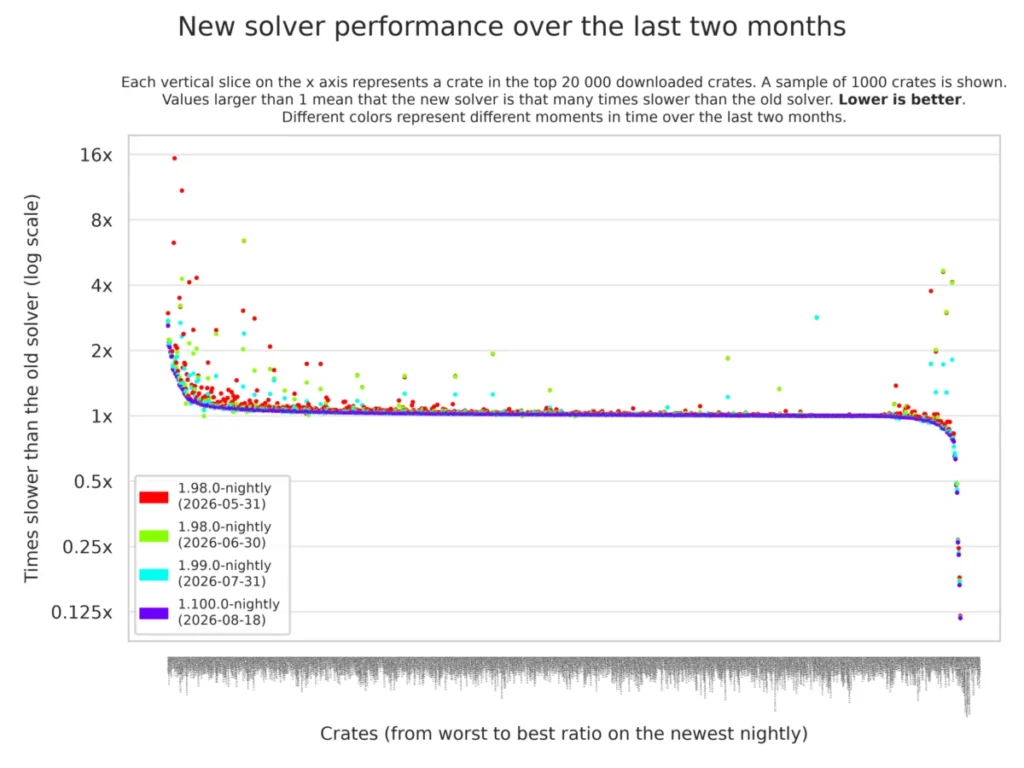
After nearly four years of intensive research, architectural redesign, and rigorous testing, the Rust compiler team has reached a pivotal milestone. The "next-generation trait solver"—the most significant internal change to the Rust compiler since its initial release—is now enabled by default in the nightly channel. This transition marks the beginning of the final push toward full stabilization, scheduled for the coming months.
This massive undertaking is not merely an incremental update; it is a fundamental re-engineering of the language’s core logic. By replacing the legacy system used to prove where-clauses and normalize associated types, the compiler team is setting the stage for a more performant, sound, and feature-rich future for the Rust ecosystem.
The Core Transformation: Why Now?
At its heart, Rust’s trait system is the engine that powers the language’s type-checking capabilities. It dictates how the compiler verifies that types conform to expected behaviors. The existing solver, while functional for many years, had become a victim of its own success. As the language evolved, the limitations of the original implementation created "technical debt," making it increasingly difficult to implement modern features or patch long-standing soundness issues.
The next-generation solver represents a complete ground-up rewrite. It changes the way the compiler handles opaque types—such as return-position impl Trait (RPIT)—and clears the path for long-awaited features like Type Alias Impl Trait (TAIT) and Return Type Notation (RTN). By removing the constraints of the old implementation, the team can finally address subtle, deep-seated bugs in the type system that have remained out of reach for years.
A Chronology of Development
The journey to this point has been a marathon of engineering. The project, tracked under the umbrella of the Rust project goals, began as a research effort to solve the "coherence" and "soundness" problems that occasionally plagued complex generic code.
- 2021–2022: Initial prototyping began, focusing on modularizing the trait solver. The team realized that the existing codebase was too tightly coupled with other compiler components to be easily refactored.
- 2023: The project gained momentum as the team began formalizing the "next-solver" architecture. During this phase, the primary focus was on correctness and ensuring that the new solver could handle the complex edge cases that the legacy system struggled with.
- 2024: The team began integrating the solver into the nightly builds, albeit behind an experimental flag. Thousands of tests were run to ensure that the transition wouldn’t break the vast ecosystem of crates hosted on crates.io.
- 2025: A massive focus on compile-time performance optimization took center stage. The team, including contributors like Nick Nethercote and Jana, spent months profiling the compiler to ensure that the new solver wouldn’t result in unacceptable slowdowns.
- 2026 (Present): The solver is now enabled by default on nightly, signaling that it is feature-complete and ready for widespread community testing.
Supporting Data: Performance and Correctness
One of the primary concerns during the development of a core compiler component is performance. A new solver that provides more features but doubles compile times would be a non-starter for the Rust community.
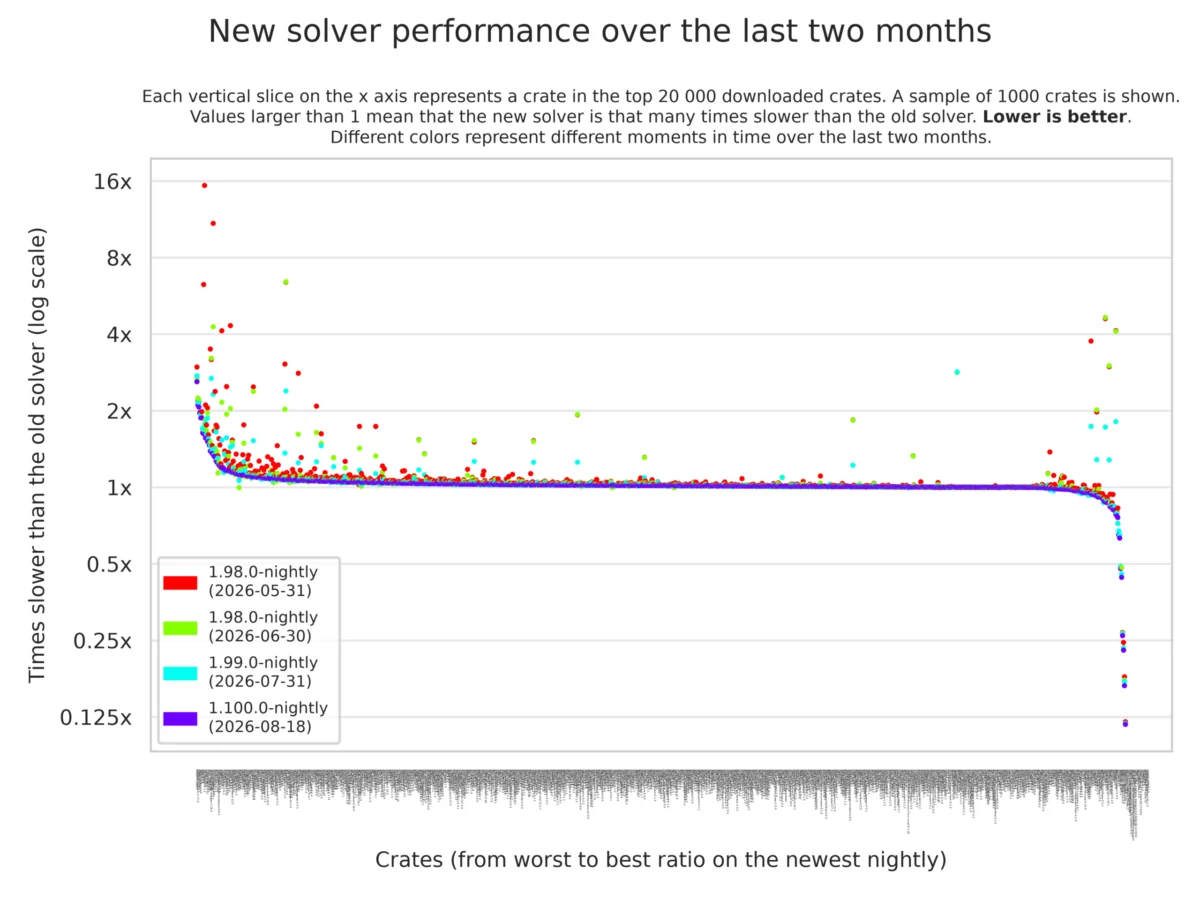
To mitigate this, the team performed extensive benchmarking. Rèmy Rakic led an effort to analyze the impact on the top 20,000 crates on crates.io. The results were telling: while initial iterations of the new solver showed performance regressions in specific edge cases, iterative optimization has brought the vast majority of the ecosystem to a performance profile nearly identical to the legacy system.
In fact, the results are often surprising. For certain trait-heavy workloads, the new solver is not just comparable—it is superior. A notable example is the datafusion crate, which compiles over eight times faster with the new solver. Furthermore, the new solver is capable of handling code that previously caused the compiler to hang, such as a famous implementation of "Chess in the type system," which now resolves in under a minute.
Official Responses and Developer Guidelines
The Rust compiler team is keenly aware that a change of this magnitude will cause breakage. Because the new solver is more correct and consistent, it may reject code that relied on "accidental" behaviors or loopholes in the old system.

How to Participate
The team is calling on the community to test their existing projects and libraries using rustup update nightly. If developers encounter issues, they are encouraged to check the official pinned GitHub issue to see if the regression has already been documented. If it is a new issue, a formal bug report is requested.
For projects that require a temporary reprieve, the new solver can be disabled by passing the -Znext-solver=coherence flag via RUSTFLAGS or by configuring the project’s .cargo/config.toml file:
[build]
rustflags = ["-Znext-solver=coherence"]
The team has explicitly stated that they have not yet spent significant time on error message ergonomics for the new solver. As such, they are soliciting feedback on "poor diagnostics," which will be a key area of focus as the release date approaches.
Implications for the Future of Rust
The stabilization of the next-generation trait solver is a prerequisite for several high-impact features.
Unlocking New Language Features
The current solver’s handling of opaque types has been a significant hurdle for Type Alias Impl Trait (TAIT) and Return Type Notation (RTN). With the new solver, these features can finally be moved toward stabilization, giving developers more power to express complex abstractions without hitting the walls of the current type system.
Fixing Unsoundness
One of the most exciting aspects of this change is the ability to fix remaining "type system unsoundnesses." These are bugs where the compiler might incorrectly allow code that should be invalid, potentially leading to memory safety issues or undefined behavior in edge cases. By creating a more robust, mathematically sound foundation, the team is reinforcing the core promise of Rust: memory safety through a rigorous type system.
Implicit Trait Bounds
The new solver also paves the way for new implicit default trait bounds, such as the Move and Forget traits. These will provide finer-grained control over how types are moved or dropped, allowing for better performance in systems-level code and more expressive ownership semantics.
Conclusion
The transition to the next-generation trait solver is a testament to the maturity of the Rust project. It demonstrates a commitment to long-term stability and architectural health over the "easy" path of short-term fixes. While the next few months will involve a concerted effort to polish the compiler and ensure a smooth migration, the long-term payoff—a faster, more consistent, and more powerful Rust—is undeniable.
As the community steps up to test this new infrastructure, they aren’t just hunting bugs; they are helping to finalize the bedrock upon which the next generation of Rust software will be built. The future of the language is here, and it is more robust than ever.