Accelerating the Cloud: AWS Launches CloudFormation Express Mode to Revolutionize Infrastructure Deployment
In a move set to transform the developer experience and optimize infrastructure management, Amazon Web Services (AWS) has officially announced the launch of AWS CloudFormation Express mode. This significant enhancement to the industry-standard Infrastructure as Code (IaC) service is designed to drastically reduce deployment times by eliminating the mandatory waiting periods associated with resource stabilization checks. By prioritizing rapid feedback loops, AWS is positioning this feature as an essential tool for both iterative development and high-velocity production workflows.
The Core Innovation: Speed Through Asynchronous Stabilization
For over a decade, AWS CloudFormation has served as the backbone for declarative infrastructure management. Historically, the service has operated with a "safety-first" approach: once a resource configuration is applied, CloudFormation enters a stabilization phase. During this time, the service monitors the infrastructure to ensure that resources are fully operational and ready to serve traffic before marking the deployment as successful. While this is critical for production stability, it often creates a bottleneck for developers iterating on code or testing architectural changes.
Express mode fundamentally changes this paradigm. Instead of holding the deployment process hostage to stabilization checks, Express mode signals the completion of a stack operation the moment the resource configuration is successfully applied. The actual stabilization happens in the background, allowing the developer to move to the next task immediately.
Why This Matters for Modern Development
The modern software development lifecycle (SDLC) is increasingly defined by speed. Whether it is a solo engineer prototyping a serverless microservice or a large-scale AI tool generating infrastructure, the time between "code change" and "deployment success" is the most significant constraint on velocity. By reducing deployment times by up to four times, AWS is effectively enabling developers to iterate faster, test more frequently, and receive almost sub-minute feedback on their infrastructure changes.
Chronology and Evolution of Cloud Deployment
To understand the magnitude of this update, one must look at the evolution of CloudFormation.
- The Early Days: Initially, CloudFormation focused on the reliable, repeatable creation of resources. The primary goal was to ensure that a stack deployment would result in a predictable state.
- The Era of Complexity: As cloud architectures grew more complex—incorporating nested stacks, cross-stack references, and complex dependencies—the stabilization checks became increasingly time-consuming, sometimes taking several minutes for seemingly minor changes.
- The AI and IaC Acceleration: With the rise of AI-assisted infrastructure generation and advanced CI/CD pipelines, the "wait time" became a major pain point. Developers using tools like the AWS Cloud Development Kit (CDK) or AI agents were being slowed down by the very system designed to help them.
- The Present: The introduction of Express mode represents the shift from a purely reliable deployment engine to a high-performance, developer-centric orchestration tool. It acknowledges that not every deployment requires an immediate confirmation of health, particularly in development and testing environments.
Supporting Data: Benchmarking the Efficiency Gains
The impact of Express mode on performance is significant, as evidenced by initial internal benchmarking provided by AWS. The differences between "Standard" mode and "Express" mode are stark, particularly in operations involving complex resource management.
Performance Case Studies
-
Amazon Simple Queue Service (SQS) Deployment:
- Standard Mode: 64 seconds.
- Express Mode: Up to 10 seconds.
- Result: An 84% reduction in deployment time.
-
AWS Lambda Function Deletion:
- Standard Mode: 20–30 minutes (due to the complexities of network interface detachment).
- Express Mode: Up to 10 seconds.
- Result: A near-instantaneous completion compared to the previous, lengthy wait times.
These metrics demonstrate that Express mode is not merely an incremental improvement; it is a fundamental shift in how the control plane handles infrastructure provisioning. By offloading the "wait" to the background, the service frees up the developer’s local terminal or CI/CD runner, allowing for a more fluid development experience.
Official Guidance: Implementing Express Mode
AWS has integrated Express mode directly into the existing CloudFormation ecosystem. It is designed to be backwards compatible with all existing templates, meaning no structural changes are required to reap the benefits.
Getting Started
Developers can enable Express mode through three primary channels:
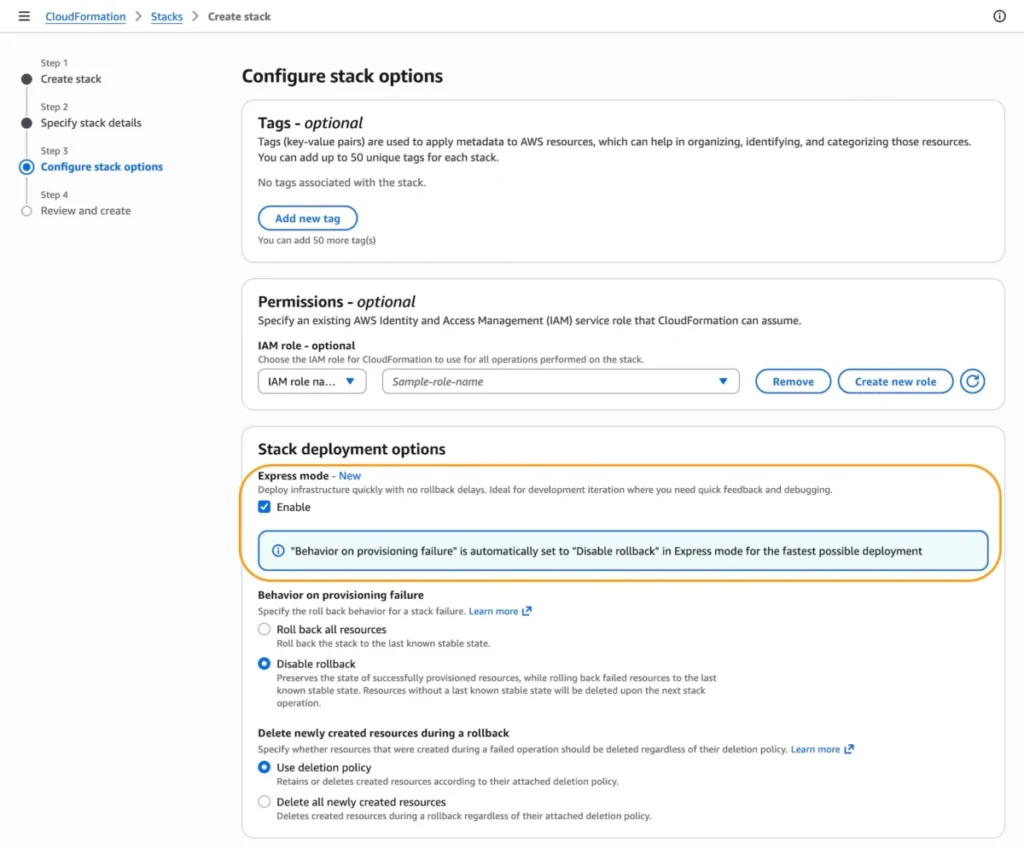
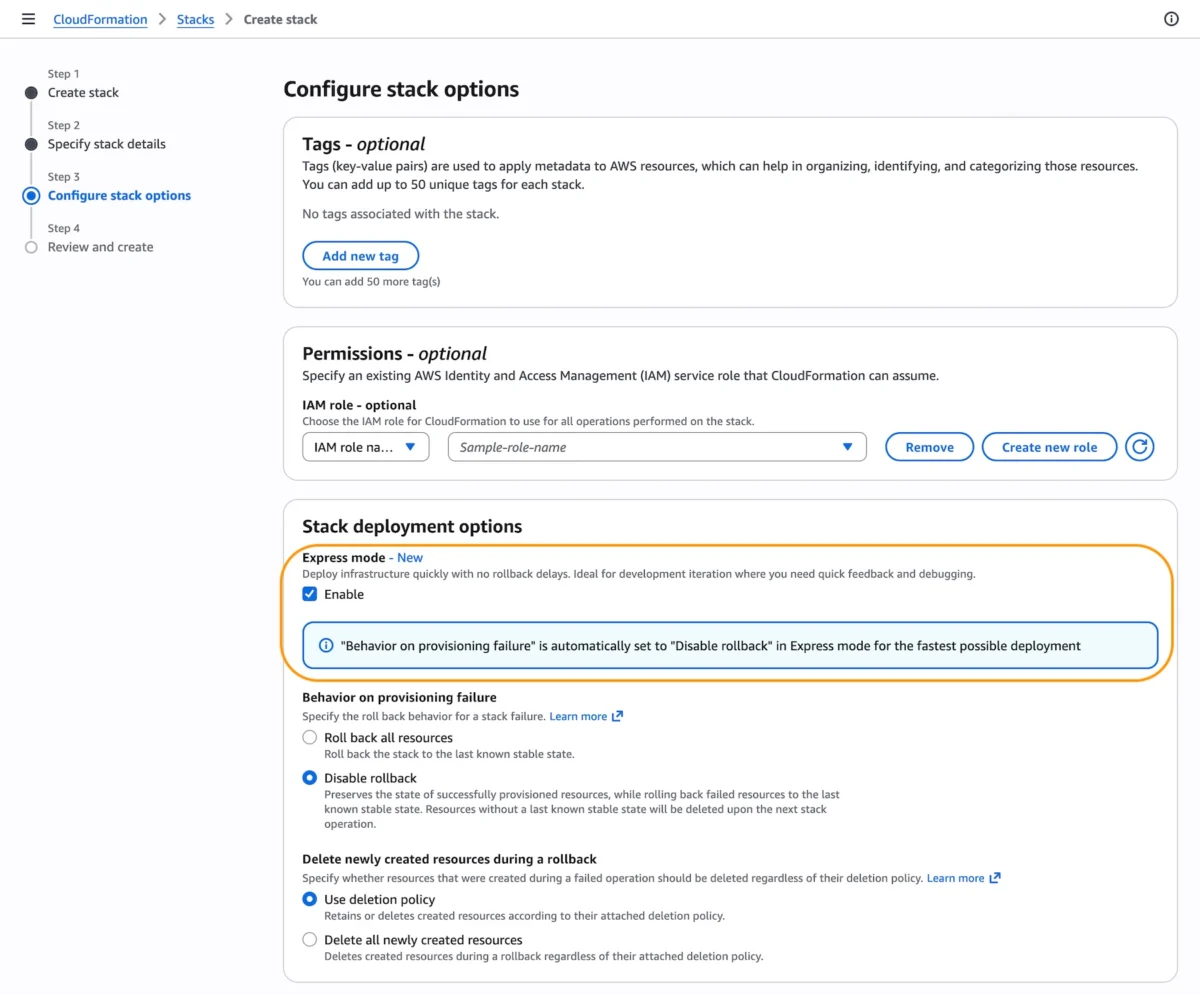
- AWS Management Console: When initiating a stack creation or update, a new "Stack deployment options" section allows users to toggle "Express mode."
- AWS Command Line Interface (CLI): By utilizing the
--deployment-configparameter, users can set the mode toEXPRESS. - Infrastructure as Code (IaC) Frameworks: Tools like AWS CDK now support the
--expressflag, which automatically configures the deployment to bypass the stabilization checks.
A Note on Safety and Rollbacks
One of the most important aspects of Express mode is its default behavior regarding failure handling. To maximize speed, Express mode disables automatic rollbacks by default. This is an intentional design choice for iterative development where the developer is likely to fix the error and redeploy immediately. However, for production scenarios, AWS recommends setting disableRollback to false to ensure that failures are handled with the traditional robustness that enterprise users expect.
Implications for the Industry
The introduction of CloudFormation Express mode has profound implications for the broader cloud ecosystem.
1. The Rise of "AI-Driven" Infrastructure
As AI agents become more prevalent in infrastructure engineering, the demand for fast, asynchronous feedback is paramount. An AI agent trying to "learn" the optimal infrastructure configuration for a high-load service will be far more effective if it can receive feedback in seconds rather than minutes. Express mode provides the infrastructure "runtime" that these agents need to optimize, test, and refine configurations at scale.

2. Enhanced Developer Productivity
The "waiting for deployment" phase is a notorious source of context-switching. A developer who is forced to wait two minutes for a stack to update often switches to another task, only to lose focus on the original problem. By trimming these wait times to under 10 seconds, AWS is helping to maintain "flow state," which is arguably the most valuable asset in engineering.
3. Cost and Complexity Reduction
While Express mode is available at no additional cost, the indirect savings are significant. Faster CI/CD pipelines mean shorter execution times on build runners, which in turn reduces the compute costs associated with running those pipelines. Furthermore, the built-in resilience of Express mode—which automatically retries transient failures during provisioning—reduces the manual intervention required to fix "flaky" deployments, thereby decreasing operational overhead.
4. A New Standard for Infrastructure Reliability
Critics might argue that bypassing stabilization checks introduces risk. However, AWS has carefully designed Express mode to ensure that while the feedback is faster, the provisioning remains reliable. The system continues to handle transient failures in the background. This suggests a maturing of the cloud model: we are moving away from the need for synchronous hand-holding in every single deployment, toward a model of "eventual consistency" in infrastructure state.
Conclusion: The Future of CloudFormation
The launch of AWS CloudFormation Express mode is a clear signal that AWS is listening to the needs of the modern, fast-paced development community. By decoupling the deployment completion signal from the stabilization process, AWS has removed a long-standing friction point in the IaC workflow.
As teams continue to adopt microservices, serverless architectures, and AI-assisted development, tools that prioritize speed without compromising on the underlying robustness of the cloud will become the new standard. Express mode is a testament to this philosophy. It is available today in all AWS commercial regions, and as adoption grows, it is likely that "Express" will become the default way that infrastructure is managed, tested, and deployed across the global AWS footprint.
For those looking to optimize their workflows, the recommendation is clear: audit your current deployment pipelines, identify the stages that are currently bottlenecked by stabilization checks, and begin integrating Express mode to reclaim your time and velocity. The era of waiting for the cloud has come to an end.