Masterclass in Quality Assurance: A Comprehensive Guide to Functional Testing Types, Techniques, and Automation Strategies
In the fast-paced ecosystem of modern software development, delivering applications that are both feature-rich and reliable is the ultimate objective. Amidst a myriad of quality assurance methodologies, functional testing remains the bedrock of software validation. Operating primarily as a black-box testing technique, functional testing confirms whether an application or system behaves precisely as expected, aligning seamlessly with pre-determined business requirements and user expectations.
This in-depth guide explores the core facets of functional testing—ranging from its distinct classifications and tactical execution methodologies to the nuances of test automation and industry best practices.
Main Facts: Deconstructing Functional Testing
At its core, functional testing is designed to verify all operational aspects of an application against system requirements. It answers a fundamental question: Does the software do what it is supposed to do?

Unlike non-functional testing, which evaluates system performance, security, and scalability, functional testing zeroes in on user actions, input validations, data manipulation, and overall business logic. It relies heavily on functional specifications or requirement documents that dictate acceptable system behavior, permissions, and business scenarios.
Core Characteristics of Functional Testing:
- Black-Box Nature: Testers do not require internal knowledge of the code structure, focusing instead on inputs and expected outputs.
- Requirements-Driven: Test scenarios are derived directly from functional specifications, user stories, and business use cases.
- User-Centric Validation: Ensures that end-users can seamlessly execute their required tasks, from logging into a portal to completing an e-commerce transaction.
Chronology: The Evolution of Testing in the Software Development Life Cycle (SDLC)
Quality assurance has evolved from an afterthought at the end of the development cycle to an integrated, continuous process within modern Agile and DevOps frameworks. Understanding where and when functional testing fits into the chronological timeline of the SDLC is vital for effective project management.
- Requirement Analysis & Test Planning: As soon as business requirements are gathered, QA teams begin conceptualizing high-level functional test scenarios and establishing entry/exit criteria.
- Unit Testing (Development Phase): Before software builds are handed over to the QA team, developers perform unit testing to validate individual code modules, functions, and paths.
- Smoke and Sanity Testing (Build Release): Upon receiving a new build, smoke tests are executed to verify build stability. Once passed, sanity testing checks vital features.
- System and Integration Testing: Once individual modules stabilize, comprehensive functional system testing and integration testing are performed to evaluate end-to-end scenarios across multiple components.
- User Acceptance & Beta Testing (Pre-Production): Finally, the product is exposed to real users or stakeholders in production-like environments to gather feedback and confirm final usability before market deployment.
Supporting Data: Classifications and Techniques of Functional Testing
Functional testing is a vast domain encompassing multiple sub-disciplines, each serving a unique purpose in certifying application stability.

Prominent Types of Functional Testing
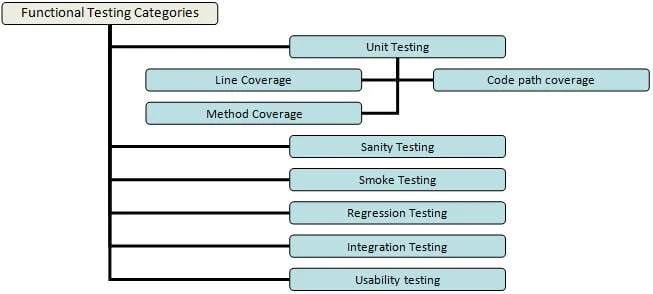
- Unit Testing: Executed primarily by developers, this involves testing individual code units or methods with specific parameters to ensure expected return values. It heavily incorporates line coverage, code path coverage, and method coverage.
- Smoke Testing: Often referred to as "build verification testing," it is a rapid suite of tests run on every new build to guarantee core stability before deep testing begins.
- Sanity Testing: Performed after a minor build release, it ensures that specific bugs have been fixed and that no immediate, major system regressions have occurred.
- Integration Testing: Validates that independently functioning modules operate cohesively when combined to execute complex, end-to-end business workflows.
- Regression Testing: Conducted whenever new code, enhancements, or bug fixes are introduced, regression tests ensure that existing functionalities remain unbroken and stable.
- System Testing: Evaluates the complete, integrated software system as a whole to verify compliance with all functional and technical requirements.
- Usability and Beta Testing: Exposes the product to actual end-users in a production-like setting to evaluate comfort, intuitiveness, and overall user experience.
Tactical Execution: Approaches and Examples
To maximize bug detection while minimizing time and cost, QA professionals employ strategic optimization techniques. Consider an online Human Resources Management System (HRMS) portal login page. The specifications dictate that a User ID must be between 6 and 10 characters long, accepting letters, numbers, and specific special characters (underscore, period, hyphen), while remaining non-blank and starting with a letter or number.
To test such a use case effectively, QA teams rely on advanced testing techniques:
- Equivalence Partitioning: Test data is divided into partitions (e.g., valid lengths between 6–10 characters versus invalid lengths exceeding 10 characters). Since data within a partition behaves identically, testing a single representative value is sufficient.
- Boundary Value Analysis (BVA): Focuses on testing the limits of input fields. For instance, testing a User ID with exactly 5 characters (below boundary) versus 6 characters (minimum boundary) ensures the system correctly handles edge cases.
- Decision-Based Testing: Evaluates system outcomes based on specific business rules—such as verifying that a correct username paired with an incorrect password triggers a specific authentication error message.
- Alternate Flow Tests: Validates secondary or alternative pathways users might take to accomplish a task aside from the primary "happy path."
- Ad-Hoc Testing: Unstructured, exploratory testing performed with the explicit mindset of "breaking" the system to uncover unforeseen discrepancies.
Official Perspectives and Industry Insights: The Automation Imperative
As software architectures grow increasingly complex, manual testing alone is often insufficient to guarantee high test coverage within tight sprint timelines. Industry experts emphasize that functional test automation is no longer a luxury, but a necessity for scaling quality assurance.

According to seasoned QA leaders, automation significantly reduces manual repetition, speeds up execution cycles, prevents bug slippage, and enhances overall test efficiency. However, experts caution against the trap of attempting to automate everything.
Best Practices for Functional Test Automation:
- Tool Selection: Organizations must choose tools that match their technical stack, budget, and team expertise. While open-source frameworks like Selenium, Sahi, Watir, and Robotium remain immensely popular, enterprise tools such as Ranorex Studio and Unified Functional Testing (UFT) offer robust features.
- Strategic Test Selection: Automate tests that are repetitive, executed across multiple builds, prone to human error, and require large volumes of data (Data-Driven Testing). Avoid automating unstable features undergoing frequent UI overhauls.
- Dedicated Automation Resources: Overloading manual QA engineers with scripting tasks often leads to burnout and suboptimal results. Establishing a dedicated automation engineering team yields superior long-term dividends.
- UI Resilience: Test scripts must be designed to withstand minor UI modifications to prevent mass test failures caused by shifting element locators.
Implications: Balancing Functional and Non-Functional Quality
The implications of robust functional testing directly impact user retention, brand reputation, and enterprise profitability. An application that fails to execute core business functions correctly will quickly be abandoned by frustrated users.
However, industry veterans continuously reiterate that functional testing cannot exist in a vacuum. While functional testing ensures that a product works correctly and fulfills business requirements, it inherently overlooks crucial non-functional parameters—such as system responsiveness, load capacity, throughput times, and security vulnerabilities.

Ultimately, achieving market-leading software quality requires a balanced, symbiotic testing strategy that intertwines rigorous functional validation with comprehensive non-functional assessments. By combining meticulous manual exploration, strategic boundary analysis, and intelligent test automation, engineering organizations can deliver resilient, high-performing applications primed for success in a competitive digital landscape.