Amazon Aurora PostgreSQL Bridges the Gap Between Operational Databases and Data Lakes with Built-In DuckDB Engine
SEATTLE — In a major architectural leap for enterprise data management, Amazon Web Services (AWS) has announced a powerful new capability for Amazon Aurora PostgreSQL that allows developers and data engineers to directly query operational data alongside massive analytical data lakes. By embedding the high-performance DuckDB analytics engine directly into Aurora PostgreSQL, AWS has effectively eliminated the friction, latency, and infrastructure bloat historically associated with Extract, Transform, and Load (ETL) pipelines.
The new feature enables seamless querying of open storage and table formats—specifically Apache Iceberg and Apache Parquet—stored natively in Amazon Simple Storage Service (S3) and S3 Tables. Furthermore, the capability extends support to Iceberg REST Catalog (IRC)-compatible catalogs via AWS Glue Data Catalog federation. This allows applications to access distributed datasets across multiple analytic systems without requiring data duplication, network hopping, or complex reverse-ETL synchronizations.
Available immediately across all commercial AWS Regions and AWS GovCloud (US) Regions at no additional software cost, this launch represents a monumental shift in how modern applications, real-time dashboards, and artificial intelligence agents interact with multi-tiered data ecosystems.
Main Facts: Unifying Operational and Analytical Worlds
For decades, enterprise architects have faced a rigid dichotomy in data storage. Operational databases—such as Amazon Aurora—were optimized for low-latency, high-concurrency transactional processing (OLTP), handling things like user accounts, live shopping carts, and immediate payment processing. Conversely, data lakes built on Amazon S3 using open formats like Apache Parquet and Apache Iceberg were engineered for massive, cost-effective analytical queries (OLAP), archiving years of historical logs, transactional histories, and telemetry data.
Bridging these two domains traditionally required building, monitoring, and maintaining complex ETL or reverse-ETL pipelines. Data had to be copied, transformed, and periodically synced from data lakes back into operational databases—or vice versa—driving up infrastructure expenses and introducing data staleness.
The integration of DuckDB directly into Aurora PostgreSQL shatters this paradigm:

- Zero ETL Required: Applications can now run unified SQL queries that seamlessly join live operational tables (including uncommitted writes) with historical data lakes.
- Automatic Schema Inference: Using features like
IMPORT FOREIGN SCHEMA, Aurora automatically reads metadata from Parquet and Iceberg files, removing the need to manually define column schemas table-by-table. - Advanced Query Optimizations: Under the hood, Aurora executes advanced performance enhancements such as predicate pushdown and column pruning, ensuring that only relevant data bytes are fetched from S3.
- Multi-Catalog Federation: Through the AWS Glue Data Catalog, developers can point to external IRC-compatible catalogs, querying data lakes dispersed across multiple ecosystems with a single connection string.
- AI Agent Ready: Modern AI workflows often require unpredictable context—ranging from live streaming telemetry to five-year-old customer behaviors. This feature provides AI agents with a single, comprehensive interface to reason over both archived and live data simultaneously.
Chronology: The Journey from DuckLabs to AWS Core Infrastructure
The realization of this feature is rooted in a significant cultural and technical milestone for both Amazon and the broader open-source database community.
- The Foundation of DuckDB: DuckDB gained widespread acclaim in the data engineering community as an embeddable, vectorized analytical database designed to execute complex SQL queries with extraordinary efficiency, particularly when operating on columnar formats like Parquet.
- DuckLabs Joins Amazon: In a strategic acquisition of talent and expertise, DuckLabs—the core engineering team behind the DuckDB project—joined AWS to help scale analytical processing efficiency across Amazon’s native cloud services.
- Integration into Aurora PostgreSQL: Leveraging the architectural lightweightness and velocity of DuckDB, AWS engineering teams embedded the analytics engine directly into the core execution pipeline of Aurora PostgreSQL.
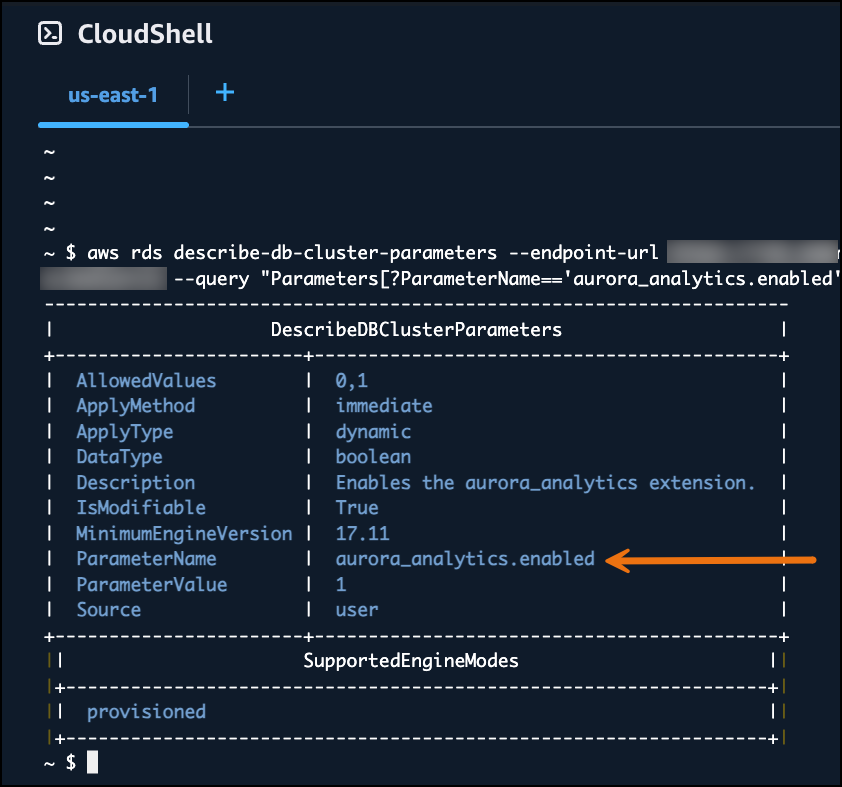
- Public Release (Versions 17 and 18): AWS officially rolled out the feature to support Aurora PostgreSQL Major Version 17 (starting with version 17.11) and Major Version 18 (starting with version 18.6).
- General Availability: The feature reached general availability across all commercial and GovCloud regions, empowering developers to instantiate the
aurora_analyticsextension with a simpleCREATE EXTENSIONcommand via the Amazon RDS console or standard PostgreSQL clients likepsql.
Supporting Data & Technical Mechanics
To understand the profound operational efficiency of this release, one must examine how the underlying mechanics handle hybrid queries. When a developer connects to Aurora PostgreSQL, they initiate the integration by enabling the feature via an IAM role (AuroraAnalytics) that grants secure read access to designated S3 buckets and the AWS Glue Data Catalog.
Practical Implementation Walkthrough
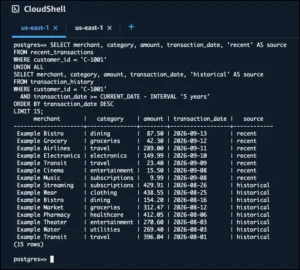
Consider a common financial services architecture where an application maintains a recent_transactions table holding the last seven days of customer activity, while an S3 data lake stores five years of archived transactions in a Parquet file.
Instead of duplicating the historical table into the database, an administrator creates a lightweight pointer:
CREATE EXTENSION aurora_analytics;

CREATE FOREIGN TABLE transaction_history ()
SERVER aurora_analytics_server
OPTIONS (
    location 's3://<my-bucket>/finance/transaction_history.parquet',
    format 'parquet'
);
Because of automatic schema inference, the parentheses are left empty as Aurora extracts column definitions directly from the Parquet metadata. Executing a unified query joining both domains looks remarkably straightforward:
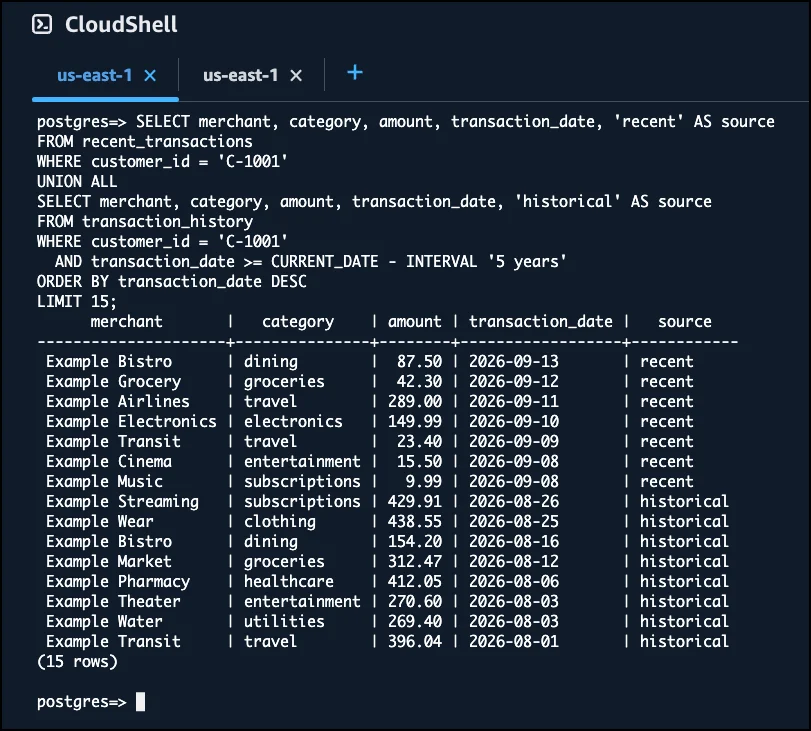
SELECT merchant, category, amount, transaction_date, 'recent' AS source
FROM recent_transactions
WHERE customer_id = 'C-1001'
UNION ALL
SELECT merchant, category, amount, transaction_date, 'historical' AS source
FROM transaction_history
WHERE customer_id = 'C-1001'
  AND transaction_date >= CURRENT_DATE - INTERVAL '5 years'
ORDER BY transaction_date DESC
LIMIT 15;
Performance and Caching Metrics
In this execution, DuckDB handles the heavy analytical lifting of scanning the columnar Parquet files in S3, while Aurora manages the live transactional rows. To maintain peak performance, Aurora applies sophisticated optimizations:

- Predicate Pushdown & Column Pruning: Unnecessary columns and rows are filtered out at the storage layer, drastically cutting down network bandwidth and S3 request volumes.
- Local Caching: Frequently accessed data lake chunks are cached directly within the Aurora instance. Subsequent queries fetch these segments at accelerated speeds.
- Observability: Database administrators can audit performance metrics in real-time utilizing the built-in
aurora_analytics_stat_statements()function, which surfaces granular data regarding rows scanned, bytes read from S3, and cache hit ratios. - Selective Materialization: For workloads demanding single-digit-millisecond latencies, engineers can easily materialize data lake tables into native Aurora tables using standard syntax like
CREATE TABLE AS SELECTorMERGE INTO, offloading analytical workloads safely onto Aurora read replicas.
Official Responses and Strategic Vision
While AWS representatives have emphasized that this capability is designed to remove infrastructure friction, the broader database industry has taken note of how closely this mirrors the modern push toward unified lakehouse architectures.
According to AWS product engineering teams, the integration is part of an ongoing commitment to make enterprise data architectures simpler, faster, and more cost-effective. By keeping query processing localized within the Aurora environment—avoiding unnecessary network hops—AWS ensures that scaling up data lake sizes does not exponentially degrade operational performance.
Furthermore, because this capability is built around the core tenets of DuckDB, AWS has established a sustainable architectural feedback loop. Future performance enhancements, vector execution updates, and functionality improvements made to the open-source DuckDB engine can seamlessly flow downstream into Aurora PostgreSQL and potentially other AWS data services over time.
Industry analysts suggest that this release directly challenges alternative enterprise architectures that require third-party middleware or proprietary data movement tools to bridge operational stores and object storage. By empowering standard PostgreSQL developers to leverage the full breadth of Apache Iceberg ecosystems using native SQL, AWS has significantly lowered the barrier to entry for advanced analytics and enterprise AI applications.
Implications for Developers, Enterprises, and AI Workloads
The introduction of direct data lake querying inside Amazon Aurora PostgreSQL carries profound implications across multiple tiers of software engineering, cloud economics, and artificial intelligence development:
1. Drastic Reduction in Engineering Overhead
For software development teams, the elimination of reverse-ETL pipelines means fewer operational failure points, reduced CI/CD deployment complexities, and less time spent troubleshooting sync lag between production databases and analytical warehouses. Engineers can rely on standard SQL semantics, tools, and extensions they already know, avoiding steep learning curves associated with disparate big-data toolchains.
2. Streamlined Cloud Economics
Operating data pipelines consumes valuable compute resources, network bandwidth, and storage footprints. By querying data in place on Amazon S3, organizations avoid the storage costs of duplicating datasets. Users pay strictly for the incremental Aurora compute consumed by the queries and standard S3 request pricing—a consumption model that scales predictably from startups to massive enterprise deployments.
3. Supercharging Artificial Intelligence and Autonomous Agents
As enterprises pivot toward generative AI, Retrieval-Augmented Generation (RAG), and autonomous AI agents, data freshness and accessibility are paramount. Traditional architectures struggle when an AI agent needs to evaluate real-time user session states alongside historical behavioral records spanning several years. Because it is impossible to predict every dataset an autonomous agent might require, pre-replicating data via ETL is unfeasible. Aurora’s new capability allows AI agents to dynamically query both live transactional states and deep historical data lakes through a single endpoint, unlocking new tiers of context-aware intelligence and responsiveness.
4. Democratizing Advanced Analytics
By bridging operational databases and open table formats like Apache Iceberg, AWS is accelerating the industry-wide convergence of data lakes and data warehouses (the "Lakehouse" model). Organizations of all sizes can now build sophisticated analytics applications, real-time fraud detection systems, and dynamic customer 360-degree dashboards directly out of their primary transactional database, democratizing analytical power previously reserved for enterprises with dedicated big-data engineering divisions.
Getting Started
Developers wishing to explore the capability can immediately provision an Amazon Aurora PostgreSQL cluster running version 17.11+ or 18.6+, attach the appropriate IAM role (AuroraAnalytics), and run CREATE EXTENSION aurora_analytics;. Comprehensive documentation, setup guides, and configuration references are currently available via the official Amazon Aurora User Guide and the Amazon RDS console.