AWS Transforms Event-Driven Architectures with Launch of Enhanced Custom Event Bus in Amazon EventBridge
SEATTLE — In a major development for cloud architects and enterprise engineering teams, Amazon Web Services (AWS) has announced the immediate availability of an enhanced custom event bus for Amazon EventBridge. Purpose-built to eradicate the friction associated with scaling serverless and event-driven applications across complex organizational hierarchies, the new offering introduces a centralized, multi-account event backbone equipped with native event ordering, unified subscriber management, granular content transformation, and a restructured pricing model.
The release marks a significant milestone for EventBridge, a foundational serverless service responsible for routing application data between AWS services, integrated Software-as-a-Service (SaaS) applications, and custom data streams. By shifting from a fragmented multi-bus structure to a cohesive organization-wide model, AWS aims to restore the operational simplicity that originally drove enterprises toward serverless computing.
Main Facts: What is the Enhanced Custom Event Bus?
The newly released enhanced custom event bus fundamentally changes how large enterprises manage event-driven patterns. Historically, organizations building event-driven applications on Amazon EventBridge initiated their journey with a single custom event bus housed inside a single AWS account. While efficient for isolated teams, this architecture quickly fractured as enterprise cloud adoption scaled.
To comply with AWS multi-account best practices—which dictate that individual teams operate within isolated accounts for security and governance—developers routinely engineered complex topologies. These workarounds involved connecting multiple event buses via cross-account rules or intricate bus-to-bus routing configurations.
The consequences of this previous architecture included:
- Operational Overhead: Platform teams lost centralized visibility into event subscriptions and publisher-subscriber relationships.
- Compounding Costs: Cross-account and bus-to-bus routing charges escalated rapidly as traffic scaled.
- Workaround Complexity: Teams requiring strict sequencing or event ordering were forced to build convoluted secondary solutions or adopt entirely different messaging technologies.
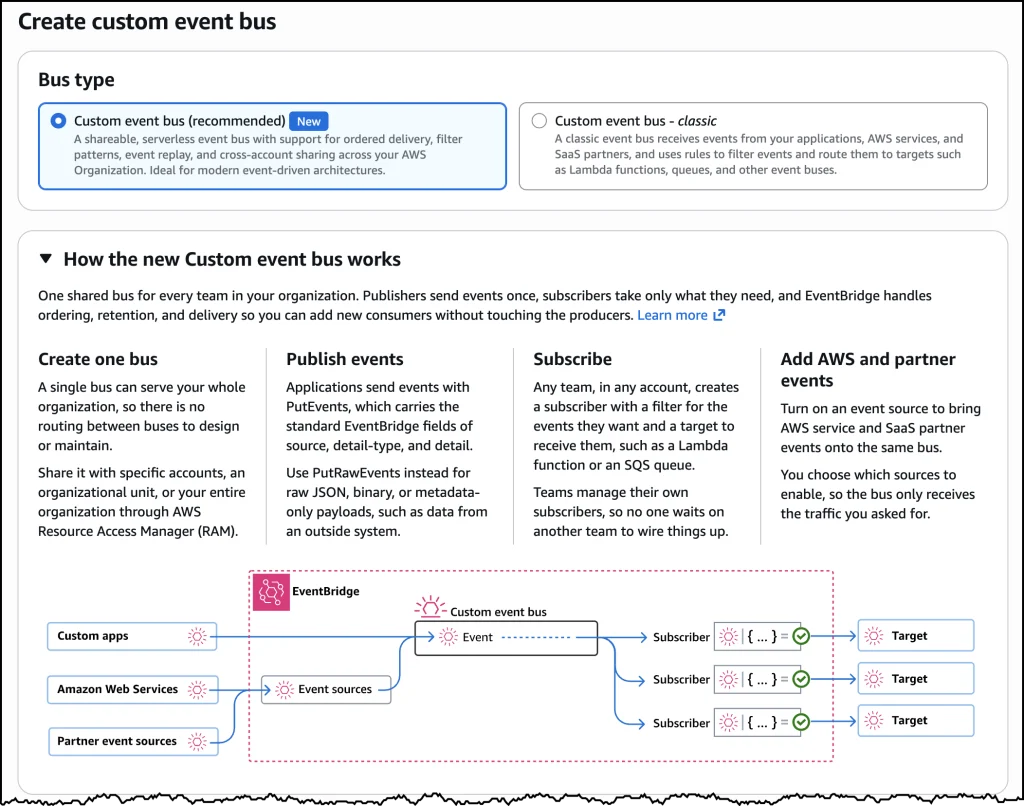
The enhanced custom event bus solves these friction points by deploying a single, centralized event bus that can be shared across all AWS accounts within an entire AWS Organization. Key capabilities of the new system include:
- Organization-Wide Sharing: Leverages AWS Resource Access Manager (AWS RAM) to permit seamless publishing and subscribing across accounts without manual cross-account permission configurations.
- Built-In Event Ordering: Supports strict event sequencing via
EventGroupIdparameters without sacrificing the performance of asynchronous consumers. - Unified Subscriber Resources: Combines filtering, target configuration, retry logic, and dead-letter queues into a single cohesive resource.
- Advanced Data Processing: Includes native content-based deduplication and JSONata expression support for payload reshaping, alongside payload deserialization for Apache Avro and Protocol Buffers.
- Scalability: Ships with a default quota of 10,000 subscribers per bus, dramatically reducing architectural fragmentation.
Chronology: The Evolution of Multi-Account Event Routing
To understand the significance of this release, it is helpful to trace the chronological path of enterprise event-driven design on AWS and the compounding challenges that necessitated this architectural pivot.
Phase 1: The Single-Bus Paradigm
In the early days of serverless maturation, development teams relied primarily on default event buses for AWS service events or stood up a single custom event bus for application-specific workflows. In this era, architectures were relatively flat. A monolithic team or a small startup could route all internal application signals through one destination with minimal oversight.

Phase 2: The Multi-Account Proliferation
As enterprises scaled their cloud footprints, security postures tightened. Security and compliance frameworks mandated strict account segregation. Organizations adopted multi-account strategies via AWS Organizations. Consequently, individual product teams were siloed into their own AWS accounts.
To maintain event-driven communication between these isolated teams, engineers began stitching together custom event buses across accounts. This required manually configuring resource-based policies, cross-account IAM roles, and intricate rule-matching loops. What began as a lightweight routing mechanism evolved into an administrative burden. Platform engineering teams found themselves acting as full-time gatekeepers for inter-team event discovery.
Phase 3: The Architectural Workarounds
Faced with strict business requirements—such as ensuring that inventory updates, financial transactions, or logistics coordinates arrived in exact chronological sequence—developers frequently layered additional services onto EventBridge. It became common practice to inject Amazon Simple Queue Service (Amazon SQS) queues and AWS Lambda concurrency controls between event buses to preserve ordering or enforce synchronous handling, inadvertently reintroducing the infrastructure management that serverless was meant to eliminate.
Phase 4: The Centralized Modern Era
With today’s launch, AWS has compressed these disparate workarounds into a native, managed capability. By providing an enhanced custom event bus that natively supports cross-account organization sharing, ordering, and advanced filtering, AWS has effectively bridged the gap between strict enterprise governance and developer agility.
Supporting Data and Technical Architecture
The underlying mechanics of the enhanced custom event bus introduce several architectural refinements designed to optimize performance, cost, and developer velocity at scale.
1. Simplified Governance via AWS RAM
Resource sharing on the new event bus is managed directly through AWS Resource Access Manager (AWS RAM). When platform administrators enable event bus sharing, they can scope access boundaries to specific AWS accounts, organizational units, or entire AWS Organizations. This eliminates the need to manually manage complex IAM trust policies and resource-based access control lists (ACLs) every time a new team wants to consume an event.
2. Balancing Asynchronicity with Event Ordering
Event-driven architectures inherently thrive on asynchronous, decoupled message consumption where the temporal order of events is irrelevant. However, domain-driven design frequently encounters stateful workflows where sequence is non-negotiable. For example, in a logistics tracking application, vehicle location updates must be processed in the exact order they are emitted; otherwise, mapping algorithms calculate invalid trajectories based on stale data.
The enhanced custom event bus solves this by allowing publishers to inject an EventGroupId into the event payload. EventBridge then guarantees sequential delivery for events bearing the same EventGroupId to subscribers that opt into ordered delivery. Crucially, other subscribers on the same bus can process events asynchronously without being bottlenecked by the sequential stream.

To support this ordered processing reliably, EventBridge introduces synchronous invocation for targets such as AWS Lambda. In this mode, EventBridge confirms successful target execution before acknowledging the event back to the stream, eliminating the historical need to interleave Amazon SQS queues solely to ensure reliable, ordered handoffs.
3. Streamlined Subscriber Management
Managing event-driven subscriptions previously required a proliferation of individual EventBridge rules, targets, retry policies, and dead-letter queues (DLQs). The new architecture consolidates these elements into a single Subscriber resource.
A single Subscriber resource defines:
- What specific events to intercept via advanced filtering patterns.
- Where to deliver the payload.
- How to manage retries and failures.
- Custom variable start times for data replay and consumer onboarding.
4. Advanced Evaluation: Deduplication and Transformation
Data hygiene at scale remains a persistent challenge for distributed systems. The enhanced custom event bus introduces content-based deduplication. If network timeouts or transient downstream errors cause a publisher to emit duplicate event payloads within a five-minute window, EventBridge automatically hashes the meaningful contents of the payload and collapses matches. This yields exactly-once delivery semantics for erratic sources, sparing developers from manually generating, tracking, and validating unique idempotency tokens.
Furthermore, subscribers can leverage JSONata expressions to reshape event payloads on the fly. If a legacy downstream microservice expects a specific JSON schema, the subscriber resource can extract, rename, and compute fields before the payload reaches its target. For organizations utilizing standardized serialization formats like Apache Avro or Protocol Buffers, EventBridge can natively deserialize these payloads into JSON, empowering subscribers to filter and route based on the entire event body without maintaining custom deserialization pipelines.
5. A Reformed Pricing Model
Financial predictability has historically been a friction point for multi-bus EventBridge topologies, where cross-account routing fees compounded rapidly. The enhanced custom event bus introduces an ingress-and-egress throughput pricing structure:
- Publishers pay strictly for the volume of events ingested.
- Subscribers pay strictly for the volume of events delivered.
This bifurcated model aligns expenses directly with utilization, ensuring that scaling the number of internal consumers does not create opaque, unpredictable financial spikes for publishing teams.
Official Responses and Industry Implications
Industry analysts and early enterprise adopters have praised the release for addressing the operational debt inherent in multi-account serverless deployments.
"As organizations scale their serverless footprints across dozens or hundreds of AWS accounts, the operational overhead of managing distributed event topologies has become a primary bottleneck," noted a leading cloud infrastructure analyst. "By combining organization-wide sharing, native ordering, and unified subscriber controls into a single managed resource, AWS is directly targeting the architectural complexity that larger engineering organizations struggle to contain."
Platform engineering leaders have similarly emphasized the value of restored visibility. In traditional multi-bus implementations, platform teams frequently flew blind regarding which downstream teams were consuming specific event streams, creating compliance blind spots. With a centralized enhanced custom event bus shared via AWS RAM, platform operators regain a holistic, unified view of all intra-organizational data flows while safely delegating granular subscription management to individual product squads.
Availability and Getting Started
The enhanced custom event bus is available immediately across a broad footprint of global AWS Regions, including:
- Americas: US East (N. Virginia, Ohio), US West (Oregon)
- Europe: Europe (Ireland, Frankfurt, Stockholm, Spain)
- Asia Pacific: Asia Pacific (Hong Kong, Malaysia, Mumbai, Singapore, Sydney, Thailand, Tokyo)
Existing Amazon EventBridge custom event buses will remain fully supported, operating unchanged under the designation Custom event bus – classic. Organizations can adopt the new enhanced custom event bus incrementally at their own pace.
Engineering teams can provision their first enhanced custom event bus today using the AWS Management Console, the AWS Command Line Interface (AWS CLI), or via standard EventBridge APIs. Comprehensive documentation and architectural deployment guides are accessible through the official Amazon EventBridge documentation portal.