Beyond Code: Why the Future of Artificial Intelligence Relies on Human Experience and Shared Learning

Introduction: The Paradox of Automated Perfection
In the rapidly evolving landscape of artificial intelligence, an AI agent can now write a complex computer program, compile it, autonomously execute it, diagnose its own runtime errors, and iteratively rewrite the code until it functions flawlessly. Yet, a fundamental paradox remains at the heart of this technological leap: What happens when the program works with absolute technical precision, but the human user finds it entirely useless?
This chasm highlights a critical distinction that the tech industry is only beginning to grapple with—the vast difference between completing a task and understanding whether the outcome possesses genuine value. As artificial intelligence becomes increasingly capable of autonomous action within the physical and digital worlds, this dichotomy is set to redefine the human role in software development and machine learning.
For decades, the software development life cycle relied on human ingenuity to build, package, and sell applications. Today, as AI lowers the barriers to code generation, the industry faces a profound structural shift. Software is transitioning from a scarce, high-value product into an accessible commodity. Consequently, the tech community must rethink where true value lies in an AI-driven economy, moving beyond model capabilities to examine how machines and humans learn together.
Main Facts: The Commoditization of Code and the Rise of Autonomous Agents
To understand the current transformation, one must examine how software engineering has evolved alongside artificial intelligence.
- The Democratization of Programming: AI models can now reason through complex problems, generate functional codebases, and propose solutions to unprecedented scenarios. While not yet capable of independently maintaining sprawling, enterprise-grade systems without human oversight, the trajectory points toward accessible, automated software creation.
- The Value Migration: As writing code becomes automated, the bottleneck of software creation shifts. The challenge is no longer how to build an application, but what to build, why it is needed, and how it impacts the real world.
- The Siloing of Interaction Data: Millions of users interact with proprietary AI platforms daily—debugging code, shaping workflows, and testing hypotheses. These interactions generate vital experiential data regarding what succeeds and what fails. Currently, this data is largely retained as proprietary assets within closed corporate ecosystems.
- The Emergence of Project 507: Addressing the need for collaborative, open frameworks that capture and share AI experiential learning, grassroots initiatives like Project 507 are emerging to build decentralized repositories for machine experience.
Chronology: The Evolution from Static Software to Dynamic AI Ecosystems
Tracing the trajectory of computing reveals how humanity arrived at the current crossroads of autonomous intelligence and shared learning.
Phase 1: The Era of Custom Engineering (Pre-2010s)
For most of computing history, software was engineered from scratch. Building applications required specialized knowledge, heavy time investments, and significant capital. Entire industries were built around proprietary software packages where the application itself was the primary commercial product.
Phase 2: The Open-Source Foundation (2010s–Early 2020s)
Over several decades, the global developer community constructed a massive foundation of open-source libraries, frameworks, and operating systems. Modern software almost universally relies on contributions from thousands of anonymous and corporate developers. This era proved that collective, open collaboration accelerates technological capability far beyond what any single entity could achieve alone.
Phase 3: The Generative AI Boom (2023–Present)
Large language models and AI agents entered the mainstream, trained on vast corpuses of human-generated text and code. AI transitioned from a passive information-retrieval tool to an active agent capable of executing multi-step workflows, writing software, and interacting with external digital tools.
Phase 4: The Current Horizon—Toward Collective Machine Experience
As autonomous agents begin to operate independently—testing hypotheses, encountering failures, and discovering workarounds—the industry faces a choice. Will these operational lessons remain trapped inside proprietary silos, or will the tech ecosystem develop open protocols for sharing machine experience, much like open-source code repositories did decades ago?
Supporting Data and Industry Dynamics: The Shift from Models to Metrics
While billions of dollars flow into training larger foundation models with more parameters, industry analysts and researchers are beginning to evaluate metrics beyond mere model scale:
- Open Source vs. Proprietary AI: While commercial incentives have successfully driven the initial wave of frontier AI models, open-source models (such as Meta’s Llama family and various open weights initiatives) have demonstrated that community-driven development can rapidly match or exceed closed-source capabilities in specific domains.
- The Cost of Redundant Failure: In an agentic future where millions of AI systems operate independently, lack of shared operational memory means different agents will repeatedly make—and solve—the exact same errors in isolation. Preserving execution contexts could drastically reduce compute waste and training overhead.
- Commercial Incentives vs. Human Need: Market forces naturally direct AI research toward revenue-generating applications. However, critical societal challenges—ranging from public health infrastructure to ethical governance—rarely align neatly with immediate corporate monetization strategies, emphasizing the need for open learning ecosystems.
Official Perspectives and Expert Analysis
Industry thinkers and open-source advocates argue that the traditional boundaries of intellectual property must adapt to the realities of generative and agentic AI.
"There is an important difference between completing a task and understanding whether the outcome was valuable," notes digital infrastructure researchers studying autonomous agent behavior. "As AI becomes increasingly capable of acting in the world, this distinction changes the role humans play in the development of artificial intelligence."
Critics of current closed-ecosystem models argue that treating human-AI interaction data purely as proprietary training fodder creates a bottleneck for collective human progress.
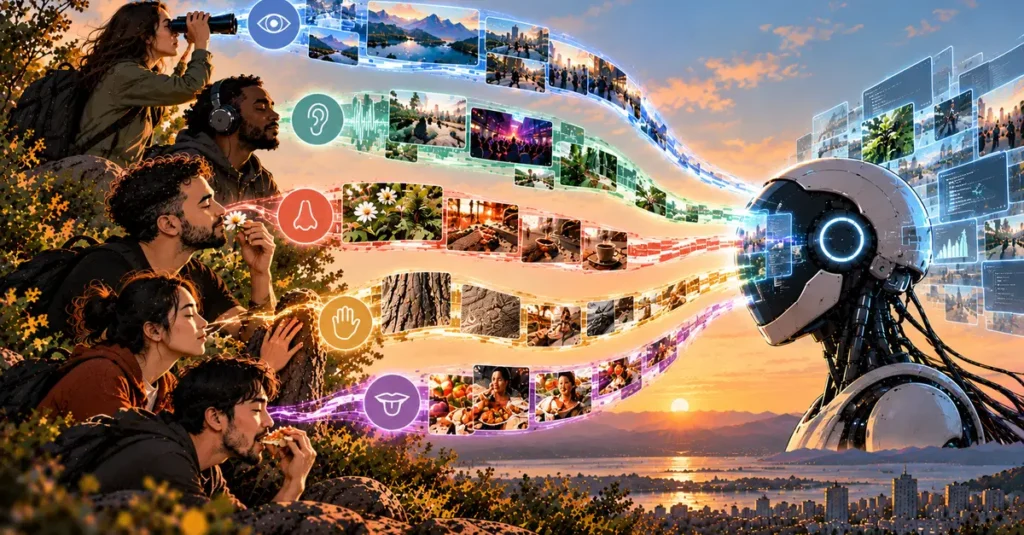
- The Human as the "Five Senses" of AI: Proponents of collaborative AI suggest that humans should not merely act as passive feedback loops (like RLHF—Reinforcement Learning from Human Feedback), but as active participants who ground artificial intelligence in real-world utility, intent, and ethical judgment.
- The Open-Source Parallel: Just as software developers realized that sharing code lines benefited the entire ecosystem without destroying individual enterprise value, proponents of shared machine experience argue that context, failure modes, and problem-solving structures can be shared without compromising private data security.
Implications: Reshaping the Future of Technology and Human Agency
The transition from code-as-a-product to experience-as-an-asset carries profound implications for software developers, enterprises, and society at large.
1. The Redefinition of Engineering Skills
As AI assumes the heavy lifting of syntax generation and boilerplate programming, the value of traditional coding skills will evolve. Programmers will increasingly function as system architects, ethical guides, and domain experts who define constraints and interpret real-world outcomes. The premium will shift toward critical thinking, problem framing, and UX evaluation.
2. Intellectual Property and the Ownership of "Experience"
A major legal and economic battleground is emerging over who owns the learnings generated when users interact with AI agents. If an AI agent, guided by a human user, discovers a novel solution to an operational problem, does that insight belong exclusively to the platform vendor, or should it be contributed to a shared knowledge commons? The industry must establish clear legal frameworks that protect private data while enabling collective machine learning.
3. Avoiding Institutional Amnesia
Without shared learning protocols, the AI-driven future risks entering a state of institutional amnesia. If autonomous agents continually solve unique problems in closed loops without preserving the contextual metadata of why an approach failed or succeeded, society will burn excessive computational resources rediscovering known solutions. Open-learning ecosystems could mitigate this inefficiency.
4. Project 507 and the Push for Open Machine Experience
Initiatives like Project 507 represent early attempts to construct open frameworks where AI systems can safely share operational experiences and build upon collective discoveries. By moving beyond isolated models toward interconnected learning networks, developers hope to ensure that the evolution of artificial intelligence remains transparent, adaptable, and aligned with human interests.
Conclusion
The future of artificial intelligence is not merely a race to build larger models or faster code generators. It is an exploration of how intelligent systems relate to the physical and social realities they inhabit.
Humanity generates continuous value through its ongoing interaction with the world—bringing intentions, ethical judgment, and contextual understanding that silicon chips alone cannot replicate. If this experiential knowledge is permanently locked behind corporate walls, the trajectory of artificial intelligence will be dictated solely by narrow commercial incentives.
By fostering open learning ecosystems and recognizing that humans are active participants in shaping machine intelligence, society can ensure that the next generation of AI serves the broader public good. Those interested in contributing to this paradigm shift can explore ongoing collaborative efforts, such as Project 507, via the community portals on participating open-source development platforms.