
Beyond the Wire: Luca Soltoggio’s "SecurePair" Reimagines Optical Communication with the ESP32
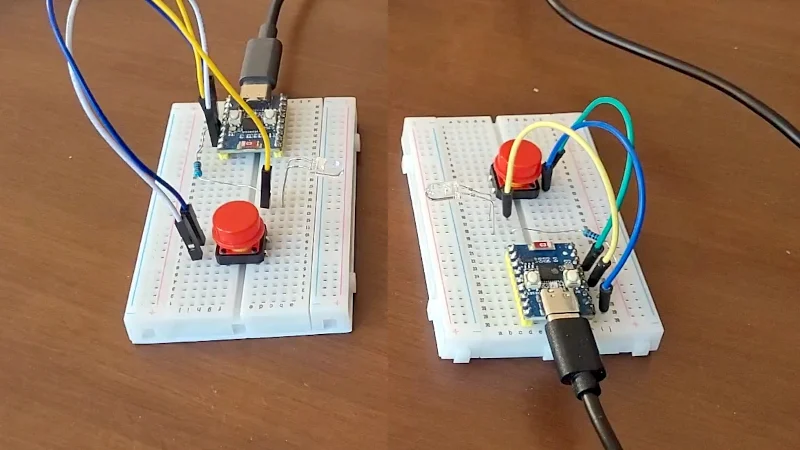
In the realm of embedded systems engineering, few tasks are as deceptively simple as establishing a reliable data link between two microcontrollers. While developers often retreat to the safety of off-the-shelf radio modules—such as those utilizing Bluetooth, Wi-Fi, or LoRa—a persistent subset of the maker community continues to push the boundaries of what is possible with fundamental components. Enter Luca Soltoggio, a developer who has successfully bypassed conventional wireless protocols to establish encrypted communication between ESP32 microcontrollers using nothing more than visible light emitted from standard LEDs.
This project, dubbed "SecurePair," is more than a novelty; it is a sophisticated exploration of optoelectronics. By utilizing a single LED to function dually as both a light emitter and a photodiode, Soltoggio has crafted a method for secure, short-range device pairing that eliminates the complexity of traditional handshake protocols.
Main Facts: The Architecture of SecurePair
The core innovation behind SecurePair lies in the physical versatility of the Light Emitting Diode (LED). While the standard operation of an LED involves the injection of current to produce photons, the device can also operate in reverse: when exposed to light, it generates a small electrical current. Soltoggio has leveraged this bidirectional capability to create a half-duplex communication channel.
Technical Foundations
- Dual-Function Hardware: The project utilizes the physical properties of LEDs to act as light sensors, capturing incoming optical signals and converting them into voltages that the ESP32’s Analog-to-Digital Converter (ADC) can interpret.
- Protocol Versatility: SecurePair is architected as an Arduino library designed specifically for key exchange and encrypted communication. While the optical link is the highlight, the library is platform-agnostic in its higher-level functions, supporting standard transport layers like ESPNow or LoRa.
- Encryption and Security: The library facilitates the exchange of cryptographic keys over an optical channel, which is inherently secure due to its line-of-sight requirement. By physicalizing the pairing process—requiring two devices to "see" each other—Soltoggio mitigates the risk of "man-in-the-middle" attacks that often plague traditional radio-based pairing methods.
Chronology: The Evolution of Optical Data Links
The history of optical communication is storied, dating back to the Photophone invented by Alexander Graham Bell in 1880. However, the integration of such technology into the modern "Internet of Things" (IoT) ecosystem has been hampered by the high signal-to-noise ratio requirements and the limitations of consumer-grade hardware.
1. The Prototyping Phase
Soltoggio began by addressing the fundamental problem of signal interference. In a room filled with ambient light (fluorescent bulbs, sunlight, or overhead LEDs), an LED-based receiver is easily overwhelmed by background noise. Through iterative testing, Soltoggio refined the software filtering algorithms within the SecurePair library to distinguish between ambient light and the specific pulse-width modulation (PWM) patterns of the transmitting device.
2. The Integration of ESP32
The choice of the ESP32 was strategic. Its dual-core processor and high-speed ADC capabilities allowed for the rapid sampling of the LED’s output. By the mid-development stage, Soltoggio had moved beyond simple blink-patterns to a structured data frame system, allowing for the transmission of actual encrypted payloads.
3. The Release of SecurePair
The public release of the SecurePair library on GitHub marked a milestone for the community. It provided a framework where users could handle the "pairing" of devices via light, followed by the seamless handover of data transmission to more robust long-range protocols like ESPNow or LoRa, which provide greater bandwidth and range than visible light communication (VLC).
Supporting Data: The Physics of LED Transceivers
To understand the efficacy of SecurePair, one must examine the electrical characteristics of the LED.
Signal Sensitivity and Sampling
An LED used as a sensor behaves essentially as a high-impedance current source. The photocurrent generated is extremely low, typically in the microampere range. Soltoggio’s implementation relies on the ESP32’s internal circuitry to amplify and sample these minute changes in current.
| Feature | LED Transmitter | LED Receiver |
|---|---|---|
| Active Component | Forward Bias (Light Emission) | Reverse/Zero Bias (Photodiode) |
| Data Rate | Limited by PWM/GPIO speed | Limited by ADC sampling rate |
| SNR Control | High brightness modulation | Software-based digital filtering |
The data throughput, while modest, is sufficient for the primary goal of the project: the exchange of a 256-bit encryption key or a handshake token. Once this secure token is exchanged, the devices shift their communication to high-speed radio frequencies, effectively creating a "secure tunnel" initiated by a physical optical handshake.
Official Responses and Community Impact
Since the publication of the project, the response from the embedded systems community has been overwhelmingly positive. Hackaday and other prominent engineering forums have highlighted the project as a prime example of "hardware hacking" that challenges the assumption that specialized equipment is required for complex tasks.
"The beauty of this approach," noted one community contributor, "is that it removes the ‘software-only’ abstraction of security. By requiring a physical light link, you gain a tangible layer of security that radio-based protocols simply cannot emulate without secondary hardware."
However, industry experts point out the limitations. For instance, VLC-based pairing is highly susceptible to atmospheric conditions and physical obstructions. Soltoggio has addressed this in the documentation, explicitly labeling SecurePair as an auxiliary tool for pairing rather than a replacement for high-speed data transmission.
Implications: A New Paradigm for IoT Security
The implications of SecurePair extend far beyond the hobbyist workbench. As the IoT landscape continues to face challenges regarding the secure onboarding of smart devices, innovative pairing mechanisms are becoming critical.
1. The "Physical Handshake" Advantage
In modern smart home environments, a user often adds a new device to a network via a mobile app, which then broadcasts the Wi-Fi credentials over a local network. This is a vulnerability point. If a malicious actor is within range, they can intercept this broadcast. By using SecurePair, the pairing process is locked to a specific physical space. A device cannot be paired unless it is literally in the line-of-sight of the controller, drastically reducing the attack surface.
2. Scaling to Swarms
While the current demonstrations feature two ESP32 units, the architecture is inherently scalable. Because the communication relies on a broadcast-like light signal, a central hub could potentially pair multiple peripheral sensors in a single optical event, streamlining the deployment of large-scale sensor networks in industrial or agricultural settings.
3. Sustainability and Component Optimization
The project also highlights a philosophy of component optimization. In a world where hardware is often discarded for failing to meet new connectivity standards, finding ways to maximize the utility of simple components like LEDs—which are ubiquitous in almost every consumer device—represents a move toward more sustainable engineering practices.
Conclusion: Looking Ahead
Luca Soltoggio’s SecurePair project serves as a poignant reminder that the most significant technological breakthroughs often come from looking at existing hardware with fresh eyes. By repurposing the humble LED, he has addressed a complex problem—secure device pairing—with an elegant, low-cost solution.
As IoT continues to expand, the intersection of optics and embedded software will likely become a more fertile ground for innovation. Whether through VLC (Visible Light Communication) or other light-based protocols, the ability to transmit data without the need for traditional RF spectrum management offers a compelling future for secure, localized communication. For now, SecurePair stands as a testament to the power of open-source development and the enduring ingenuity of the maker community.
For developers interested in implementing their own optical links, the SecurePair library is currently maintained and available on GitHub, serving as a gateway for those willing to look past the "off-the-shelf" solution and into the physics of the light itself.







