Bridging the Intent-Execution Gap: Why AI Coding Agents Ignore Clean Code Principles—and How to Fix Them
In the fast-paced landscape of modern software engineering, AI coding assistants have evolved from simple autocomplete tools into autonomous agents capable of generating entire features, refactoring legacy components, and navigating complex codebases. Yet, a fundamental paradox plagues day-to-day development with these models: ask any modern LLM to explain advanced architectural concepts like the Strategy pattern, and it will effortlessly deliver a textbook response complete with UML sketches, TypeScript boilerplate, and nuanced caveats on trade-offs.
Turn around in the exact same session and ask that very same model to implement a practical feature—such as applying a 10% discount for VIP customers at checkout—and the resulting code frequently violates the architectural wisdom it just articulated. Functions swell past 150 lines, database calls mingle directly with domain business rules, and expanding features requires appending yet another brittle else if statement to an already bloated codebase.
While the code may function and tests may pass, the agent has effectively bypassed the clean code principles it inherently understands. This phenomenon highlights a critical realization for modern software teams: knowing a software engineering principle and applying it by default are two entirely different skills. AI coding agents possess only the former for free.
The Anatomy of AI-Driven Drift: Why Models Ignore What They Know
The disconnect between an AI model’s theoretical knowledge and its practical output does not stem from ignorance. Rather, it is a byproduct of how large language models process context. When an agent is prompted to execute a task, it optimizes for the path of least resistance based on the immediate signals embedded within its working environment.
The Signal-to-Output Matrix
| What the Agent Sees | What it Tends to Produce |
|---|---|
| Your direct request (e.g., "add a discount") | The smallest, most direct change satisfying the immediate prompt |
| The surrounding legacy codebase | Code matching existing patterns, even if those patterns include anti-patterns like 300-line functions |
| Passing unit tests | An operational definition of "done" focused strictly on green test suites rather than long-term maintainability |
| An absence of stated standards | Generic, default coding conventions that may directly contradict enterprise best practices |
This dynamic extends far beyond business logic. Security research demonstrates that when an AI agent is asked to build an application featuring user authentication, it will frequently store JSON Web Tokens (JWTs) insecurely in browser localStorage. This occurs despite the model’s ability to eloquently lecture on the security vulnerabilities of doing so.
Conversely, overcorrecting can trigger the opposite failure mode. Issuing a vague mandate such as "strictly follow SOLID principles and design patterns" often drives the model toward extreme architectural ceremony. The agent might generate an IDiscountService interface backed by a single implementation, an over-engineered factory pattern, and five separate files for a feature that realistically required twenty lines of procedural logic. This code proves just as difficult for human developers to maintain, albeit through a different set of complexities. The core issue is clear: vague principles produce either code bloat or complete architectural drift.
Who is Modern Code Really For?
As development teams increasingly adopt agentic workflows, the human role shifts from direct writer of code to architectural reviewer and prompter. In environments where AI agents handle the bulk of feature implementation, a human engineer will rarely touch the underlying code in isolation. Instead, subsequent agent sessions will read, modify, and build upon the work generated by previous prompts.
Even in this automated paradigm, human maintainability remains paramount for several critical reasons. Most importantly, code that is clean and comprehensible to a human developer is also comprehensible to an upcoming agent session. Clean, modular code requires the model to open fewer files, parse less extraneous context, and make fewer erroneous assumptions during subsequent executions. Clean code has effectively evolved from a professional courtesy among colleagues into a vital component of the agent’s context window.
Translating Abstract Principles into Verifiable Rules
Documentation for advanced coding environments like Claude Code explicitly notes that instruction files are treated as "context, not enforced configuration." Furthermore, the documentation emphasizes that specific, concise instructions yield significantly higher consistency than broad directives. Instructing an agent to "use 2-space indentation" consistently succeeds where telling it to "format code properly" fails.
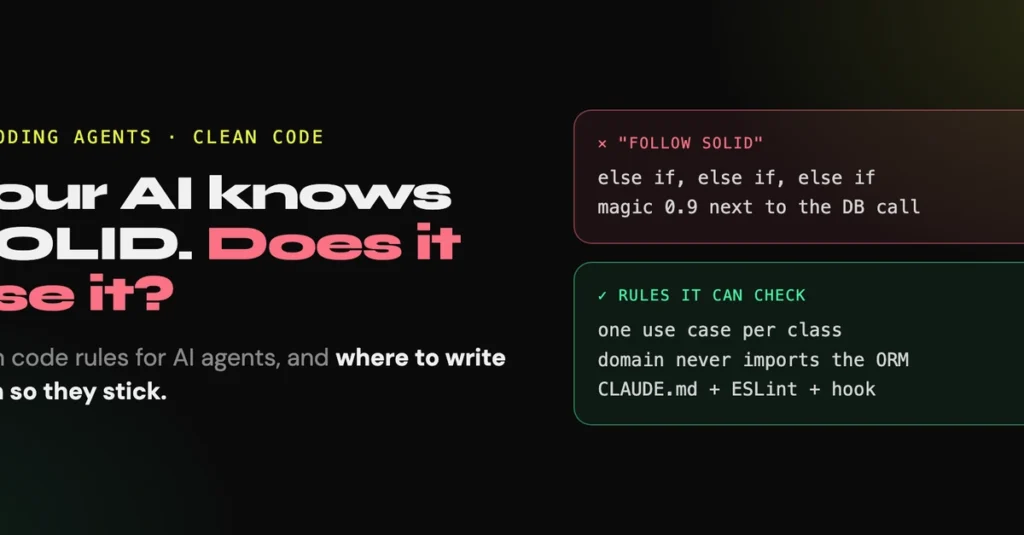
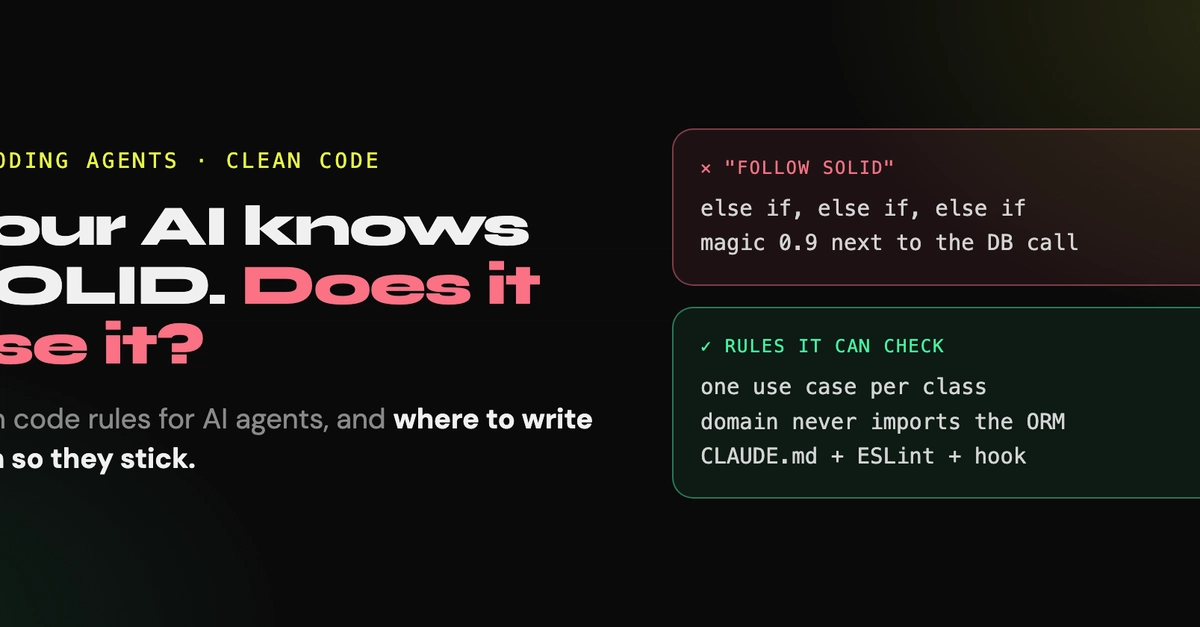
The same rule applies to software architecture. Abstract mandates like "follow SOLID" remain mere semantic vibes. Concrete constraints—such as "inject dependencies exclusively through the constructor; never instantiate a repository inside a use case"—form verifiable rules that can be programmatically checked in a code diff.
Vague Directives vs. Verifiable Rules
| Vague Instruction | Verifiable Rule for Agents and Reviewers |
|---|---|
| Follow the Single Responsibility Principle (SRP) | Each class or module must have exactly one reason to change. A use case performs one explicit task, resulting in a strict one-class-per-use-case architecture. |
| Write clean code | Functions must execute a single logical operation, accept a maximum of 3 parameters, and completely ban magic numbers or strings in favor of named constants or enums. |
| Use good architecture | The domain layer must remain entirely isolated, avoiding imports of frameworks, ORMs, HTTP clients, or database drivers. Dependencies must point strictly inwards. |
| Use design patterns | Employ a design pattern only when addressing a concrete, documented problem. Explicitly state the problem and include the pattern’s name within the class nomenclature or a concise comment. |
| Keep code readable | Restrict methods to a single level of indentation. Prohibit else statements entirely; require the use of guard clauses. |
| Don’t over-engineer | Apply rules pragmatically. If a strict rule harms readability or fights framework idioms, prioritize clarity and explicitly document the trade-off. |
The final provision regarding pragmatism is essential. Without a built-in escape hatch, a rigid rule set inevitably resurrects the architectural ceremony problem.
Establishing Hierarchical Rule Management
Managing these constraints effectively requires categorizing them across a multi-layered hierarchy, extending from broad personal standards down to strict code enforcement mechanisms.
The Architectural Rule Hierarchy
| Layer | Implementation Tool | Content Scope |
|---|---|---|
| Personal Standards | ~/.claude/CLAUDE.md & ~/.claude/rules/ |
Global engineering standards applicable across all projects. |
| Enterprise Policies | Managed CLAUDE.md (deployed via IT) |
Company-wide security policies, compliance mandates, and core coding guidelines. |
| Project Standards | ./CLAUDE.md or AGENTS.md |
Repository-specific architecture, layer definitions, folder structures, and execution commands. |
| Contextual Rules | .claude/rules/*.md using paths: scoping |
Domain-specific constraints (e.g., strict purity rules applied only to src/domain/**). |
| Machine Enforcement | Linters, dependency cruisers, CI/CD hooks | Uncompromising technical laws that block compilation or merging upon violation. |
Adopting path-scoped configurations allows teams to enforce strict functional paradigms where they matter most—such as pure domain layers—while allowing relaxed idioms in presentation or infrastructure tiers.
Rules are Context; Linters are Law
While instruction files dramatically raise the probability of generating high-quality code, they do not guarantee it. Extended coding sessions, large pull request diffs, or conflicting prompts can cause an agent to slip past its guardrails. Therefore, any standard that can be validated by a machine must be enforced by a machine.
Crucially, automated checks hold zero weight if they operate exclusively on a developer’s local machine without blocking integration. True enforcement requires Continuous Integration (CI) pipelines to outright reject code that fails predefined static analysis.
Enforcing Rules via Static Analysis
Modern JavaScript and TypeScript ecosystems can leverage tools like typescript-eslint to programmatically curb anti-patterns:
// eslint.config.js
import tseslint from "typescript-eslint";

export default [
  ...tseslint.configs.recommended,

    files: ["src/**/*.ts"],
    rules:
      "max-depth": ["error", 2],            // Enforces shallow nesting (proxy for single indentation)
      "no-else-return": "error",            // Eliminates redundant else blocks after returns
      "max-params": ["error", 3],           // Caps function parameter bloat
      "max-lines-per-function": ["error", 40], // Enforces small, cohesive functions
      complexity: ["error", 8],             // Bounds cyclomatic complexity
      "no-magic-numbers": ["warn",  ignore: [0, 1] ],
    ,
  ,
];
Furthermore, architectural boundaries require dependency analysis tools such as dependency-cruiser to transform conceptual separation into build-breaking code constraints:
// .dependency-cruiser.cjs
module.exports =
  forbidden: [

      name: "domain-is-pure",
      severity: "error",
      from:  path: "^src/domain" ,
      to: node_modules/(express,
    ,
  ],
;
By pairing these static analysis gates with real-time agent hooks (such as Claude Code’s PostToolUse execution hooks), developers can feed linter errors directly back into the agent’s context window while it is still actively iterating on the solution, preventing compounding architectural debt before the code ever reaches human review.
Re-architecting the VIP Discount Feature
When an agent is deployed against the initial VIP discount prompt equipped with comprehensive global standards, project-level architectural files, and strict domain rules, the output shifts dramatically.
Rather than polluting a 150-line checkout controller, the refactored domain logic remains isolated, pure, and testable:
// src/domain/pricing/customer-discount.ts
const VIP_DISCOUNT = Percentage.of(10);
const EMPLOYEE_DISCOUNT = Percentage.of(20);

// Preserving original business rules: VIP priority, non-stacking.
export function applyCustomerDiscount(customer: Customer, subtotal: Money): Money
  if (customer.isVip()) return subtotal.minus(VIP_DISCOUNT.of(subtotal));
  if (customer.isEmployee()) return subtotal.minus(EMPLOYEE_DISCOUNT.of(subtotal));
  return subtotal;
If future business requirements demand dynamic campaign injections, the agent can pragmatically introduce the Strategy pattern—not out of unnecessary ceremony, but in direct response to a concrete requirement where variations diverge independently:
// src/domain/pricing/discount-policy.ts
export interface DiscountPolicy
  appliesTo(customer: Customer): boolean;
  apply(subtotal: Money): Money;


// src/application/checkout/calculate-total.use-case.ts
export class CalculateTotal
  constructor(private readonly policies: OrderedDiscountPolicies)

  execute(input: CalculateTotalInput): CalculateTotalOutput
    const subtotal = input.cart.subtotal();
    const total = this.policies.applyFirstMatch(input.customer, subtotal);
    return  total: total.toString() ;
Conclusion: Achieving Sustainable AI-Assisted Engineering
The integration of artificial intelligence into software engineering workflows represents an irreversible shift. However, treating AI agents as infallible architectural visionaries leads directly to bloated codebases, unmaintainable monoliths, and technical debt generated at unprecedented scale.
Sustainable AI-assisted development relies on a three-tier defense strategy:
- Instruction files provide the necessary contextual intent and standards.
- Automated linters and dependency checkers enforce the measurable boundaries of the system as unbreakable law.
- Human judgment reviews edge cases, evaluates business trade-offs, and validates system design.
By transforming vague engineering principles into concrete, checkable rules, engineering teams can bridge the gap between what an AI model knows in theory and what it executes in practice—ensuring that agent-generated code remains clean, scalable, and resilient for the long term.