
Digital Sovereignty: The Netherlands Pioneers a New Paradigm with DAWO
In an era where geopolitical tensions are increasingly played out through digital infrastructure, the Dutch government has taken a decisive step toward technological independence. Following a series of international incidents that highlighted the risks of reliance on foreign-controlled software ecosystems, the Netherlands has launched DAWO (Digitaal Autonome Werkomgeving Overheid), or the Digital Autonomous Work Environment for Government. This initiative represents one of the most ambitious government-led open-source migrations in history, aiming to build a sovereign digital stack—from the operating system level up to collaborative cloud tools—built entirely on a NixOS foundation.
The Catalyst: A Wake-Up Call from the ICC
The genesis of DAWO is rooted in a sobering reality check that occurred in early 2025. When the U.S. government imposed sanctions on the International Criminal Court (ICC), the repercussions were swift and severe, extending far beyond the courtroom. The ICC’s chief prosecutor found his access to critical Microsoft services, including institutional email, abruptly terminated. Shortly thereafter, personal and institutional bank accounts linked to the tribunal were frozen in multiple jurisdictions.
For the Dutch government, which hosts the ICC in The Hague, this was not merely a matter of foreign policy; it was a demonstration of "digital fragility." The realization that a foreign power could effectively paralyze an international body by toggling access to a software suite hit home. The incident sparked a bitter realization within the Dutch cabinet: essential government operations were currently tethered to the strategic decisions of a single foreign government. If the Netherlands could not guarantee the continuity of its own services, its digital sovereignty was, at best, a formality.
The DAWO Initiative: A Holistic Blueprint
DAWO is not a simple software migration; it is an architectural overhaul. The initiative seeks to standardize the entire government digital stack, encompassing:
- Operating Systems: Replacing Windows environments with hardened NixOS distributions.
- Office Productivity: Developing sovereign alternatives for document processing and spreadsheet management.
- Collaboration Tools: Moving away from proprietary, US-hosted cloud services.
- IT Infrastructure: Implementing unified management tools for government-wide deployment.
- Artificial Intelligence: Creating a localized, secure framework for AI integration that respects privacy and national security.
The initiative became an official government mandate in July 2025, following a directive from the Interdepartmental Commission for Government Business Operations (ICBR). The directive effectively mobilized the nation’s three primary IT service providers—SSC-ICT, DICTU, and DUO-ICT—to collaborate on a standardized, sovereign platform. Spearheaded by experts within the Ministry of the Interior and Kingdom Relations (BZK), including notable figures like Victor Gevers, Rutger Putter, and Bram Buijs, DAWO is currently in its intensive development and pilot phase.
Why NixOS? The Logic of Reproducibility
The selection of NixOS as the core of the DAWO stack is perhaps the most radical aspect of the project. Unlike traditional Linux distributions that rely on mutable system states, NixOS is built upon the Nix package manager, which utilizes a functional programming language to handle system configuration.
The Power of Immutability
In a standard Windows or even a traditional Linux environment, systems evolve over time, leading to "configuration drift." This makes it difficult to maintain security compliance across thousands of machines. NixOS solves this by installing every package into an isolated, immutable, and cryptographically signed directory. Because the entire system state is defined by a single configuration file, a working environment is perfectly reproducible.
For the Dutch government, this provides an unprecedented level of efficiency. Rutger Putter, one of the project’s lead architects, estimates that 80 to 90 percent of a configuration can be carried over between different government departments. This drastically reduces the labor-intensive "re-imaging" and maintenance cycles that currently plague government IT departments.
Hardware Longevity and Sustainability
Beyond the technical elegance, NixOS offers a practical benefit: hardware lifecycle extension. Because NixOS is significantly more efficient than modern iterations of Windows, the DAWO team has successfully deployed the pilot environment on decommissioned laptops that would otherwise have been discarded. By lowering the system requirements for high-security environments, the Netherlands is not only securing its software but also reducing its electronic waste footprint.
Strategic Independence
A crucial, often overlooked factor in the choice of NixOS was its neutral governance. During the selection process, the DAWO team considered openSUSE and Fedora. Both were eventually disqualified due to their commercial entanglements. openSUSE maintains ties to SUSE, and Fedora is a downstream project of Red Hat, which is owned by the US-based IBM. In the eyes of the Dutch government, substituting one US-based corporate dependency for another—even an open-source one—did not achieve the goal of true sovereignty. NixOS, by contrast, is a community-driven project with no single corporate owner, ensuring that the development roadmap remains in the hands of its users rather than a boardroom in Silicon Valley.

Chronology of the Shift
- Early 2025: US sanctions against the ICC highlight the risks of vendor lock-in.
- Mid-2025: The Dutch government begins internal assessments of its reliance on proprietary software.
- July 2025: The Interdepartmental Commission for Government Business Operations (ICBR) issues the official mandate for DAWO.
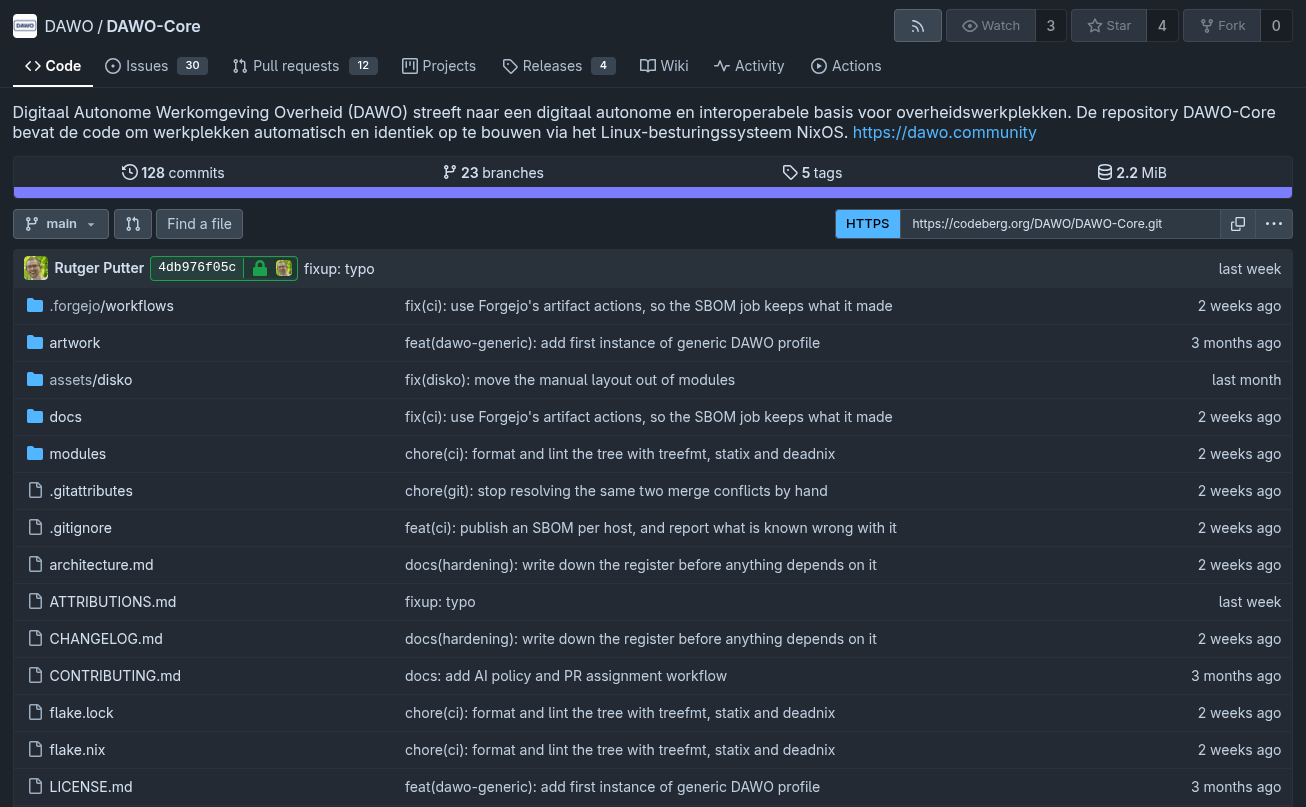
- Late 2025: The core DAWO repository is established on the government’s Forgejo instance, signaling a departure from commercial code-hosting platforms like GitHub.
- Early 2026: Initial pilot programs are launched across eight municipalities via the Association of Dutch Municipalities (VNG).
- Future (2027): The first stable, enterprise-wide release is projected to follow extensive feedback loops from municipal trials.
The Broader European Context: A Continental Trend
The Netherlands is by no means an outlier; it is part of a growing European movement toward digital sovereignty. The European Union has long been concerned about the dominance of US "Big Tech" in public infrastructure, but recent geopolitical events have accelerated these concerns into concrete action.
In Germany, the state of Schleswig-Holstein has become a poster child for this shift, having initiated a long-term transition away from Microsoft software. The regional government is redirecting its massive licensing fees toward the support of open-source projects, viewing the budget as an investment in a local, controllable ecosystem rather than a sunk cost in proprietary subscriptions.
Similarly, Denmark’s Road Traffic Authority has made headlines by ditching Microsoft services in favor of domestic, open-source solutions. In France, the momentum is even more pronounced, with the government pushing a national Linux transition. With 80,000 health insurance employees already migrated to domestic tools, France is proving that large-scale transitions are not just possible—they are viable at an enterprise scale.
Implications for the Future
The implications of the DAWO initiative are twofold: they are both political and economic.
Political Implications: The Reclaiming of Agency
DAWO serves as a clear signal that the Dutch government views digital infrastructure as a critical component of national security. By decoupling its operations from US-based tech giants, the Netherlands is insulating its administrative functions from the vagaries of foreign politics. This "digital neutrality" is likely to become a benchmark for other mid-sized nations seeking to maintain autonomy in a multipolar world.
Economic Implications: Building a Local Ecosystem
By hosting all DAWO code on an internal Forgejo instance and inviting collaboration via Codeberg, the Dutch government is fostering a domestic open-source industry. This is an investment in human capital. Rather than funneling tax revenue into the licensing coffers of foreign corporations, the government is creating a market for local IT consultants, systems integrators, and software developers who specialize in the NixOS ecosystem.
Challenges Ahead
Despite the enthusiasm surrounding DAWO, the path to a full-scale deployment remains complex. Transitioning a government to a new OS requires more than just code; it requires cultural change. Civil servants are accustomed to specific workflows and proprietary interfaces. The DAWO team acknowledges that the success of the project will hinge on the user experience.
The integration of legacy applications—software built decades ago that only runs on proprietary Windows APIs—remains the greatest technical hurdle. The DAWO team is currently exploring containerization and virtualization strategies to bridge this gap, ensuring that while the OS is sovereign, the essential functions of government are not disrupted during the transition.
Conclusion
The Dutch DAWO initiative is a watershed moment for open-source software in the public sector. It shifts the conversation from "open source as a cost-saving measure" to "open source as a strategic imperative for sovereignty." By grounding their digital future in the technical rigor of NixOS and the transparency of a public code repository, the Netherlands is building a model that other nations will undoubtedly study. In the wake of the ICC incident, the Dutch government has proven that while you cannot control the decisions of foreign powers, you can control the tools you use to run your country. DAWO is, in effect, the Dutch government reclaiming its digital house.








