From Satire to Silicon: How Maker Tucker Osman Brought the "Mactini" Meme to Life as a Fully Functional Micro-Laptop
Main Facts
In the ever-evolving landscape of maker culture and hardware hacking, the line between internet satire and functional engineering continues to blur. The latest testament to this phenomenon is the "Mactini," an ultra-small, fully functional minimalist computer engineered by maker Tucker Osman. Inspired by a satirical BBC meme that poked fun at the relentless pursuit of shrinking tech, Osman’s creation is far more than a mere visual gag. It is a genuine, working computing device packed into a microscopic form factor, operated entirely through a single, multi-functional button.
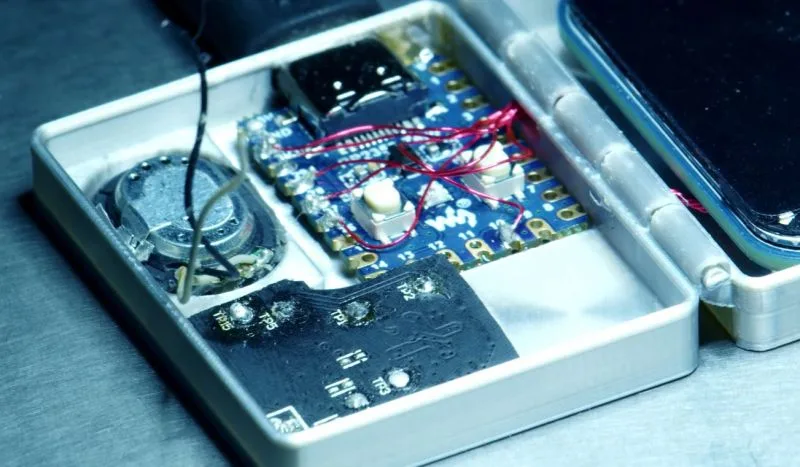
At its technical core, the Mactini is driven by a compact Waveshare development board powered by the cutting-edge RP2350 microcontroller. This modest yet capable brain manages the system’s display, audio output, and user inputs. Visual output is rendered on a minuscule 1.69-inch SPI LCD screen driven by an ST7789V2 controller, offering a resolution surprisingly adept at displaying basic text-based and graphical user interfaces. Housed inside a custom, 3D-printed enclosure designed in FreeCAD, the Mactini successfully bridges the gap between whimsical internet humor and serious embedded systems engineering.
Rather than relying on high-end, expensive off-the-shelf modules for every subsystem, Osman cleverly integrated recycled hardware. The audio output system, for instance, utilizes an iPad speaker paired with an audio amplifier salvaged from a discarded scrap board. This resourceful approach not only drastically reduces the overall cost of the build but also highlights the viability of e-waste recycling in modern DIY electronics. Complete with comprehensive technical documentation, schematics, and open-source design files shared on Hackaday.io, the Mactini project stands as a masterclass in creative engineering, efficient resource management, and minimalist design.
Chronology: The Evolution of a Meme-Turned-Machine
To understand the magnitude of the Mactini project, it is essential to trace its journey from a fleeting digital joke to a tangible piece of hardware resting on a workbench.
Phase 1: The Genesis of the Meme
The conceptual journey of the Mactini began in the digital ether. Rooted in a satirical BBC broadcast meme that mocked the tech industry’s obsession with making devices progressively thinner, lighter, and ultimately more ridiculous, the "Mactini" was initially conceptualized as the ultimate absurdity in ultra-portable computing—a laptop so small it defies practical utility. While most viewers laughed at the sketch and scrolled away, maker Tucker Osman saw a design challenge.
Phase 2: Component Selection and Architectural Planning
Moving from concept to execution, Osman began mapping out the hardware requirements. The primary constraint was physical space: the device had to be impossibly small while retaining core computing capabilities. The selection of the Waveshare board featuring the RP2350 microcontroller proved to be the pivotal turning point. Released as a successor to popular microcontrollers, the RP2350 offered the ideal balance of processing power, low power consumption, and peripheral support. For the visual interface, a 1.69-inch SPI LCD utilizing the ST7789V2 controller was selected for its small footprint and reliable driver support.
Phase 3: Prototyping and Firmware Optimization
With the core hardware chosen, Osman tackled the software architecture. Running a graphical display and processing video streams on a microcontroller presents significant bottlenecks. To overcome this, Osman implemented Direct Memory Access (DMA) within the firmware. This allowed screen data to be copied efficiently without bogging down the CPU cycles of the RP2350. Furthermore, Motion JPEG (MJEPG) decoding was integrated to handle video playback, allowing the Mactini to stream short clips and animations smoothly on its tiny screen.
Phase 4: Enclosure Design and Hardware Integration
Simultaneously, the physical shell of the device was designed using FreeCAD, an open-source parametric 3D modeler. The design underwent several iterations to ensure it could snugly house the Waveshare board, display, wiring, and the salvaged audio components without exceeding the micro-laptop aesthetic. Once finalized, the case was produced via 3D printing. The final assembly required delicate soldering, careful cable management, and the integration of the single tactile button that serves as the device’s sole input method.
Phase 5: Documentation and Community Release
Following successful testing, Osman compiled his notes, schematics, code, and 3D printing files, publishing the complete project documentation on Hackaday.io. This allowed fellow makers, enthusiasts, and engineers to examine his design choices, replicate the build, or adapt the firmware for their own ultra-minimalist hardware experiments.
Supporting Data and Technical Specifications
A closer examination of the Mactini’s bill of materials and technical architecture reveals a sophisticated deployment of low-cost, high-efficiency components.
| Component Category | Part / Specification | Function within the Mactini Architecture |
|---|---|---|
| Microcontroller | Waveshare board (RP2350-based) | Central processing unit managing system tasks, input, and peripherals |
| Display Panel | 1.69-inch SPI LCD (ST7789V2 controller) | Renders text, graphical interfaces, and Motion JPEG video output |
| Input Interface | Single Tactile Push-Button | Handles all user navigation, commands, and device interactions |
| Audio Transducer | Salvaged iPad Speaker | Converts audio signals into audible sound waves |
| Audio Amplification | Recycled amplifier from scrap board | Boosts audio signals to drive the iPad speaker clearly |
| Enclosure | Custom 3D-printed shell (FreeCAD) | Houses and protects internal electronics while defining the form factor |
| Firmware Protocol | Direct Memory Access (DMA) | Optimizes screen data transfer and reduces CPU latency |
| Video Decoding | Motion JPEG (MJPEG) | Enables smooth playback of animations and video clips on a micro-screen |
The engineering choices reflect a deep understanding of resource constraints. By utilizing DMA for screen refreshing, the Mactini avoids the common pitfalls of micro-controller graphics processing, such as stuttering frames and high latency. The decision to incorporate salvaged audio components underscores an increasing awareness within the maker community regarding sustainability and electronic waste reduction.
Official Responses and Maker Community Reactions
The unveiling of the Mactini has generated considerable buzz across hacker spaces, online maker forums, and embedded systems communities. Rather than being dismissed as a transient novelty, the project has been widely praised for its clever firmware implementation and hardware ingenuity.
Tucker Osman, reflecting on the challenges encountered during the build, noted that the primary hurdle was not necessarily physical miniaturization—though routing wires in such a confined space required immense patience—but rather software optimization. Fitting video decoding routines and efficient display handling onto a microcontroller without exceeding memory limitations demanded creative programming strategies.
Prominent figures within the open-source hardware community have lauded the project’s documentation. On platforms like Hackaday.io, fellow engineers have expressed admiration for how Osman turned a satirical concept into a fully functional piece of educational technology. Reviewers have highlighted the Mactini as a prime example of "creative computing," where the limitations imposed by the hardware actually inspire more elegant software solutions. Furthermore, educators have pointed to the Mactini as an engaging pedagogical tool to introduce students to microcontroller programming, DMA utilization, and the principles of computer architecture without requiring expensive lab equipment.
Implications of the Mactini Project
While the Mactini is unlikely to replace commercial laptops or even mainstream handheld gaming consoles, its cultural and technical implications extend far beyond its diminutive size.
1. Redefining Minimalist Human-Computer Interaction
By condensing every computing function down to a single button, the Mactini challenges modern interface paradigms. In an era where devices boast multi-touch displays, gesture controls, voice activation, and complex keyboard layouts, the Mactini strips interaction back to its absolute bedrock. It forces designers and users alike to rethink how much input complexity is truly necessary for basic computing tasks.
2. Promoting Sustainable E-Waste Recycling
The integration of salvaged components—such as the iPad speaker and scrap-board amplifier—sends a powerful message to the broader tech industry and DIY community. As electronic waste continues to mount globally, projects that successfully incorporate harvested parts demonstrate that high-performance innovation does not always necessitate buying brand-new silicon and components. This ethos encourages a circular economy mindset among hobbyists and professional engineers alike.
3. Democratizing Advanced Embedded Engineering
By sharing comprehensive documentation, FreeCAD files, and firmware routines openly, Osman has lowered the barrier to entry for advanced microcontroller projects. Aspiring makers who might be intimidated by complex embedded systems can use the Mactini as a stepping stone to learn about SPI displays, DMA memory management, and 3D computer-aided design.
4. The Power of Playful Innovation
Ultimately, the Mactini proves that humor and creativity are potent catalysts for technical excellence. By taking a satirical meme seriously, Tucker Osman not only created a functional, conversation-starting device but also pushed the boundaries of what can be achieved with modest microcontrollers and a healthy dose of maker ingenuity. As technology marches relentlessly toward greater complexity, projects like the Mactini remind us of the pure, inventive joy found in building something extraordinary out of next to nothing.