Waveshare Unveils Powerful ESP32-C5 Development Board Featuring a 3.5-Inch Touch Display and Advanced AI Voice Capabilities
The newly released development kit merges dual-band Wi-Fi, Matter/Thread connectivity, and comprehensive sensor suites into a breadboard-friendly form factor designed for next-generation smart home interfaces.
Main Facts
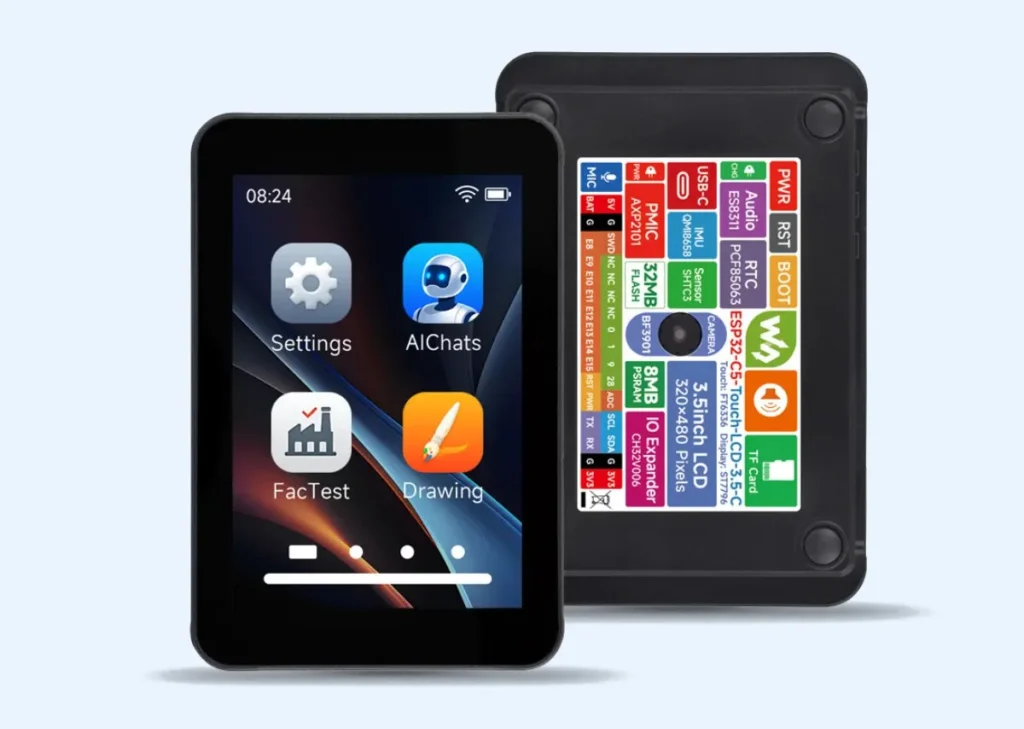
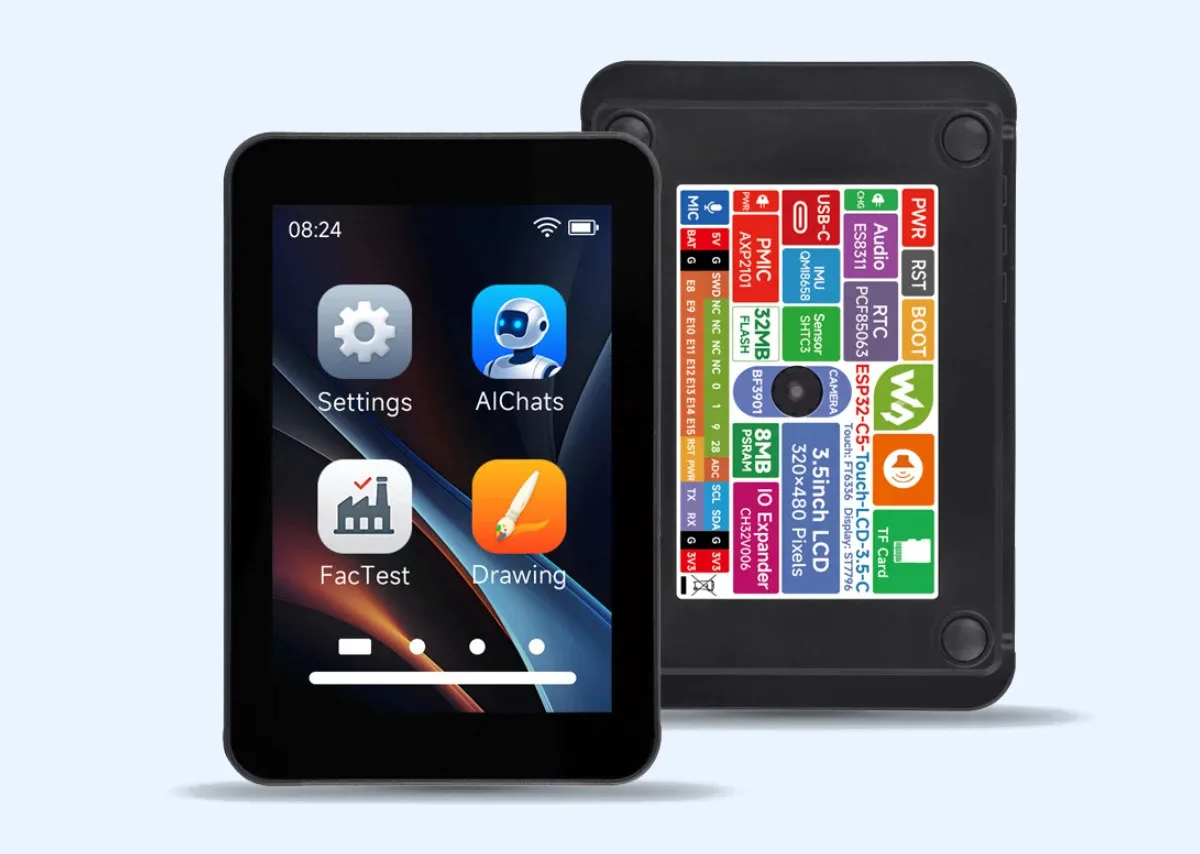
Waveshare has introduced a feature-rich, highly integrated development board centered around the Espressif ESP32-C5-WROOM-1U module, coupled with a spacious 3.5-inch capacitive IPS touch display. Representing one of the most capable and expansive ESP32-C5 form factors featuring an integrated touch panel to date, this devkit is purpose-built for developers looking to craft sophisticated voice-activated and visual interfaces capable of communicating seamlessly with cloud-based Large Language Models (LLMs) and advanced AI platforms.
Powered by a 32-bit RISC-V primary processor running at speeds up to 240 MHz, the board is heavily provisioned with onboard memory: 384 KB of SRAM, 320 KB of ROM, 8 MB of PSRAM, and a substantial 32 MB of Flash memory. Additionally, a secondary low-power RISC-V core operating at 40 MHz handles background tasks and power efficiency optimization.
Wireless connectivity is a primary strong suit. The integrated ESP32-C5 radio module supports dual-band Wi-Fi (operating on both 2.4 GHz and 5 GHz spectra), Bluetooth 5 LE, and IEEE 802.15.4 protocols. This multi-radio configuration enables native support for modern smart home communication standards such as Zigbee 3.0 and Thread, allowing the board to integrate directly into Matter-compliant home automation ecosystems without requiring supplementary hardware or communication modules.
The hardware ecosystem built around the processor is exceptionally dense. Visuals are managed by a 3.5-inch capacitive IPS panel boasting a 320 x 480 pixel resolution and 262K color depth, driven by an ST7796 controller over an SPI interface, while an FT6336 touch controller handles user interaction via the I2C bus. Furthermore, the board packs an onboard suite of environmental and motion sensors, including a six-axis QMI8658 Inertial Measurement Unit (IMU), a PCF85063 Real-Time Clock (RTC), and an SHTC3 temperature and humidity sensor.
Audio capabilities are equally robust, featuring an ES8311 audio codec paired with an NS4150B amplifier, supplemented by an onboard microphone and speaker setup. This enables complete bidirectional audio functionality—recording user speech, playing back synthesized responses, and supporting interactive, real-time conversational agents. Storage expansion is supported via an onboard TF (microSD) card slot, ideal for logging data and caching heavy multimedia assets.
Pricing for the kit spans $31.99 to $35.99 directly through Waveshare’s official storefront, ranging slightly higher on third-party platforms like AliExpress ($37.99 to $43.99) and Amazon ($43.99 to $47.99), depending on bundled accessories such as an optional camera module and 3.7V lithium battery.
Chronology of Development
The arrival of the Waveshare ESP32-C5 3.5-inch touch devkit represents the culmination of several years of silicon evolution by Espressif Systems and subsequent hardware integration by modular manufacturing leaders like Waveshare.
- Late 2023 – Early 2024: Espressif Systems announces the development of the ESP32-C5 microcontroller family, marking a major milestone as the company’s first RISC-V-based SoC to incorporate native dual-band (2.4 GHz and 5 GHz) Wi-Fi alongside 802.15.4 connectivity.
- Mid 2024: Engineering samples and early modules—specifically the ESP32-C5-WROOM-1U—begin reaching prominent hardware partners and design houses, igniting prototyping efforts aimed at bridging low-cost microcontrollers with high-efficiency wireless mesh protocols (Thread/Zigbee).
- Late 2024 – 2025: Demand grows within the maker and IoT engineering communities for localized edge-AI interfaces capable of bridging hardware endpoints with powerful cloud LLMs (such as OpenAI’s GPT models or open-source alternatives). Developers increasingly experiment with combining ESP32 series chips with touchscreens and audio codecs.
- September 2026: Waveshare officially launches its comprehensive development board centered on the ESP32-C5 module and a massive 3.5-inch capacitive touch IPS display. Documentation, sample firmware utilizing ESPBrookesia, and tutorials for the XiaoZhi AI voice assistant platform go live on Waveshare’s official technical portal, opening the ecosystem to global developers.
Supporting Data & Technical Specifications
To fully understand the engineering footprint of Waveshare’s new offering, a granular review of its internal architecture, electrical characteristics, and software toolchains provides clear context for its capabilities.
Hardware Specifications Table
| Feature / Component | Specification Details |
|---|---|
| Microcontroller Module | ESP32-C5-WROOM-1U |
| Main Processing Core | 32-bit RISC-V, up to 240 MHz |
| Low-Power Core | RISC-V, 40 MHz |
| Onboard Memory | 384 KB SRAM, 320 KB ROM, 8 MB PSRAM, 32 MB Flash |
| Wireless Connectivity | Dual-band Wi-Fi (2.4/5 GHz), Bluetooth 5 LE, IEEE 802.15.4 (Zigbee 3.0, Thread, Matter) |
| Display Panel | 3.5-inch IPS Capacitive Touch, 320 x 480 resolution, 262K colors |
| Display & Touch Drivers | ST7796 (SPI interface for display), FT6336 (I2C interface for touch) |
| Sensors & Peripherals | QMI8658 6-axis IMU, PCF85063 RTC, SHTC3 Temp/Humidity sensor |
| Audio Subsystem | ES8311 Audio Codec, NS4150B Amplifier, Onboard Microphone & Speaker |
| Power Management | AXP2101 PMU, USB Type-C port, MX1.25 connector for optional 3.7V Li-ion battery |
| Physical Dimensions | 95.11 x 63.67 x 14.10 mm |
| Expansion Interface | 32-pin expansion header (2.45 mm pitch, breadboard-friendly) |
| Software Ecosystem | ESP-IDF, Arduino IDE, VS Code (Espressif IDF plugin), ESPBrookesia, XiaoZhi AI framework |
Power Management and Form Factor
The inclusion of the AXP2101 Power Management Unit (PMU) elevates the board from a benchtop prototype to a viable candidate for portable, battery-powered deployments. Power can be delivered via the modern USB Type-C interface or an optional 3.7V lithium battery connected securely via an MX1.25 header. Measuring 95.11 x 63.67 x 14.10 mm, the hardware incorporates a 32-pin expansion header featuring a standard 2.45 mm pitch, making it straightforward to mount directly onto traditional breadboards or custom carrier boards without requiring specialized interface adapters.

Software and Development Ecosystem
Waveshare provides robust out-of-the-box software support to minimize time-to-market for developers. The board is natively compatible with Espressif’s official ESP-IDF development framework, the popular Arduino IDE, and Visual Studio Code equipped with the Espressif IDF extension.
Factory-loaded firmware leverages ESPBrookesia, Espressif’s modular system framework designed specifically for smart appliances and GUI development. Furthermore, Waveshare has released comprehensive technical guides and tutorials centered around the XiaoZhi AI voice assistant ecosystem, demonstrating how developers can link the hardware directly to online conversational AI models, speech-to-text engines, and text-to-speech APIs.
Official Responses and Documentation
Waveshare has positioned the release as a vital stepping stone for engineers looking to bridge the gap between traditional embedded microcontrollers and modern generative artificial intelligence.
In official documentation published via the Waveshare Developer Portal, the manufacturer emphasizes that the board is engineered specifically to eliminate the friction typically associated with designing connected edge devices. By consolidating high-resolution touch displays, high-fidelity audio codecs, multi-protocol wireless radios, and diverse environmental sensors onto a single, cohesive printed circuit board (PCB), developers no longer need to spend weeks designing custom breakout boards or debugging complex wiring harnesses.
Technical representatives from the engineering team have highlighted the significance of the ESP32-C5’s dual-band Wi-Fi capabilities. In dense residential or commercial environments where the overcrowded 2.4 GHz spectrum frequently suffers from interference, packet loss, and latency spikes, the ability to operate reliably on the 5 GHz band ensures robust, low-latency streaming of audio data and seamless communication with cloud-based AI services. Furthermore, native integration of 802.15.4 means the device bypasses the need for external co-processors when bridging local home automation mesh networks with cloud platforms.
Implications for the IoT and Edge-AI Industry
The launch of Waveshare’s ESP32-C5 touch devkit carries several broad implications for hobbyists, commercial product designers, and the wider Internet of Things (IoT) landscape:
1. Democratization of Conversational Edge AI
Historically, building a functional, voice-controlled smart assistant interface required pairing expensive single-board computers (such as a Raspberry Pi 4 or 5) with external USB microphones, sound cards, and standalone touchscreens—a setup characterized by high power consumption, expensive component bills, and lengthy boot times. By shifting this capability down to a low-cost, low-power RISC-V microcontroller like the ESP32-C5, developers can now build responsive, network-connected voice terminals that boot instantly, consume minimal electrical power, and operate efficiently on battery backup.
2. Streamlining the Smart Home Matter Standard
With the industry-wide push toward the Matter interoperability standard, smart home devices must increasingly communicate locally via Thread or Wi-Fi while maintaining secure cloud connections. The inclusion of dual-band Wi-Fi and an 802.15.4 radio directly on the ESP32-C5 silicon allows this development kit to serve simultaneously as an advanced control panel (or "smart switch") and an active node inside a secure Matter mesh network. This dual functionality dramatically simplifies the development of smart home wall panels, thermostats, and intelligent appliance interfaces.
3. Accelerated Prototyping and Lowered Financial Barriers
Priced between $31 and $48 depending on retail channels and optional hardware bundles (such as integrated cameras and lithium batteries), the kit significantly lowers the financial barrier to entry for enterprise prototyping. Engineering teams can quickly validate proof-of-concept designs for smart home hubs, industrial machine interfaces, retail kiosk controllers, and interactive educational tools without committing to expensive custom silicon tooling or complex multi-board manufacturing runs.
As edge computing continues to merge with cloud-based large language models, hardware modules like Waveshare’s ESP32-C5 touch devkit provide the exact foundational building blocks required to bring conversational intelligence out of the smartphone and directly into everyday physical appliances.