Next-Generation Portable IoT: Inside the New ESP32-S3R8 Touch E-Paper Development Board with LoRa and NFC
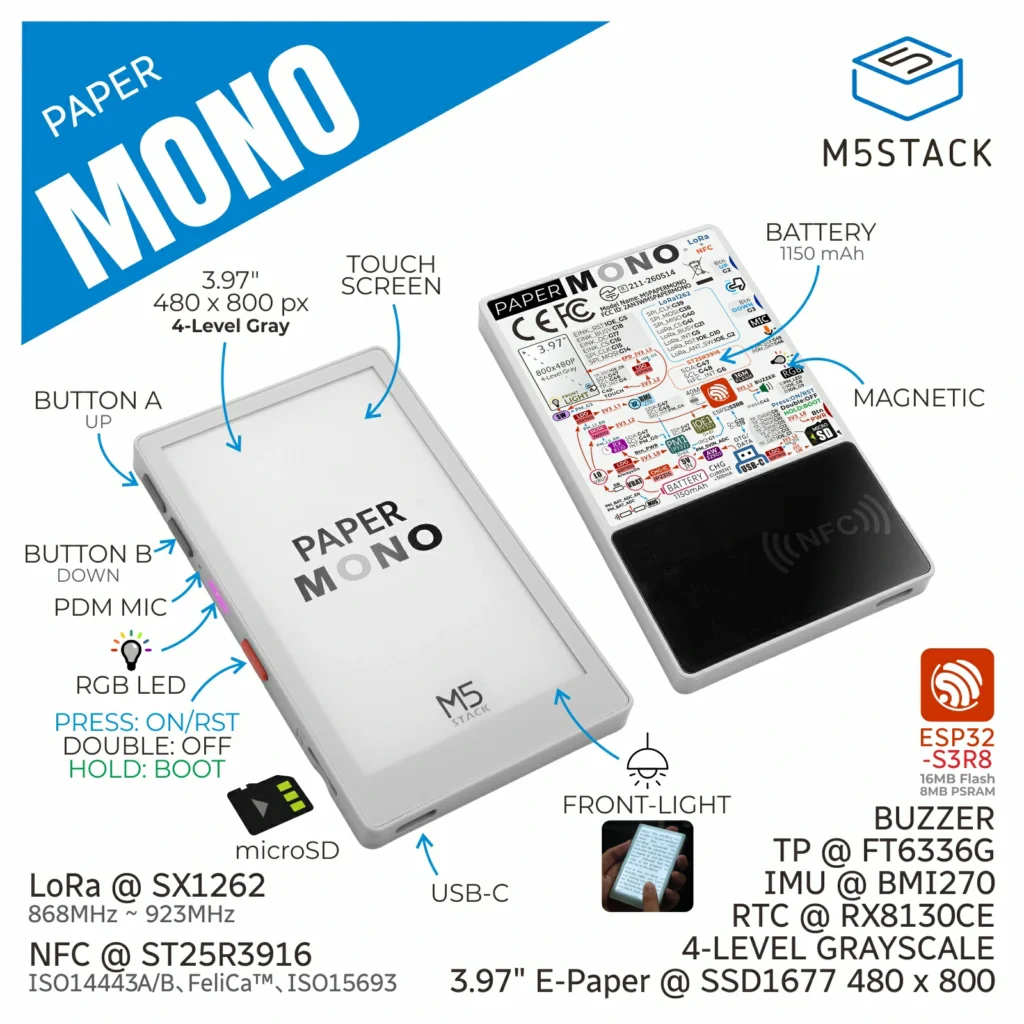
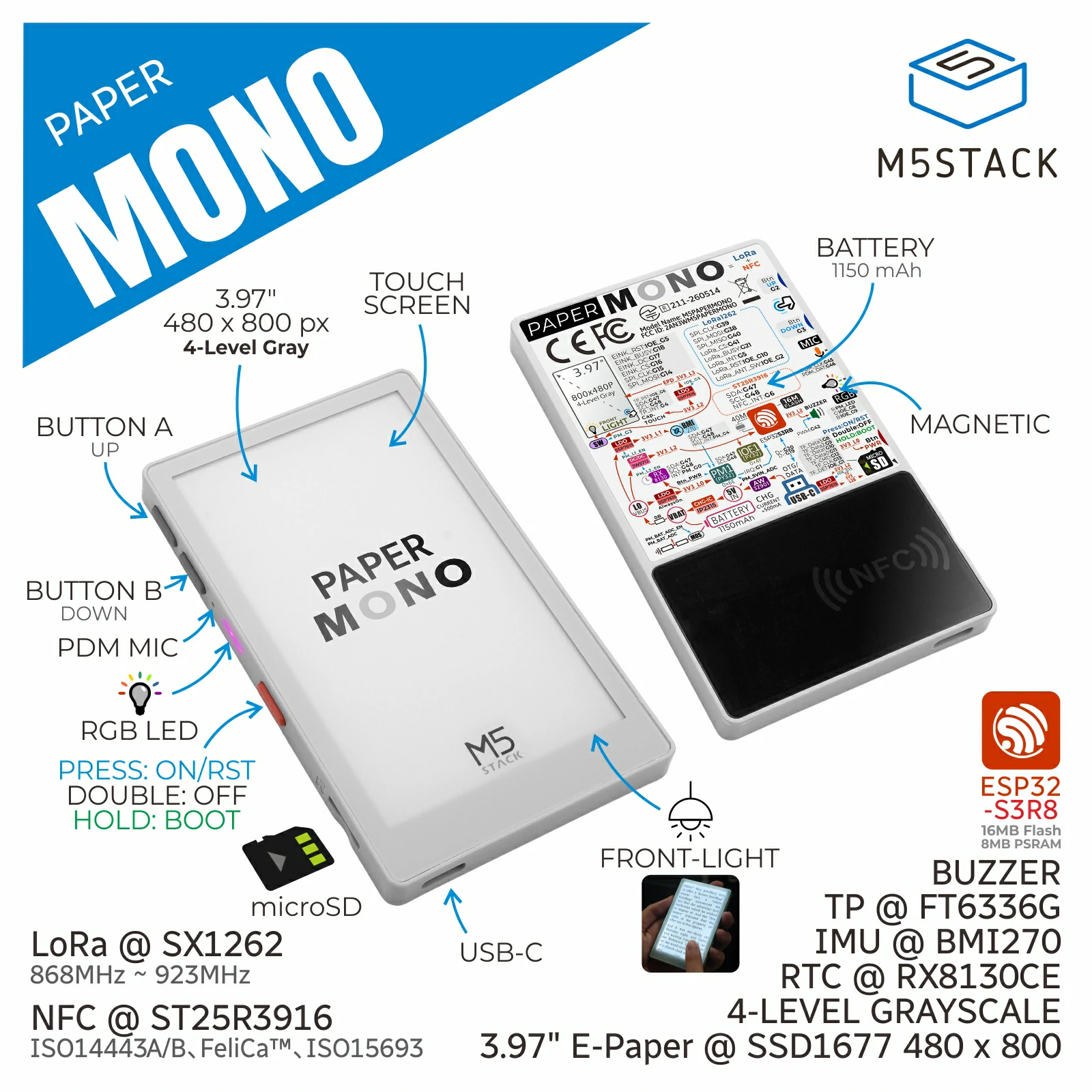
The landscape of edge computing and portable Internet of Things (IoT) hardware has taken a significant leap forward. A newly introduced development board has merged several of the most sought-after technologies in embedded systems—a 3.97-inch capacitive touch e-paper display, LoRa long-range wireless communication, and Near Field Communication (NFC)—onto a single, highly integrated ESP32-S3R8 platform.
Designed explicitly for developers, engineers, and makers crafting standalone, battery-powered smart objects, this compact device eliminates the historical trade-offs between rich user interfaces, long-range connectivity, and energy efficiency. By packing an extensive array of environmental, inertial, and audio peripherals into a chassis that measures just 101 x 61 x 7.95 mm and weighs a mere 74.7 grams, the board sets a new standard for all-in-one IoT prototyping and deployment.
Main Facts: A Powerhouse of Integrated Features
At first glance, the sheer density of hardware features integrated into this slim form factor is striking. The architecture centers around the powerful ESP32-S3R8 module, bolstered by 8 MB of PSRAM and 16 MB of high-speed flash memory. This substantial memory allocation ensures that developers can run complex, resource-heavy graphical user interfaces and manage multiple concurrent communication protocols without encountering memory bottlenecks.
The visual output is anchored by a high-resolution 3.97-inch monochrome e-paper display featuring an 800 × 480 pixel layout and 4-gray-level support. Managed by an SSD1677 display driver and paired with an FT6336G capacitive touch controller, the screen bridges the gap between the ultra-low power consumption of electronic paper and the interactive fluidity of modern touch interfaces.
Connectivity options are equally robust. For long-range, low-power telemetry, the board integrates a Stamp LoRa-1262 module driven by Semtech’s SX1262 chip, operating seamlessly across the 868 MHz to 923 MHz frequency bands. Short-range data exchange and identification are handled by an ST25R3916 NFC chip, offering comprehensive support for ISO14443A, ISO14443B, FeliCa, and ISO15693 protocols.
Beyond display and communication, the board functions as a complete sensory node out of the box. It features:
- BMI270 6-axis Inertial Measurement Unit (IMU): For motion, tilt, and spatial orientation tracking.
- RX8130CE Real-Time Clock (RTC): Ensuring accurate timekeeping even during deep-sleep states or complete power-downs.
- PDM Microphone and Buzzer: Enabling localized audio feedback, alarms, and primitive voice-command implementations.
- 1150 mAh Lithium Battery: Rechargeable via an onboard USB Type-C port, providing ample autonomous runtime for field deployments.
Chronology: The Evolution Toward All-in-One IoT Prototyping
The journey toward this comprehensive development board reflects broader shifts in the embedded systems industry over the past decade.
- Phase 1: Fragmented Prototyping (Early 2010s): Building a portable IoT device historically required stacking multiple breakout boards. Developers routinely wired an Arduino or early ESP8266 microcontroller to a separate LoRa shield, an individual e-paper breakout, and external sensor modules via jumper wires. This resulted in bulky, fragile prototypes plagued by power management inefficiencies and high failure rates.
- Phase 2: The Rise of Specialized SoCs (2018–2022): The introduction of Espressif Systems’ ESP32 family revolutionized the market by integrating Wi-Fi and Bluetooth onto single, affordable chips. However, adding specialized low-power displays or sub-GHz radio protocols still required modular additions, leaving a gap in the market for fully integrated, low-power visual IoT nodes.
- Phase 3: The Convergence of E-Paper and Wireless (2023–Present): Manufacturers began exploring tighter integration of electronic paper displays with microcontrollers due to the soaring demand for sustainable, sunlight-readable smart tags, industrial dashboards, and asset-tracking badges. The culmination of this trend is the current ESP32-S3R8 board, which merges visual interactivity, tactile touch input, motion sensing, local audio, and dual-frequency wireless protocols (LoRa and NFC) into a single commercial-off-the-shelf (COTS) unit.
Supporting Data and Technical Specifications
To fully understand the engineering achievement behind this board, a granular look at its performance metrics and hardware capabilities is required.
Display Performance and Refresh Modes
Electronic paper has historically suffered from sluggish refresh rates, limiting its utility in dynamic interfaces. This board addresses the limitation through advanced driver tuning (SSD1677) and offers multiple operational profiles:
- Quality Mode: Requires approximately 4.71 seconds for a full screen refresh, prioritizing high contrast and image fidelity.
- Fastest Mode: Reduces refresh time to an astonishing 0.07 seconds (70 milliseconds), rendering the screen viable for rapid UI transitions, menus, and simple animations.
Radio and Communication Parameters
- LoRa Subsystem: Powered by the Semtech SX1262 within the Stamp LoRa-1262 module. Operating in the 868/923 MHz spectrum, it provides exceptional link budgets for kilometer-range transmissions in rural or industrial settings while drawing minimal current during transmission bursts.
- NFC Subsystem: Built around the ST25R3916. It enables rapid pairing, badge emulation, asset identification, and bidirectional data transfer with standard NFC-enabled smartphones and industrial readers.
Physical and Electrical Specifications
- Dimensions: 101 mm × 61 mm × 7.95 mm
- Weight: 74.7 grams
- Processor: ESP32-S3R8 dual-core Xtensa LX7 microprocessor
- Memory: 8 MB PSRAM, 16 MB Flash
- Power Source: Integrated 1150 mAh rechargeable Li-ion battery with USB-C charging circuitry and power management ICs.
Software Ecosystem and Developer Support
Powerful hardware is only as good as the software ecosystem supporting it. The manufacturer has prioritized accessibility by ensuring that the board integrates smoothly with industry-standard development frameworks.
Arduino IDE and ESP-IDF Compatibility
For hobbyists and rapid prototypers, the board is fully compatible with the Arduino IDE, allowing developers to leverage thousands of existing libraries for sensors, displays, and communication protocols. For enterprise deployments and performance-critical applications, engineers can utilize ESP-IDF (Espressif IoT Development Framework), gaining deep control over power states, dual-core task scheduling, and hardware acceleration features.
UiFlow 2 Support
To further lower the barrier to entry, the board supports UiFlow 2, a visual block-based and Python-driven programming environment. This allows users to construct complex IoT logic, design graphical user interfaces, and establish cloud or local data pipelines without writing extensive lines of boilerplate code.
Official demonstration repositories and user guides are hosted on platforms like GitHub (notably the M5PaperMono-UserDemo project), providing developers with turnkey examples to initialize the e-paper display, read the 6-axis IMU, parse NFC tags, and transmit telemetry packets via LoRa.
Implications for the IoT Industry
The introduction of a unified, highly integrated touch e-paper device carrying both LoRa and NFC has profound implications across multiple vertical markets.
1. Sustainable Industrial Automation and Smart Warehousing
In industrial environments, equipment monitoring dashboards must remain active for months or years without battery replacements. E-paper technology consumes power only when the image changes. Combined with the deep-sleep capabilities of the ESP32-S3R8 and the long-range reporting of LoRa, this board can serve as a remote maintenance terminal or smart bin label that updates dynamically based on sensor feedback from the internal IMU or external machinery.
2. Smart Agriculture and Environmental Monitoring
Agricultural IoT deployments frequently suffer from lack of grid power and harsh sunlight that washes out standard LCD or OLED panels. E-paper is exceptionally readable under direct sunlight. Field technicians can carry this portable device to remote crop-monitoring stations, use NFC to instantly pair or retrieve local diagnostic logs from underground soil sensors, and view real-time telemetry without straining the battery.
3. Smart Access Control, Asset Tracking, and Event Badging
Because the board supports NFC, a 6-axis IMU, and a buzzer, it functions exceptionally well as an intelligent, interactive badge. It can act as an access control token, display dynamic schedule updates or credentials via e-paper, track physical movement via the accelerometer, and sound local alerts or acoustic feedback.
4. Prototyping Efficiency
By eliminating the engineering overhead associated with custom PCB design, component sourcing, and signal integrity testing for disparate radios and displays, this board dramatically shortens time-to-market. Startups and enterprise research-and-development departments can transition from a proof-of-concept idea to a field-testable prototype in a fraction of the traditional timeline.
Conclusion
The convergence of a high-speed capacitive touch e-paper display, dual wireless standards (LoRa and NFC), robust onboard sensing (IMU, RTC, microphone), and substantial computing overhead (ESP32-S3R8 with 8 MB PSRAM) creates a compelling proposition for modern IoT developers.
By solving the historical challenges of high power draw, poor sunlight readability, and fragmented hardware architectures, this device stands out as a formidable platform for portable smart objects. Whether deployed in smart logistics, agricultural telemetry, or interactive industrial interfaces, it provides a versatile, future-proof foundation for the next generation of connected edge devices.