Securing the Modern Web: A Comprehensive Deep Dive into Acunetix Web Vulnerability Scanner (WVS)
Introduction: The Escalating Threat Landscape of Web Applications
In the digital era, websites and web-based applications have transcended their origins as simple static brochures to become the absolute core of global business operations. From e-commerce platforms processing millions of daily financial transactions to cloud-hosted enterprise resource planning (ERP) systems, the modern web application ecosystem serves as the backbone of commerce.

However, this heightened reliance on web architecture has inevitably attracted malicious actors. Cybercriminals are more active, sophisticated, and automated than ever before, constantly probing the digital perimeter for weaknesses to exfiltrate critical business data, compromise customer privacy, and launch devastating operational disruptions.

Within this high-stakes environment, security auditing can no longer remain an afterthought appended to the end of a development lifecycle. Proactive web vulnerability scanning must be integrated natively into a comprehensive software testing life cycle (STLC). Enter the Acunetix Web Vulnerability Scanner (WVS)—an industry-standard, automated security auditing solution engineered specifically to combat the relentless rise of threats targeting the web application layer.

Main Facts: What Is Acunetix Web Vulnerability Scanner?
Acunetix WVS is a robust, highly optimized web application security testing tool designed to identify critical vulnerabilities such as SQL Injection (SQLi), Cross-Site Scripting (XSS), and the entire spectrum of the OWASP Top 10 risks. Functioning primarily as a black-box scanner, Acunetix evaluates websites and web applications without requiring prior knowledge of their underlying source code or architecture—mimicking the exact methodology of a real-world attacker.

Core Capabilities at a Glance:
- Automated Auditing: Launches intelligent suites of simulated attacks against target web environments.
- Detailed Reporting: Generates granular developer notes, executive summaries, and rigorous compliance documentation.
- Advanced Engine Integrations: Features the DeepScan engine for handling complex HTML5, AJAX, and JavaScript-heavy applications.
- Interactive Application Security Testing (IAST): Utilizes optional server-side sensors (AcuSensor) for pinpoint accuracy.
- Out-of-Band Detection: Leverages AcuMonitor to track elusive second-order vulnerabilities.
Chronology: A Hands-On Walkthrough of an Acunetix WVS Security Audit
To understand how Acunetix WVS operates in a live environment, we can trace the chronological sequence of setting up, executing, analyzing, and resolving a security scan using the software’s intuitive interface.

Phase 1: Initiating and Configuring the Scan Wizard
Starting a new security audit is streamlined via the Scan Wizard, accessible directly from the main toolbar.

- Target Selection: The auditor designates the target URL. For testing and training purposes, Acunetix maintains dedicated test beds (such as
http://testphp.vulnweb.com). - Scanning Profile Selection: Auditors select a logical grouping of tests. While the Default profile executes every available test, users can tailor profiles to focus exclusively on high-risk alerts or custom parameters to save time.
- Granular Scan Settings: Although default configurations cater to the vast majority of web applications, users can fine-tune proxy configurations, network timeouts, and crawling scopes. Advanced options even allow importing crawling results from third-party tools like PortSwigger’s Burp Suite, Telerik’s Fiddler, or Acunetix’s native HTTP Sniffer.
Phase 2: Navigating Password-Protected Areas and Login Sequences
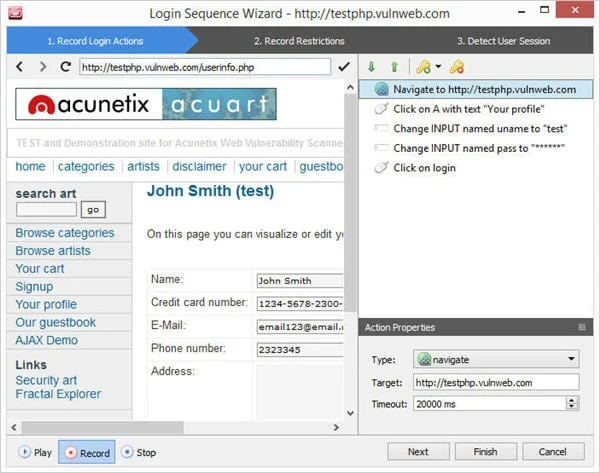
Modern web applications frequently lock core functionalities behind authentication gateways. Configuring a scanner to handle logins can historically be tedious, but Acunetix WVS simplifies this through its Login Sequence Recorder.

- Recording the Session: The auditor walks through the standard login procedure in a browser-like recorder. Acunetix captures these actions to replay them during the automated scan.
- Excluding Destructive Links: To prevent the scanner from accidentally logging itself out during a crawl, users can restrict specific links (such as a "Logout" button or dynamic nonces protected by wildcards).
- Session Patterns: The recorder automatically detects unique indicators that differentiate a "logged-in" state from a "logged-out" state, ensuring the scanning engine maintains proper access throughout the audit lifecycle.
- Mobile User-Agents: Acunetix intelligently identifies if a target site responds differently to mobile devices, allowing auditors to switch user-agent strings to mimic iPhones or Android devices.
Phase 3: Execution, Analysis, and Remediation
Once the crawl and scan conclude, Acunetix WVS compiles a comprehensive list of vulnerabilities, categorized by severity.

Clicking on a specific vulnerability—such as an SQL Injection flaw—reveals the exact input parameter affected alongside variations of the attack payloads used. The software provides a deep-dive summary explaining the risk, its potential business impact, and precise remediation advice.

Phase 4: Re-Testing and Verification
Rather than forcing security teams to run a lengthy, full-site scan from scratch to verify a fix, Acunetix features a dedicated Retest function. By right-clicking a resolved alert and selecting Retest alert(s), the scanner runs targeted checks on that specific parameter. Successfully patched vulnerabilities are clearly marked in a grey, strike-through font.

Supporting Data: Advanced Technologies Powering Acunetix WVS
What separates basic vulnerability scanners from enterprise-grade auditing tools is the sophistication of their underlying technology stacks. Acunetix WVS incorporates several proprietary engines to ensure minimal false positives and maximum coverage.

1. The DeepScan Engine (Handling AJAX and JavaScript)
Modern single-page applications (SPAs) rely heavily on complex JavaScript frameworks, HTML5, and asynchronous AJAX calls. Traditional crawlers frequently fail to map these applications properly.

Acunetix integrates a fully functional headless browser directly into its crawler via the DeepScan Engine. This allows the scanner to:

- Execute and interact with client-side code dynamically.
- Detect DOM-based Cross-Site Scripting (DOM-XSS) with exceptional accuracy.
- Generate a complete execution stack trace, showing developers precisely how an XSS payload flowed through the browser’s Document Object Model.
2. AcuSensor for IAST (Interactive Application Security Testing)
Black-box scanning has inherent limitations because it cannot observe internal server-side code execution. Conversely, traditional static source code analysis tools often struggle to contextualize vulnerabilities in a live runtime environment.

Acunetix bridges this gap via AcuSensor, an optional server-side component available for PHP and .NET applications.

- Seamless Installation: In .NET environments, DLLs do not need to be recompiled; sensors can be injected and un-injected on the fly.
- Unmatched Precision: Because the sensor has direct visibility into backend logic, it uncovers hard-to-reach flaws that black-box scanners miss, such as SQL injections nested inside
INSERTstatements or deep database queries. - Code-Level Reporting: AcuSensor points developers directly to the exact file and line of vulnerable code, dramatically shrinking remediation windows.
3. AcuMonitor for Out-of-Band Vulnerabilities
Certain security flaws do not yield immediate responses during an automated scan. These second-order vulnerabilities include:

- Blind XSS (Delayed XSS)
- XML External Entity Injection (XXE)
- Server-Side Request Forgery (SSRF)
- Host Header Attacks and Email Header Poisoning
- Blind Out-of-Band SQL Injection and Remote Code Execution
Acunetix solves this through AcuMonitor, a cloud-based intermediary service that monitors out-of-band network callbacks in the background. When a targeted application interacts with the AcuMonitor service asynchronously, Acunetix automatically logs and flags the second-order vulnerability without requiring manual intervention from the security auditor.

Official Responses and Enterprise Reporting
Compliance and stakeholder communication are critical pillars of any corporate cybersecurity strategy. Acunetix WVS features a dedicated Reporter module capable of translating raw technical findings into actionable, audience-specific documentation.

Compliance and Executive Reporting
- High-Level Overviews: Executives and non-technical stakeholders can review concise documents such as the Executive Summary, Quick Report, and Affected Items summary.
- Regulatory Compliance Standards: Organizations bound by strict regulatory frameworks can generate pre-formatted reports aligned directly with industry standards, including the OWASP Top 10, PCI-DSS, and HIPAA. These templates are updated regularly to reflect evolving compliance mandates.
- Developer Reports: Highly configurable and technical, these reports supply engineering teams with exact code snippets, parameter variations, and remediation guidelines, exportable in professional formats such as PDF and HTML.
Implications: The Future of Web Application Security Testing
The deployment of automated tools like Acunetix Web Vulnerability Scanner marks a profound shift in how organizations approach digital defense. By combining aggressive black-box probing with advanced technologies like IAST (AcuSensor), headless browser crawling (DeepScan), and out-of-band monitoring (AcuMonitor), Acunetix equips both security professionals and software developers with an all-in-one arsenal.

Key Takeaways for Organizations:
- Shift-Left Security: Integrating automated scanners into the STLC ensures vulnerabilities are caught during development rather than after a catastrophic public breach.
- Efficiency and Accuracy: Advanced fingerprinting technology optimizes scan times by tailoring checks to specific backend stacks (PHP, .NET, Ruby, Java, and major CMS platforms like WordPress), while sensor integration eliminates frustrating false positives.
- Manual + Automated Synergy: Beyond automated auditing, Acunetix includes integrated manual penetration testing tools, allowing security auditors to verify complex threat vectors seamlessly within a single software environment.
As cyber threats grow increasingly automated, enterprises must fight fire with intelligent automation. Tools like Acunetix WVS provide the visibility, precision, and reporting required to maintain a resilient security posture in an ever-hostile digital landscape.