The Edge AI Frontier: Optimizing Ultralytics YOLO26 on Raspberry Pi with Intel OpenVINO
The landscape of edge computing is undergoing a radical transformation as high-performance computer vision models move from data centers to localized, low-power hardware. In a landmark technical collaboration, engineers from Intel and Ultralytics have unveiled a comprehensive framework for deploying the latest YOLO (You Only Look Once) models on Raspberry Pi hardware using the OpenVINO toolkit.
This initiative, spearheaded by Alexander Nesterov and Dmitriy Pastushenkov of Intel, alongside Francesco Mattioli and Nuvola Ladi of Ultralytics, marks a significant milestone in making real-time AI accessible for developers, hobbyists, and industrial engineers. By leveraging the OpenVINO 2026.2.0 release, the partnership has effectively turned the Raspberry Pi—a device once considered too modest for heavy inference—into a robust platform for sophisticated visual intelligence.
Main Facts: A Unified Vision for the Edge
The core of this development lies in the integration of Ultralytics YOLO26 with the OpenVINO (Open Visual Inference and Neural Network Optimization) runtime. OpenVINO serves as a deployment layer that abstracts the complexities of the underlying hardware, allowing the same code to run efficiently across Intel CPUs, GPUs, and now, ARM-based architectures like those found in the Raspberry Pi.
Several key pillars define this new deployment standard:
- Model Optimization: The transition from standard model formats to OpenVINO’s Intermediate Representation (IR) allows for significant reductions in load latency.
- Hardware-Specific Compilation: The runtime compiles models specifically for the target device’s instruction set, whether it be the Cortex-A72 of the Raspberry Pi 4 or the more powerful Cortex-A76 of the Raspberry Pi 5.
- Persistent Caching: By implementing
cache_dirprotocols, developers can ensure that edge devices—which often face power instability—can reboot and resume inference operations within seconds by bypassing the compilation phase. - Standardized Python Workflow: Utilizing PyPI-distributed Linux Arm64 wheels, the installation process now mirrors standard desktop Python environments, removing the "platform-specific exception" status that once plagued Raspberry Pi AI projects.
Chronology: The Road to OpenVINO 2026.2.0
The journey toward seamless AI on ARM has been an iterative process. Historically, OpenVINO was synonymous with Intel x86 architecture. However, the rising demand for edge-based IoT solutions necessitated a shift.
Early 2024 – 2025: The ARM Expansion
Intel began aggressively expanding the OpenVINO CPU plugin to support ARM architectures through the ARM Compute Library (ACL) and KleidiAI. This allowed OpenVINO to serve as a high-level API that could intelligently route operations to the most efficient low-level executors available on ARM chips.
June 2026: The Milestone Release
The release of OpenVINO 2026.2.0 introduced official support for the latest iteration of Raspberry Pi OS, based on Debian Trixie (version 13). This update provided the necessary 64-bit environment and Python 3.10–3.13 compatibility required for modern machine learning libraries.
Present Day: The YOLO26 Integration
With the launch of YOLO26, Ultralytics refined the "single-pass" detection mechanism. The collaboration with Intel ensured that as soon as YOLO26 hit the market, it featured built-in export support for OpenVINO, specifically optimized for the constraints of edge devices like the Raspberry Pi 5.
Supporting Data: Performance and Hardware Profiling
The effectiveness of this deployment model is best illustrated through the performance delta between different Raspberry Pi generations. The engineers emphasize that while the software is consistent, the hardware "envelope" dictates the use case.
Hardware Comparison Matrix
| Feature | Raspberry Pi 4 | Raspberry Pi 5 |
|---|---|---|
| Processor | Quad-core Cortex-A72 @ 1.8GHz | Quad-core Cortex-A76 @ 2.4GHz |
| Memory | Up to 8GB LPDDR4 | Up to 16GB LPDDR5 |
| Ideal Use Case | Prototypes, lightweight services | Sustained camera workloads, edge services |
| Deployment Fit | Single-camera pipelines | Richer, multi-task applications |
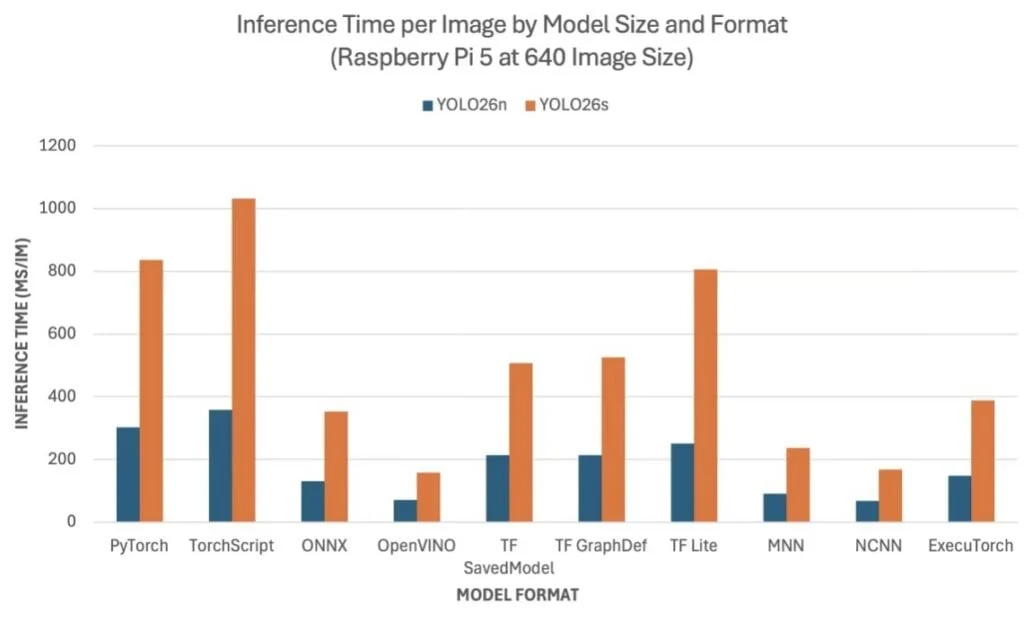
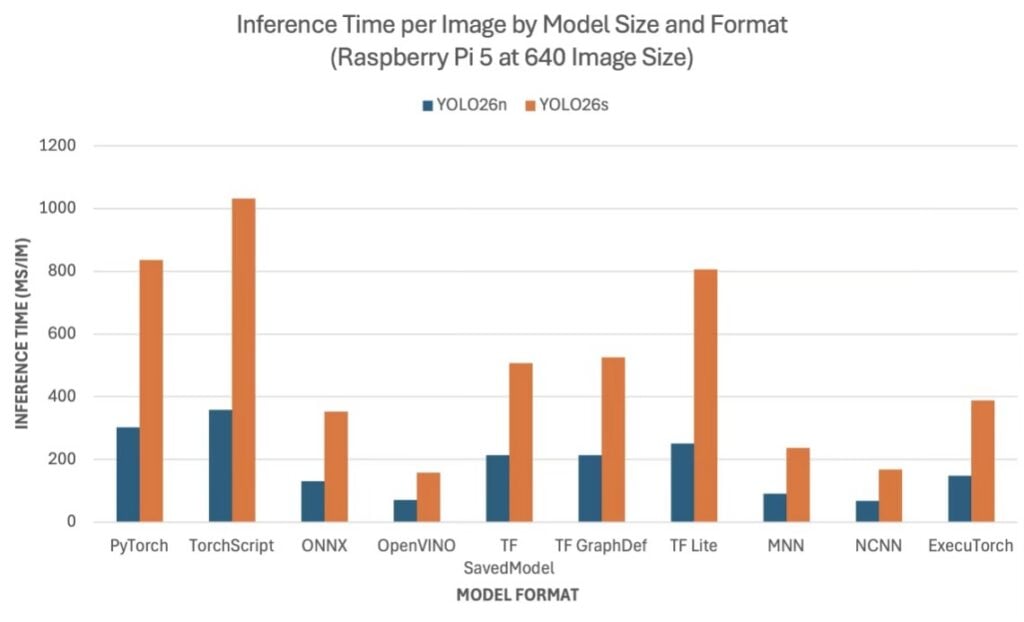
Data provided by Ultralytics demonstrates that when running the YOLO26 model, OpenVINO consistently outperforms other generic runtimes on ARM. This is attributed to the "layered runtime path." When a model is loaded, the OpenVINO CPU plugin selects an executor path for each operation (convolution, transpose, etc.) based on the specific shape and precision of the data.
Notably, while the Raspberry Pi executes quantized (INT8) models in "simulation mode"—running the graph in floating-point precision—the architectural benefits of the OpenVINO IR format still yield lower latency compared to raw ONNX or PyTorch formats.
Official Responses: Perspectives from Intel and Ultralytics
The collaboration is viewed by both organizations as a democratic move for the AI industry.
Intel’s Stance:
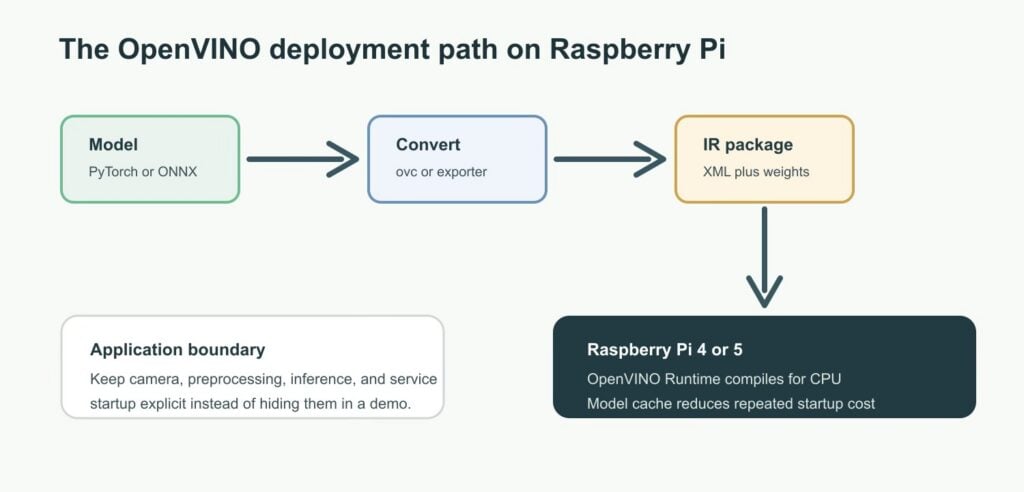
According to Alexander Nesterov and Dmitriy Pastushenkov, the goal was to ensure the Raspberry Pi is not an "exception" to the OpenVINO ecosystem. "The standard deployment practices—convert, compile, cache, and package—now apply directly to this small Linux Arm64 target," the engineers noted. Intel’s focus has been on the CPU plugin’s internal JIT (Just-In-Time) emitters, ensuring that even without a dedicated NPU, the ARM Cortex cores are utilized to their maximum theoretical throughput.
Ultralytics’ Perspective:
Francesco Mattioli and Nuvola Ladi emphasize the accessibility of the YOLO workflow. "Ultralytics is focused on making computer vision easy to use," they stated. By integrating OpenVINO export options directly into the Ultralytics Python package, they have removed the barrier to entry. "A developer can now go from a .pt PyTorch model to a fully optimized OpenVINO IR model with a single line of code: model.export(format='openvino')."
Licensing and Ethics:
Ultralytics also clarified the licensing structure for these deployments. While the models are available under the AGPL-3.0 license to foster open collaboration, the company offers an Enterprise License for proprietary commercial or R&D applications, ensuring a sustainable path for both open-source contributors and corporate users.
Technical Deep-Dive: Reliability in Deployment
For a deployment to be considered "production-ready," the engineers identified several critical factors that go beyond simple inference speed.
1. The Power and Thermal Variable
On the Raspberry Pi 5, sustained AI workloads generate significant heat. The team warns that cooling and power must be treated as "runtime dependencies." Without active cooling, the SoC will throttle its clock speed, leading to inconsistent inference times that can break real-time application logic.
2. The Path to Repeatability
The guide outlines three distinct deployment paths:
- The PyPI Path: Best for standard Python applications where OpenVINO is simply another dependency.
- The Native Source-Build Path: Necessary for developers who need to integrate C++ or debug platform-specific runtime issues directly on the board.
- The Cross-Build Path: The "gold standard" for release engineering, allowing developers to build Linux AArch64 artifacts on powerful x86 workstations before shipping them to a fleet of Raspberry Pi devices.
3. Model Caching and Startup
In industrial settings, a device must be "ready" immediately after power-on. The team highlights that OpenVINO’s Core.set_property(props.cache_dir: "./ov_cache") is not just a benchmarking tool but a vital deployment feature. It ensures that the time-consuming process of hardware-specific model compilation only happens once.
Implications: The Future of Distributed Intelligence
The successful marriage of YOLO26 and OpenVINO on Raspberry Pi hardware has profound implications for several sectors:
Industrial Automation: Small, affordable boards can now be placed at every stage of a conveyor belt to perform real-time quality inspection without the need for expensive industrial PCs.
Robotics and Drones: The reduced weight and power requirements of the Raspberry Pi, combined with the high accuracy of YOLO26, allow for more sophisticated autonomous navigation in smaller form factors.
Smart Cities: Localized traffic monitoring and pedestrian safety systems can be deployed at scale, processing data at the edge to preserve privacy and reduce bandwidth costs associated with cloud processing.
As OpenVINO and Ultralytics continue to refine their respective technologies, the gap between "edge" and "workstation" performance continues to shrink. The message from the engineering team is clear: the tools are now in place, the hardware is capable, and the deployment path is standardized. The focus now shifts to the developer community to "go forth and build" the next generation of visual AI applications.
Community Contribution
Both Intel and Ultralytics remain committed to open-source growth. The CPU plugin source that powers these ARM deployments is hosted on GitHub, inviting community members to contribute JIT emitters and performance fixes. This collaborative model ensures that as ARM architecture evolves, the software layer will be ready to harness its power, keeping the Raspberry Pi at the forefront of the edge AI revolution.