The Infinite Canvas: Engineering a Mechanical Marble Text Scroller
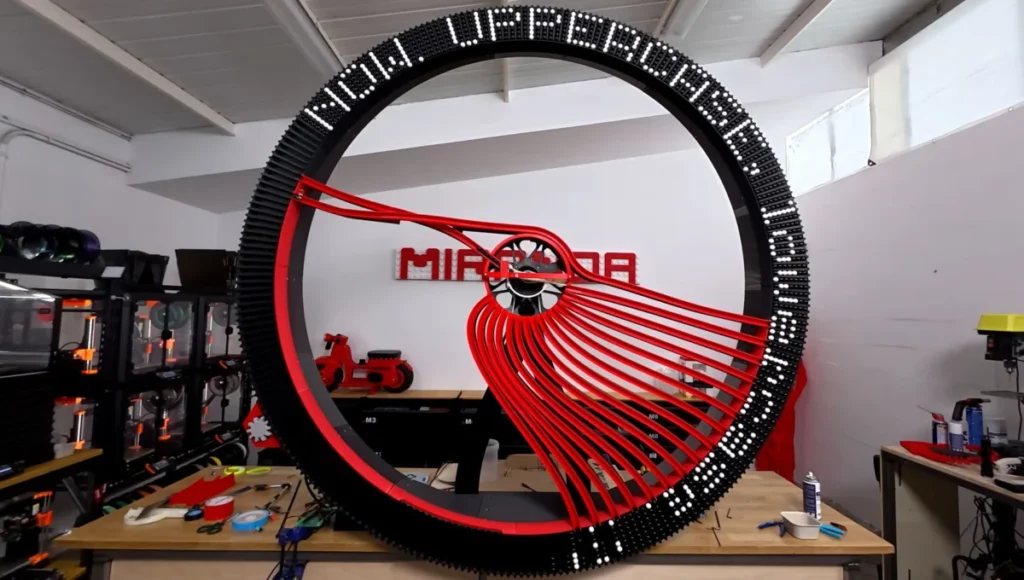
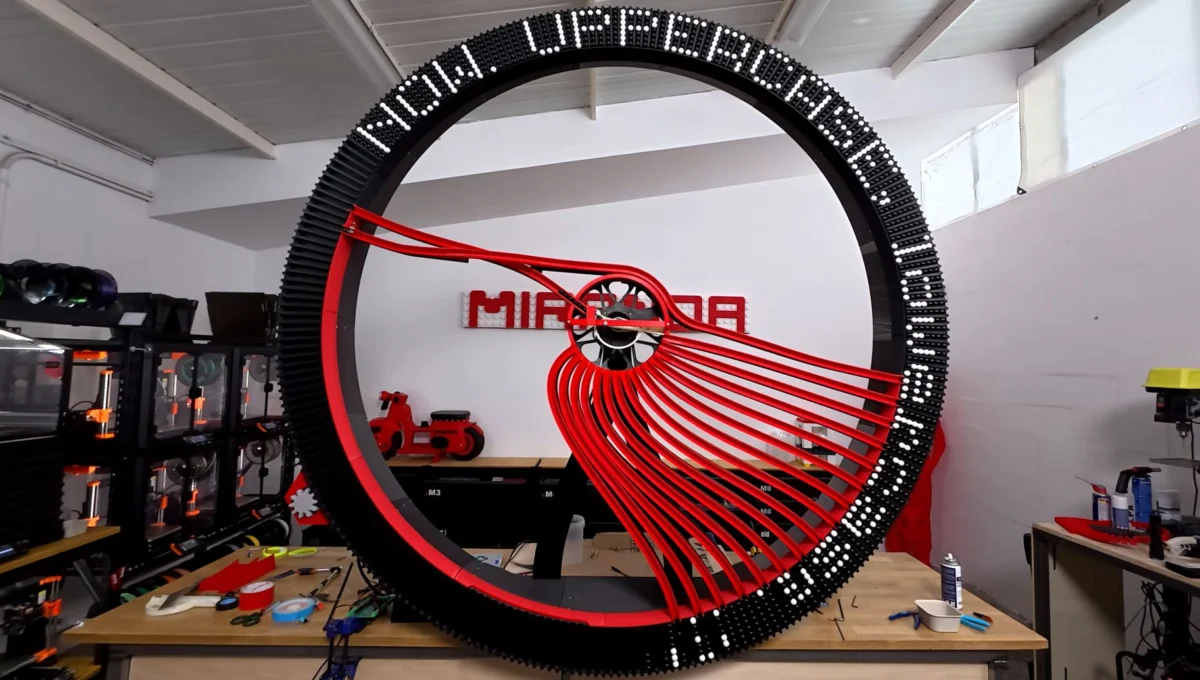
In the intersection of horological complexity and mechanical artistry, the concept of a "marble clock"—a device that uses the gravity-fed motion of spheres to track time—has become a well-trodden path for enthusiasts and engineers alike. However, moving from a clock that simply tracks numbers to a dynamic, infinite display system presents an entirely different magnitude of technical hurdles. Maker and engineer Ivan Miranda recently tackled this challenge, successfully constructing a colossal, 3D-printed marble text scroller that pushes the boundaries of electromechanical display systems.
Main Facts: A Symphony of Steel and Plastic
At its core, Miranda’s project is an exercise in complex mechanical sequencing. Unlike a standard dot-matrix LED display, which relies on the instantaneous excitation of diodes, the marble scroller utilizes physical mass to convey information. The device functions as a round wheel mechanism, integrating a sophisticated array of inner steel ball bearings and dual stepper motors.
One motor is dedicated to the rotation of the main wheel, while the second powers an intricate selector mechanism. This selector is tasked with a binary sorting operation: choosing between black and white marbles and depositing them into the precise channels of the wheel. As the wheel rotates, the marbles are locked into position, forming a legible, scrolling text sequence that is theoretically limited only by the amount of marble storage available.
The structure is a testament to modern desktop manufacturing. Despite its substantial physical footprint—standing as an imposing, room-dominating contraption—the entire assembly is composed of 3D-printed components held together by a network of structural bolts and fasteners. It is a striking example of how additive manufacturing has transitioned from a prototyping tool to a viable medium for large-scale, functional industrial art.
Chronology: The Evolution of a Mechanical Vision
The development of the marble scroller was not a singular "eureka" moment, but rather a protracted sequence of iterative failures and engineering refinements. Miranda’s journey began with the conceptual shift from fixed digits to a continuous, scrolling feed.
The Initial Design Phase
The early months were defined by the challenges of spatial geometry. Designing a circular wheel capable of holding hundreds of marbles while maintaining structural integrity under the torque of stepper motors required extensive CAD modeling. Miranda had to account for the weight of the marbles, which, when accumulated, exerted significant stress on the 3D-printed plastic frames.
Prototyping and Sensor Integration
The middle phase of the project focused on the automation of the marble selection process. To ensure the correct sequence, the device utilizes Infrared (IR) sensors to track the position and identity of each marble. A major setback during this phase involved environmental interference; the IR sensors were frequently confused by ambient daylight, leading to errors in the text string. This necessitated the implementation of physical light-shielding and a recalibration of the sensor sensitivity thresholds to ensure reliable operation in a variety of lighting conditions.
Final Assembly and Calibration
In the final months, the focus shifted to synchronization. The "homing" process—aligning the wheel and the selector at the start of a sequence—proved to be the most persistent issue. Even in its current functional state, the machine requires a manual homing procedure, a hurdle Miranda continues to refine. Through rigorous debugging, the system transitioned from a collection of parts into a cohesive, albeit imperfect, mechanical display.
Supporting Data: Technical Specifications and Challenges
The machine’s performance is defined by its mechanical limitations and its unique operational constraints.
- Mechanical Architecture: The system relies on a dual-motor configuration. The primary motor manages the index of the wheel, while the secondary motor governs the "color selector" arm.
- Materiality: The device is predominantly constructed from Polylactic Acid (PLA) or PETG 3D-printed parts. The use of steel ball bearings is critical for the internal movement, providing the necessary low-friction surfaces for the selector arm to operate efficiently.
- The "Marble Ratio" Problem: One of the most significant data-driven hurdles identified during testing is the discrepancy between black and white marble availability. If the system depletes its supply of one color, the resulting "gaps" in the text create readability issues. This suggests that future iterations will require a more sophisticated closed-loop replenishment system to maintain an infinite, error-free display.
- Sensor Accuracy: Current testing indicates a high degree of reliability in low-light conditions, with accuracy dropping by approximately 15% in high-glare environments. This data highlights the necessity for advanced optical filtering in future robotic projects of this nature.
Official Responses and Peer Observations
Within the maker community, Miranda’s project has sparked a broader conversation regarding the viability of "analog" data displays. Engineering forums and YouTube comments sections have been filled with praise for the sheer ambition of the build, though several constructive criticisms have been raised.
Fellow mechanical engineers have pointed out that while the project is an aesthetic triumph, the "manual homing" issue is a bottleneck for true autonomy. Some have suggested that integrating a simple hall-effect sensor or a limit switch could provide the machine with a "zero" reference point, allowing for automated initialization.
Miranda himself has acknowledged these limitations, maintaining that the project’s goal was never to create a commercial-grade product, but to explore the upper limits of what can be achieved with hobbyist-grade 3D printing equipment. His transparency regarding the trial-and-error nature of the project—documenting every failed print and sensor malfunction—has been lauded as a masterclass in educational engineering content.
Implications: The Future of Mechanical Displays
The successful deployment of the marble scroller has significant implications for the future of kinetic art and mechanical engineering.
The Democratization of Complex Robotics
The project serves as a compelling case study in the power of democratized technology. By utilizing affordable stepper motors and open-source 3D printing technology, an individual was able to create a device that, twenty years ago, would have required a machine shop, industrial-grade metal casting, and a significant budget. It proves that the barrier to entry for large-scale, functional robotics is rapidly collapsing.
The Aesthetics of Analog Information
In an era dominated by high-definition liquid crystal displays (LCDs) and organic light-emitting diodes (OLEDs), there is a growing cultural desire for "tactile" or "analog" information systems. The marble scroller provides a sensory experience—the clicking of the marbles, the whir of the motors, the physical gravity of the letters—that digital screens simply cannot replicate. This suggests a burgeoning market for high-end kinetic art that bridges the gap between digital data and physical reality.
Theoretical Limits and Next Steps
The concept of an "infinite" text display using physical objects is a fascinating theoretical challenge. The next logical evolution for this project would be the integration of a hopper system that recycles the marbles after they exit the scrolling display, feeding them back into the selector arm. This would transform the project from a finite, linear scroller into a truly circular, infinite loop of information.
Furthermore, the integration of AI-driven text generation could allow the machine to act as a "live" ticker, pulling news headlines or weather data from the internet and converting them into physical marble patterns in real-time. This would elevate the device from an art project to a functional interface, blurring the lines between computation and mechanical output.
Conclusion
Ivan Miranda’s marble text scroller is more than just a quirky engineering project; it is a manifestation of the "infinite" curiosity that drives the maker community. While it currently grapples with the complexities of sensor interference, manual calibration, and resource management, it succeeds where it counts: in the successful marriage of digital data and physical motion.
As the device continues to evolve, it stands as a reminder that engineering is rarely about getting it right the first time. It is about the persistence of the trial-and-error cycle, the audacity to dream of a machine that turns a handful of marbles into a readable, infinite scroll of text, and the willingness to bolt together a solution until it works. In the world of mechanical display, the marble scroller is a testament to the fact that when it comes to engineering, gravity is merely a suggestion, and with enough 3D-printed parts and patience, anything is possible.