The New Era of Persistent AI: A Deep Dive into OpenAI’s Dots and Meta’s Muse
The landscape of artificial intelligence is undergoing a seismic shift. For years, AI interaction was defined by the "prompt-response" cycle: a user would ask a question, the AI would generate an answer, and the session would effectively conclude. Today, that model is being replaced by a new class of "always-on" AI agents designed to function as digital coworkers.
Leading this charge are two major tech titans: Meta, with its September 8th release of Muse, and OpenAI, which debuted its persistent "Dots" within the ChatGPT ecosystem just three weeks later. These agents represent a departure from static chatbots, as they possess the capability to work autonomously in the background, interface with cloud computing resources, and interact with third-party services long after the user has closed their browser tab.
The Evolution of Agentic AI: A Chronology
The transition toward agentic AI did not happen overnight. The industry spent much of 2023 and early 2024 refining large language models (LLMs) to be more accurate and hallucination-resistant. However, the limitation remained that the AI was tethered to the user’s immediate attention.
- Early September 2024: Meta officially launched Muse. Designed to bridge the gap between social media curation and personal productivity, Muse arrived with a focus on ease of use, leveraging the familiarity of WhatsApp and web interfaces to help users organize their digital lives.
- Late September 2024: OpenAI followed suit with Dots. By integrating these persistent agents into the ChatGPT infrastructure—specifically leveraging the power of GPT-6 Astra—OpenAI signaled its intent to dominate the enterprise and professional productivity market.
- October 2024 – Present: As these tools have moved into public testing, the industry has begun to grapple with the complexities of these agents, ranging from technical capabilities to regulatory hurdles and the inevitable friction with companies like Amazon, which has already moved to block automated scraping tools.
Comparing the Capabilities: Dots vs. Muse
While both agents promise to liberate users from the tedium of repetitive digital tasks, they operate through fundamentally different architectures and design philosophies.
Meta’s Muse: The Concierge Approach
Muse is built to be accessible, user-friendly, and highly versatile. It runs on a dedicated Secure Virtual Machine (VM), equipped with its own sandboxed browser. This allows Muse to interact with the internet much like a human would, navigating pages, filling out forms, and retrieving information.
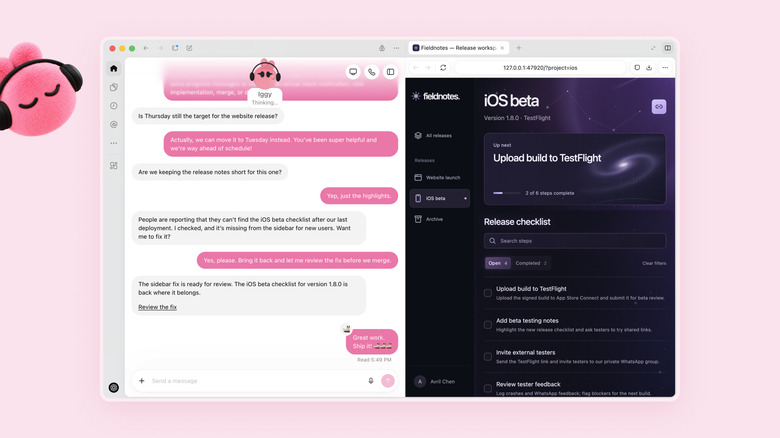
The experience is explicitly designed to feel like messaging a colleague. Whether through a dedicated app or via WhatsApp, a user can instruct Muse to monitor price fluctuations on retail sites, compile travel itineraries, or curate social media posts into organized collections. In early testing, Muse demonstrated an impressive ability to scrape Instagram and Facebook posts to create structured recipe databases or restaurant recommendations.

OpenAI’s Dots: The Enterprise Powerhouse
In contrast, Dots are deeply embedded within the ChatGPT ecosystem. Powered by the sophisticated GPT-6 Astra architecture, each Dot functions as a self-contained digital worker. Each agent has its own dedicated cloud computing environment, allowing it to execute tasks, manage plugins, and maintain long-term memory of specific project contexts.
Dots are designed for workflows that span multiple applications. Through integration with ChatGPT Work and Codex, a Dot can perform recurring research, manage local file retrieval, and execute multi-step operations that would otherwise require manual intervention. OpenAI’s vision is clearly focused on the "agent-as-a-service" model, where a user can manage multiple specialized Dots simultaneously to handle different facets of their professional life.
Technical Infrastructure and Operational Constraints
Despite the "sci-fi" promise of autonomous assistants, both platforms are currently governed by strict guardrails. The autonomy of these agents is not absolute; it is a calculated, permission-based function.
The Permission Layer
Both companies are acutely aware of the security risks associated with autonomous agents. Meta’s Muse mandates explicit user approval for any high-stakes action, such as executing a financial transaction or sending an email. OpenAI employs a similar "Human-in-the-Loop" strategy, utilizing a combination of Custom Rules and an "Auto-review" system.
Even with these safeguards, the agents are fallible. The recent decision by Amazon to restrict Muse from its shopping platform serves as a cautionary tale: third-party websites are increasingly viewing AI agents as a threat to their terms of service, particularly regarding data scraping and automated traffic.
Privacy and Data Handling
The privacy implications of granting an AI access to your browser, email, and calendar are significant.
- Meta’s Stance: Meta emphasizes that data within the Muse VM is isolated from its primary advertising algorithms. However, users should be aware that the default setting often allows Meta to use interactions to "improve the model." Users must proactively dive into settings to opt out of this data-sharing practice.
- OpenAI’s Stance: OpenAI creates a distinction between personal and enterprise users. Personal-plan Dots may have their activity logs used for model training, whereas Business and Enterprise data is generally siloed and excluded from training cycles by default.
Cost Analysis: The Barrier to Entry
Perhaps the most stark point of divergence between the two is the pricing structure.
| Tier | Meta Muse | OpenAI Dots |
|---|---|---|
| Free/Entry | Usage-capped free tier | Not available for personal use |
| Mid-Tier | $20/month (Power) | $100/month (Pro 100) |
| High-Tier | $100/month (Maximum) | $100-$125/user/month (Business) |
For the average consumer, Muse is significantly more accessible. The ability to trial the service at a lower cost point makes it an attractive entry point for those curious about agentic AI. OpenAI, meanwhile, has positioned its Dots firmly in the premium professional category. With the lowest entry point starting at $100 per month, OpenAI is clearly targeting power users, researchers, and enterprise teams rather than casual hobbyists.
Implications for the Future of Work
The rise of persistent AI agents suggests a future where the definition of "working" changes. If an agent can research, synthesize, and execute tasks while the user is offline, the productivity multiplier is theoretically immense. However, this shift raises three critical questions:
1. The Erosion of Digital Boundaries
When an AI can access your local machine to retrieve files or browse the web on your behalf, the concept of a "closed" system vanishes. Security experts warn that the more "permissions" we grant these agents, the larger the attack surface becomes for potential bad actors who might exploit these agents to exfiltrate data.
2. The Legal and Ethical Gray Zone
Who is liable when an AI makes a mistake? If a Dot or Muse accidentally purchases the wrong product, sends an unauthorized email, or misinterprets a legal document, the current legal framework is poorly equipped to assign responsibility. As these agents become more autonomous, we will likely see a surge in "AI malpractice" claims and litigation surrounding terms-of-service violations.
3. The Shift in Human Skill Sets
We are moving toward an era where the primary skill required of a professional will not be the execution of a task, but the management of the agent performing the task. "Prompt engineering" is evolving into "agent orchestration"—the ability to set parameters, establish constraints, and audit the output of digital agents.
Conclusion: A Measured Optimism
The emergence of Meta’s Muse and OpenAI’s Dots marks the end of the beginning for generative AI. We have moved past the novelty of having a chatbot write a poem or summarize an article; we are now in the age of the digital delegate.
While the high costs and persistent privacy concerns are real, the utility offered by these systems is undeniable. For the professional who manages multiple, complex, and recurring digital workflows, these tools are not just toys—they are essential infrastructure. However, as these agents continue to expand their reach, the burden remains on the user to remain the final arbiter of intent. As with all powerful technologies, the benefit derived from an AI agent is only as good as the oversight provided by the human who controls it.
As we look toward the remainder of the year and into 2025, the competition between these two platforms will likely intensify. We should expect to see more integrations, more granular permission controls, and perhaps, more friction with the traditional web as the digital world attempts to reconcile with a new, autonomous tenant.