
The Oxidization of Ubuntu: Canonical’s Strategic Pivot to Sequoia PGP


Ubuntu’s ongoing transformation from a C-centric operating system to one anchored in the memory-safe capabilities of Rust has reached a significant milestone. With the release of Ubuntu 26.10, "Stonking Stingray," Canonical has officially introduced Sequoia PGP into the main software archives. While this inclusion is currently a side-by-side offering rather than a total replacement for the venerable GnuPG (GPG), it signals the beginning of the end for decades of C-based cryptography management in the Ubuntu ecosystem.
This transition is not merely a technical swap; it represents a broader shift in the philosophy of Linux infrastructure security. By prioritizing memory safety, Canonical is aligning its flagship distribution with modern programming paradigms, aiming to mitigate the vulnerabilities that have historically plagued C-based toolchains.
The Foundation: Understanding OpenPGP
To appreciate the significance of this shift, one must first understand what OpenPGP represents. OpenPGP is not a single piece of software; it is a vital, vendor-neutral standard (defined originally as RFC 4880 and now updated to RFC 9580). This standard acts as the "universal language" for data security, dictating how information should be encrypted, decrypted, signed, and verified.
For over thirty years, the Linux ecosystem has relied almost exclusively on GnuPG (GPG) to implement this standard. Written in C, GnuPG has been the workhorse of the open-source world, powering everything from secure email communications and package repository verification to software signing and file encryption. However, as the digital landscape has become more hostile, the inherent risks associated with memory-unsafe languages like C—specifically buffer overflows and pointer errors—have pushed developers toward more resilient alternatives.

Chronology of the "Oxidization" Strategy
Canonical’s move toward Rust is not a sudden whim but a deliberate, multi-year strategy. The company has been systematically auditing and replacing legacy components, prioritizing critical system utilities that handle high-privilege operations.
- 2023–2024 (The Pilot Phase): Canonical began experimenting with Rust-based replacements for foundational utilities. The focus was on identifying tools that, if compromised, would grant an attacker systemic control over the OS.
- 2025 (The Coreutils Migration): One of the most ambitious undertakings was the "rustification" of Coreutils. This involved rewriting essential commands like
ls,cat, andcpin Rust. After extensive testing, this project reached 100% completion with the release of 26.10. - 2025 (The Sudo-rs Precedent): Before tackling cryptography, Canonical tested the waters with
sudo-rs, a memory-safe implementation of the standardsudocommand. This served as a "proof of concept" for the user experience: it demonstrated that replacing a critical, long-standing tool with a Rust alternative could be done without breaking user workflows. - 2026 (The Current Milestone): With the arrival of Ubuntu 26.10, Sequoia PGP has been integrated into the main archive. This marks the transition from theoretical research to real-world deployment.
Sequoia PGP: Why the Switch?
Sequoia PGP was established in 2017 by a team of former GnuPG developers who recognized that the aging C codebase of GnuPG was becoming increasingly difficult to maintain and secure. By building Sequoia in Rust, the team was able to leverage modern language features that prevent common memory-related security flaws by design.
Architectural Differences
The most striking difference between the two is their architecture. GnuPG was built as a monolithic, command-line-first utility. In contrast, Sequoia PGP is designed as a library-first architecture. This allows other applications to integrate robust cryptographic functionality directly into their own codebases, rather than needing to spawn external processes to interact with a command-line tool.
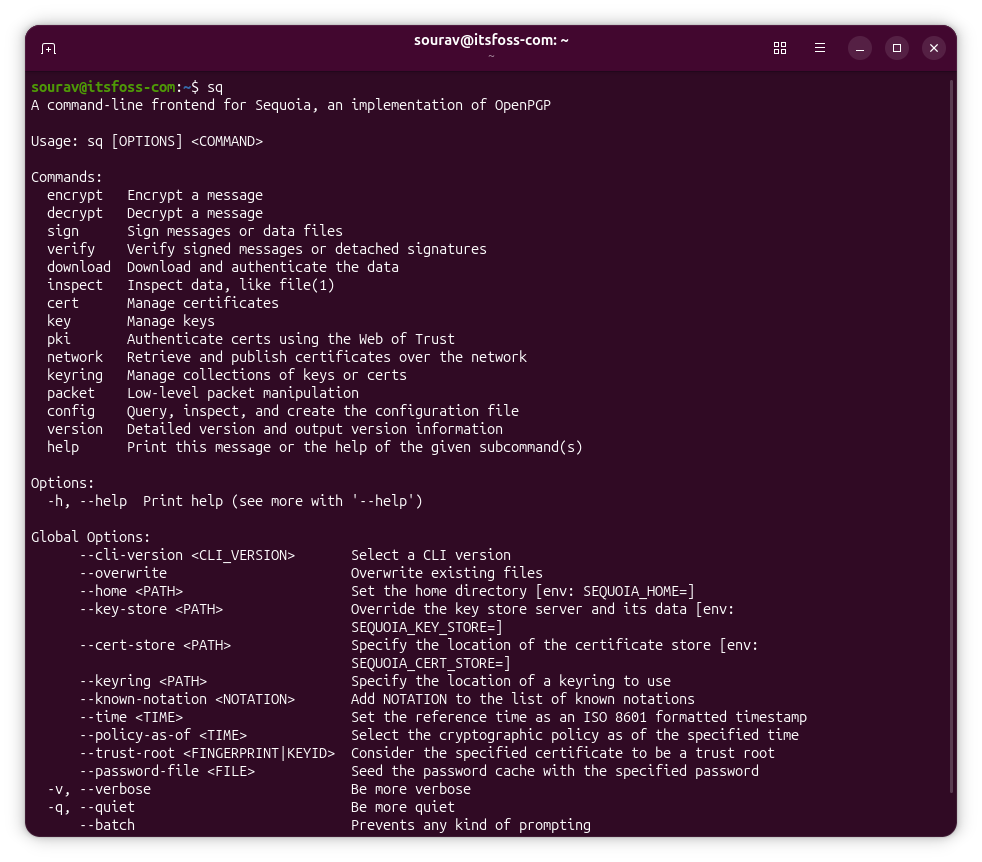
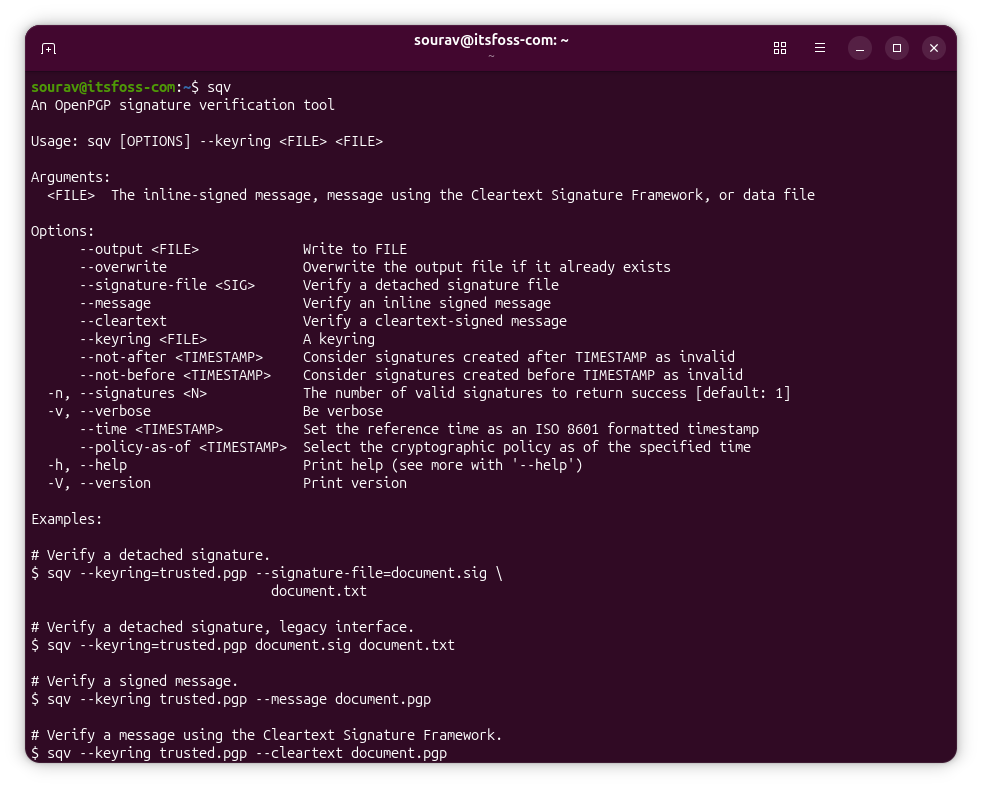
For the end-user, Sequoia provides two primary tools:

sq: The direct successor togpg, handling encryption, decryption, signing, and complex key management.sqv: A lightweight utility designed specifically for signature verification, serving as the replacement forgpgv.
Furthermore, Sequoia is built to support the 2024 revision of the OpenPGP standard, RFC 9580. GnuPG, meanwhile, has continued to iterate on the older RFC 4880 branch, pursuing its own specific extensions. This divergence in standards compliance is a major driver for Canonical’s interest, as they aim to provide users with the most modern, RFC-compliant cryptographic tools available.
Implications for Users and Developers
The presence of both tools in Ubuntu 26.10 is intentional. Currently, when a user types gpg or gpgv, the system still invokes the legacy GnuPG binaries. Canonical is intentionally taking a "cautious-first" approach, allowing the community to test the stability of Sequoia while maintaining a fallback to the trusted status quo.
The Developer Experience
For developers, this transition represents a significant upgrade. The library-first nature of Sequoia means that applications can now implement complex PGP logic without the overhead of shell-outs or the need to parse the stdout of a command-line tool. This leads to faster, more reliable, and significantly more secure software builds.
The Security Landscape
From a security perspective, the migration is a proactive measure. Cryptographic software is the most common target for sophisticated state-level actors and cyber-criminals. By reducing the "attack surface" through the elimination of C-based memory management, Canonical is effectively closing an entire class of vulnerabilities before they can be exploited.
Official Stance and Future Roadmap
Canonical has been transparent about the fact that this is not an overnight switch. In their official documentation for Ubuntu 26.10, the "oxidized" OpenPGP implementation is highlighted as a strategic objective rather than an immediate default.
The transition process follows a well-trodden path:
- Integration into Main: This has now been achieved.
- Community Feedback and Debugging: Over the next few release cycles, developers will report bugs, test edge cases, and ensure that the interoperability between GnuPG-generated keys and Sequoia remains seamless.
- Default Switchover: Only once the community and the engineering team are satisfied with the performance and stability of Sequoia will Canonical consider aliasing
gpgcommands to thesqbinary.
"We are committed to the security of our users," said a representative close to the development cycle. "However, with cryptography, ‘move fast and break things’ is not an acceptable mantra. We are taking the time to ensure that every transition—from sudo to coreutils to OpenPGP—is battle-tested."
Conclusion: The Long-Term Vision
The inclusion of Sequoia PGP in Ubuntu 26.10 is a testament to the maturation of the Rust language in the systems-programming domain. It marks a transition where the Linux distribution is no longer merely a collection of legacy tools, but a platform that actively evolves to meet the security challenges of the next decade.
While the "Stonking Stingray" release keeps GnuPG as the primary handler, the presence of Sequoia in the main repository serves as a clear notice to the industry: the era of memory-unsafe system utilities is coming to a close. For users, the immediate impact is minimal, but the long-term benefit is a significantly more robust, secure, and modern Ubuntu.
As we look toward future releases—Ubuntu 27.04 and beyond—we can expect the "oxidization" of the distribution to continue. Whether this will lead to the total deprecation of GnuPG remains to be seen, but the momentum is clearly behind the new, memory-safe generation of tools. For those concerned about the integrity of their data, the transition to Sequoia PGP is not just a change in technology—it is a necessary evolution of trust.








