AWS Revolutionizes Serverless Computing with the Launch of Lambda MicroVMs
In a significant expansion of its serverless ecosystem, Amazon Web Services (AWS) has unveiled AWS Lambda MicroVMs, a groundbreaking compute primitive designed to bridge the long-standing gap between event-driven functions and traditional, persistent virtual machines. By leveraging the industry-proven Firecracker virtualization technology, AWS is empowering developers to create highly isolated, stateful, and interactive environments for untrusted, user-generated, or AI-authored code.
This launch marks a pivotal shift for developers building multi-tenant applications, such as AI coding assistants, interactive data science notebooks, and secure sandboxing platforms, who have historically been forced to choose between the rapid scaling of Functions-as-a-Service (FaaS) and the deep isolation of dedicated infrastructure.
The Core Innovation: Solving the Multi-Tenant Dilemma
For years, the software development industry has struggled with a "trilemma" of compute: how to achieve strong security isolation, near-instant startup performance, and long-term state persistence simultaneously.
The Trade-off Landscape
- Virtual Machines (VMs): Provide robust security via kernel-level isolation but suffer from slow boot times—often measured in minutes—making them unsuitable for responsive, user-facing interactive sessions.
- Containers: Offer fast startup times but rely on a shared-kernel architecture. While powerful, they require extensive custom security hardening to safely execute untrusted code in a multi-tenant environment.
- Functions as a Service (FaaS): Ideal for event-driven, request-response workloads, but fundamentally stateless. They are not designed for sessions that require a persistent environment over several hours.
AWS Lambda MicroVMs effectively eliminates these trade-offs. By allowing each end user or session to inhabit its own dedicated MicroVM, AWS provides the security of a VM with the agility of a serverless function.

Chronology of Development: From Firecracker to Lambda
The foundation of this new service is Firecracker, an open-source virtualization technology built by AWS. Since its inception, Firecracker has been the silent engine powering the massive scale of AWS Lambda, handling over 15 trillion monthly invocations.
The Evolution
- Initial Adoption: Firecracker was introduced to provide lightweight, fast-launching microVMs for standard Lambda functions, ensuring that each function call remained strictly isolated from others.
- The Emerging Requirement: As AI coding assistants (like Amazon Q or GitHub Copilot) and interactive web-based IDEs gained popularity, the demand for "stateful isolation" grew. Developers needed to run complex user-supplied scripts that required a persistent file system and memory state.
- The Engineering Pivot: AWS engineers recognized that the same technology used for short-lived functions could be re-engineered to support persistent, stateful sessions. By adding snapshotting and resuming capabilities, the team created a way to "pause" a full compute environment and "resume" it in milliseconds.
- The Public Reveal: Following a rigorous internal testing phase and integration with the existing AWS Lambda control plane, Lambda MicroVMs were released to the public, marking a new chapter in serverless architecture.
Supporting Data: Technical Specifications and Performance
AWS Lambda MicroVMs are built to handle intensive workloads, providing significant headroom for developers. Key specifications include:
- Architecture: ARM64-based execution.
- Capacity: Up to 16 vCPUs, 32 GB of RAM, and 32 GB of local disk storage per MicroVM.
- Lifecycle Management: Support for up to 8 hours of total runtime.
- Idle Management: Intelligent suspension policies that automatically snapshot memory and disk state during inactivity, reducing operational costs.
How the "Snapshot-Resume" Mechanism Works
The performance secret of Lambda MicroVMs is the "image-then-launch" workflow.
- Initialization: The developer defines the environment via a Dockerfile.
- Snapshotting: Lambda builds the image and takes a Firecracker snapshot of the running disk and memory state.
- Instant Resume: When a user triggers an interaction, the environment does not "cold boot." Instead, it resumes from the pre-initialized snapshot, bypassing the lengthy initialization and package-installation phases.
Implications for Modern Software Development
The introduction of Lambda MicroVMs carries profound implications for various sectors of the tech industry.

1. The Era of "AI-Native" Infrastructure
With AI coding assistants becoming a standard in modern development, the ability to safely run user-provided code in a dedicated, isolated sandbox is critical. Lambda MicroVMs allow platforms to provide an "interactive sandbox" experience without the massive overhead of managing a fleet of EC2 instances.
2. Democratizing Data Science and Analytics
Data platforms can now offer "in-browser" coding environments (like Jupyter notebooks) that are backed by powerful, stateful compute. When a user stops typing, the environment pauses; when they resume, their variables, loaded models, and file structures are exactly where they left them.
3. Security and Compliance
For industries with strict regulatory requirements, the ability to guarantee that user-provided code cannot access other users’ data or the host kernel is a game-changer. Lambda MicroVMs provide a hardware-backed security boundary that is significantly more difficult to breach than traditional container-based isolation.
Official Perspective and Strategic Direction
AWS positions Lambda MicroVMs not as a replacement for standard Lambda functions, but as a specialized tool within the serverless toolkit.

"Lambda Functions remain the gold standard for event-driven, request-response architecture," an AWS spokesperson noted during the launch. "Lambda MicroVMs are purpose-built for the growing class of applications that require long-lived, stateful, and secure sessions. We are effectively handing the developer a ‘virtual desktop’ of compute that behaves like a serverless function."
This strategy reflects a broader AWS trend: moving away from a "one-size-fits-all" compute service toward a collection of highly specialized, purpose-built primitives. By reducing the operational burden of managing virtualization, AWS allows companies to redirect their engineering talent toward feature development rather than infrastructure plumbing.
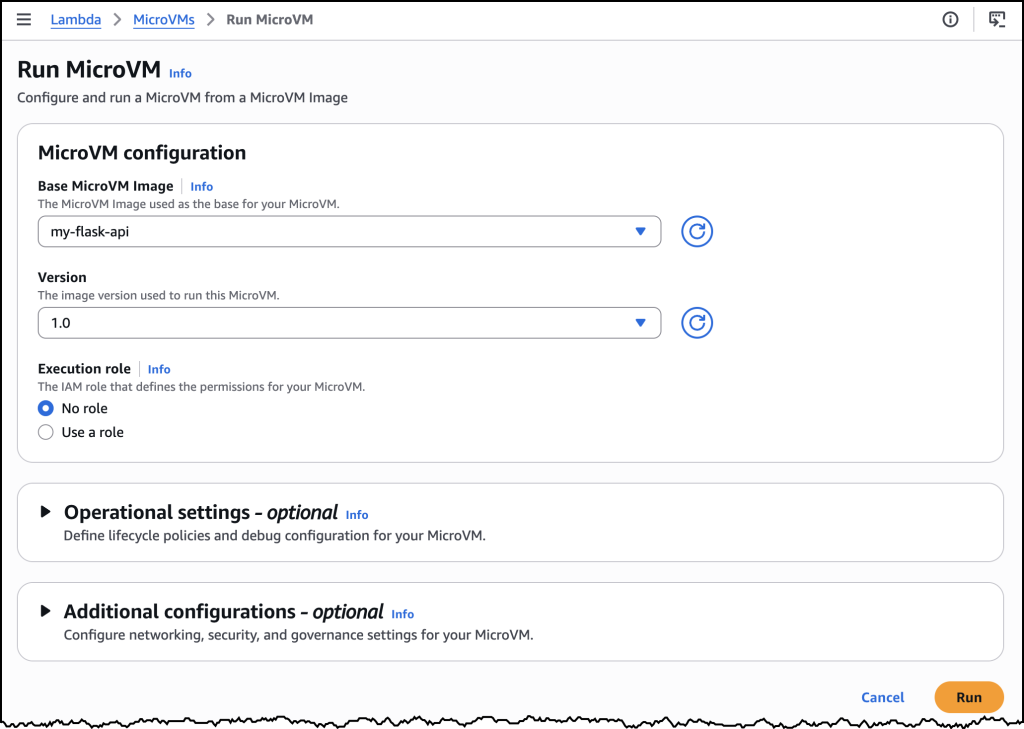
Getting Started: A Developer’s Roadmap
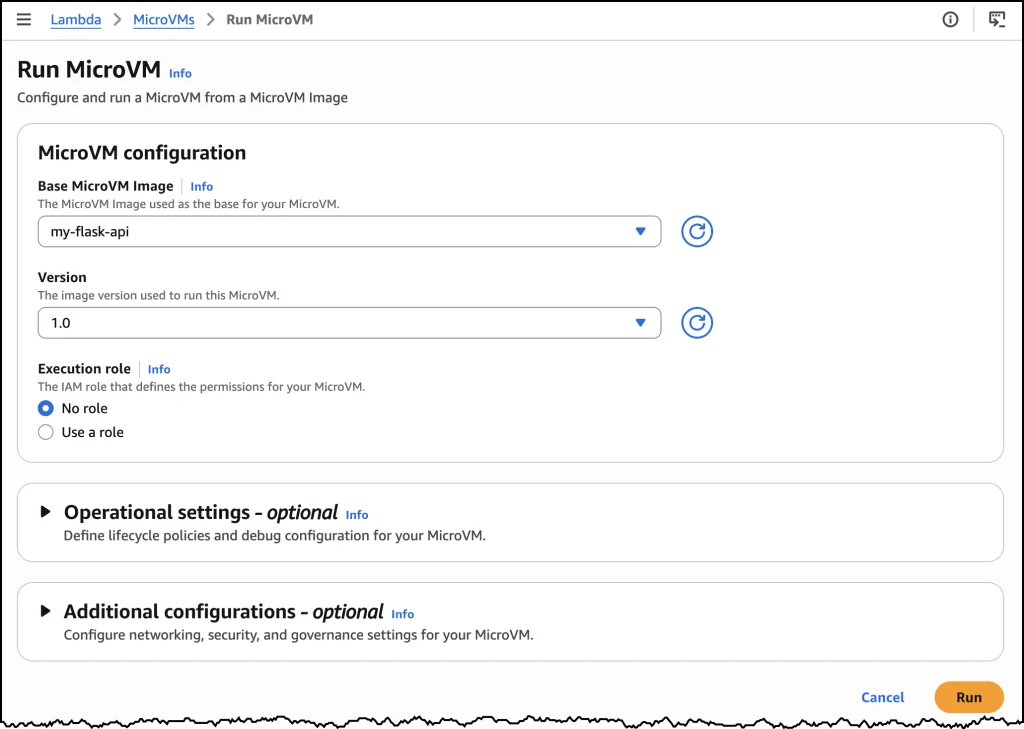
For developers looking to integrate Lambda MicroVMs, the barrier to entry is minimal.
- Preparation: Package your application code and environment dependencies into a zip file.
- Image Creation: Use the
aws lambda-microvms create-microvm-imagecommand, referencing your Dockerfile. - Configuration: Define your
idle-policyto balance cost and performance. - Deployment: Deploy via the AWS CLI or the Lambda Console.
The service is currently available in major regions, including US East (N. Virginia, Ohio), US West (Oregon), Europe (Ireland), and Asia Pacific (Tokyo).
Conclusion: The Future of Isolated Compute
The launch of AWS Lambda MicroVMs is more than just a new feature; it is an acknowledgment that the "serverless" paradigm is maturing. As applications become more interactive and intelligence-driven, the underlying compute must evolve to meet the dual demands of high-performance statefulness and uncompromising security.
By abstracting the complexities of Firecracker micro-virtualization, AWS has lowered the ceiling for what developers can build. Whether it is an AI agent running a script or a complex simulation requiring hours of compute time, Lambda MicroVMs provide the foundation upon which the next generation of multi-tenant applications will be built. As adoption grows, we can expect to see an explosion in "interactive-first" cloud applications, setting a new benchmark for speed, security, and developer experience in the cloud.