Breaking Free from Proprietary Apps: How Maker Bas BotBerg Reverse-Engineered a Bluetooth Thermal Printer Using an ESP32-C3
In the landscape of modern consumer electronics, hardware freedom is increasingly rare. Manufacturers routinely lock down budget-friendly peripherals—such as portable Bluetooth thermal printers, smart scales, and pocket label makers—behind proprietary, cloud-dependent smartphone applications. These closed ecosystems strip users of local control, forcing them through cumbersome app interfaces, forced account registrations, and intrusive data collection just to print a simple grocery list or a line of sensor data.
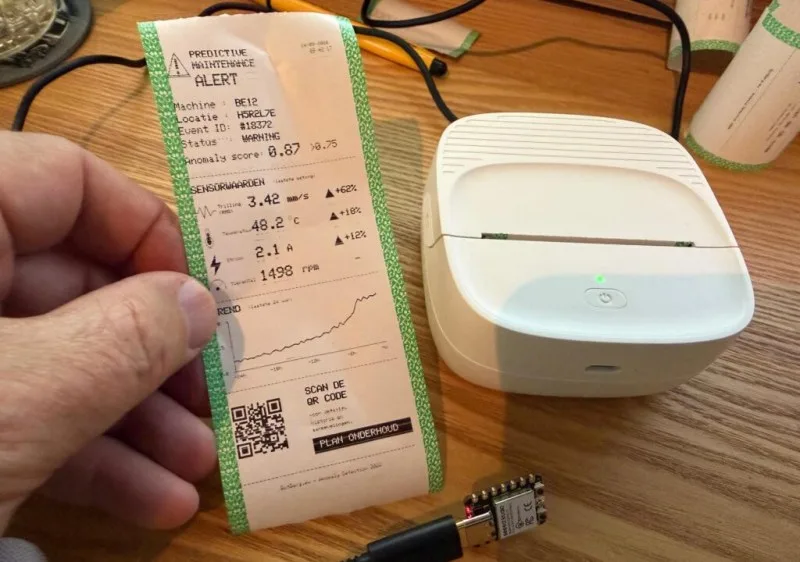
Enter maker and developer Bas BotBerg, who has demonstrated a masterclass in hardware liberation. By bypassing the official vendor app entirely, BotBerg successfully drove a portable Bluetooth thermal printer using a compact, low-cost ESP32-C3 SuperMini microcontroller. The project bridges the gap between physical sensor data—such as temperature, humidity, and system metrics—and tangible, inkless thermal paper reports without ever routing traffic through an Android or iOS smartphone.
Rather than resorting to the traditional, often messy route of capturing Bluetooth HCI (Host Controller Interface) logs on a rooted Android device, BotBerg opted for a direct-query approach. By analyzing Bluetooth Low Energy (BLE) services, systematically probing characteristics, and mapping the proprietary communication protocol from scratch, this project serves as a definitive blueprint for reverse-engineering closed-source hardware.
Main Facts
The core achievement of BotBerg’s project is the complete decoupling of a standard portable thermal printer from its manufacturer-mandated smartphone software, replacing the phone with a standalone microcontroller.
- The Microcontroller: The project relies on the ESP32-C3 SuperMini module, a tiny yet powerful development board featuring built-in Wi-Fi and Bluetooth Low Energy (BLE). Its small footprint makes it ideal for embedded sensor-reporting nodes.
- The Peripherals: A standard, inexpensive pocket Bluetooth thermal printer commonly found in online marketplaces.
- The Methodology: Instead of sniffing encrypted application traffic or intercepting phone packets, the developer directly interrogated the printer’s BLE stack.
- The Toolchain: Initial discovery and payload iteration were handled in Python using the Bleak library. The final, standalone implementation was written in C++ for the ESP32-C3, leveraging the Adafruit GFX library to format text and render custom icons.
- The Broader Impact: The methodology provides a repeatable, structured framework for hardware hackers and IoT engineers looking to free trapped peripherals from proprietary software walls.
Chronology: From Black Box to Standalone Firmware
Reverse-engineering a closed-source Bluetooth device is rarely a straight line. It requires patience, methodical observation, and iterative testing. BotBerg’s journey from unboxing the printer to running a fully autonomous, microcontroller-driven reporting node unfolded across several distinct phases.
Phase 1: Abandoning the App and Shifting to BLE Discovery
When dealing with inexpensive BLE peripherals, the conventional wisdom dictates installing the manufacturer’s app, pairing the device, and attempting to monitor communications. However, modern apps often employ certificate pinning, encrypted payloads, and obfuscated routines that make packet sniffing an excruciating endeavor.
BotBerg bypassed this hurdle by turning his attention directly to the printer’s advertised BLE profile. Using generic scanning tools, he listed all available Bluetooth Low Energy services and characteristics broadcasted by the printer. By focusing on the device’s exposed GATT (Generic Attribute Profile) services rather than app-level traffic, the investigation shifted from a software decryption problem to a hardware communication puzzle.
Phase 2: Probing Writable Services with Python and Bleak
Once the GATT services were cataloged, the next challenge was identifying which characteristics accepted incoming data. BLE services contain characteristics marked with specific permissions—read, notify, indicate, or write.
To accelerate the discovery phase, BotBerg turned to Python, utilizing the cross-platform Bleak BLE library. Python allowed for rapid prototyping, enabling the developer to write short scripts that connected to the printer, targeted specific UUIDs, and fired off test byte arrays within seconds.
This phase was defined by systematic trial and error:
- Isolate characteristics with "Write" or "Write Without Response" properties.
- Send experimental raw data payloads to a selected characteristic.
- Observe the printer’s physical or logical reaction.
- Refine the payload and repeat.
Phase 3: The Breakthrough and Protocol Mapping
The turning point of the project arrived unexpectedly during a routine test transmission. Upon sending a specific byte sequence to a newly identified writable endpoint, the printer’s internal stepper motor whirred to life, feeding a blank section of thermal paper.
This mechanical response was the ultimate validation: the correct command channel had been found, and the payload structure was understood. From this moment onward, the reconnaissance became structured. Every successful command—whether initiating a print line, adjusting line feeds, or altering text density—was cataloged. Endpoint UUIDs, header bytes, and command wrappers were mapped out, creating a functional protocol dictionary.
Phase 4: Translating Python Scripts to C++ and ESP32-C3 Firmware
With the protocol fully mapped in Python, the final hurdle was porting the logic to a resource-constrained microcontroller environment. BotBerg migrated the payloads and connection routines into a C++ firmware designed specifically for the ESP32-C3 SuperMini.
To ensure the printed reports were clean and informative, the project incorporated the Adafruit GFX library. This enabled the ESP32-C3 to do more than just dump raw ASCII text; it allowed for structured formatting, alignment control, and the generation of custom graphical icons. The microcontroller was transformed into an autonomous publishing node, capable of reading local environmental sensors and translating those readings into beautifully formatted thermal receipts on demand.
Supporting Data and Hardware Architecture
Understanding why this project succeeds requires looking closely at the components involved. The hardware ecosystem chosen by BotBerg represents a minimalist, highly efficient approach to modern IoT design.
The ESP32-C3 SuperMini Module
At the heart of the setup is the ESP32-C3, a 32-bit RISC-V single-core microcontroller operating at up to 160 MHz. Unlike older ESP8266 or ESP32 chips, the C3 architecture brings a modern instruction set and low power consumption profile, making it a favorite for edge-computing and wearable projects.
+-------------------------------------------------------+
|                    ESP32-C3 SuperMini                 |
|                                                       |
|  [ Sensor Inputs ] -> (C++ Firmware / Adafruit GFX)   |
|                              |                        |
|                              v                        |
|                  [ BLE Protocol Stack ]               |
+-------------------------------------------------------+
                           |
                           | Wireless BLE Link
                           v
+-------------------------------------------------------+
|             Portable Thermal Printer                  |
|                                                       |
|  [ Writable GATT Characteristics ] -> [ Stepper/Head ]  |
+-------------------------------------------------------+
Key specifications of the SuperMini board utilized in this project include:
- RISC-V 32-bit Core: Highly efficient processing for handling BLE stacks and graphics buffers.
- Integrated Wireless: Native 2.4 GHz Wi-Fi and Bluetooth 5 (LE) support.
- Form Factor: Ultra-compact "SuperMini" breakout board layout, featuring castellated pads and a tiny footprint easily integrated into enclosures or custom PCBs.
- Cost-Effectiveness: Widely available globally for just a few dollars, lowering the barrier to entry for hobbyists and professionals alike.
The Thermal Printing Mechanism
Portable Bluetooth thermal printers operate on simple, elegant physics. They do not use ink cartridges; instead, they rely on thermally sensitive paper that darkens when selectively heated by a microscopic array of heating elements embedded in the print head.
Communication protocols for these devices typically involve sending a stream of raster image data or formatted text commands (such as ESC/POS commands) over a serial-over-BLE UART characteristic. By discovering the correct service UUIDs, BotBerg bypassed the application layer and spoke directly to the printer’s internal controller board.
Official Responses and Industry Context
While independent hardware hackers like Bas BotBerg operate outside corporate frameworks, the implications of their work speak directly to a growing tension in the consumer electronics industry between closed ecosystems and the "Right to Repair" / open-hardware movements.
Independent IoT analysts and open-source hardware advocates have increasingly criticized manufacturers for locking down simple peripherals. Industry watchdogs note that budget-tier devices—such as mini thermal printers, handheld label makers, and portable badge printers—often rely on white-label hardware manufactured in massive factories, then branded and restricted by software vendors who monetize user data or push locked subscriptions.
When reached for comment regarding the proliferation of third-party firmware modifications for budget peripherals, an open-source hardware advocate remarked:
"Projects like Bas BotBerg’s ESP32 thermal printer interface remind the industry that physical devices ultimately belong to the consumer who purchases them. When manufacturers build walls around basic hardware using proprietary apps, they create digital obsolescence. Reverse-engineering these protocols isn’t just about printing sensor logs without a phone; it’s about reclaiming agency over the tools we own."
Manufacturers of these budget printers rarely offer official developer documentation or public APIs, viewing their smartphone apps as proprietary moats. Consequently, community-driven reverse engineering—documented on platforms like Hackaday.io—remains the primary mechanism for keeping such hardware functional and adaptable.
Implications: A Standard Methodology for Hardware Liberation
The true significance of BotBerg’s project extends far beyond printing sensor readouts on thermal paper. It provides a repeatable, methodical framework that can be applied to almost any locked-down Bluetooth peripheral on the market.
1. The Universal Reversal Playbook
Whether dealing with a smart plant monitor, an automated pet feeder, or a Bluetooth-enabled soldering iron, the methodology demonstrated here remains identical:
- Step 1: Skip the App. Ignore the official smartphone software and any attempts to sniff encrypted application-layer traffic.
- Step 2: Enumerate Services. Scan the device’s BLE advertisements to map its GATT server structure.
- Step 3: Isolate Write Channels. Use rapid-iteration tools (like Python’s
Bleak) to probe characteristics marked with write permissions. - Step 4: Map the Protocol. Send controlled payloads, observe physical or logical reactions, and record the functional command set.
- Step 5: Port to Microcontroller. Translate the validated protocol into lightweight C++ or MicroPython firmware on a dedicated Wi-Fi/BLE SoC like the ESP32 series.
2. Edge Computing and Autonomous IoT
By removing the smartphone from the equation, developers can build truly autonomous edge devices. In industrial monitoring, remote field stations, or smart-home setups, relying on an Android or iOS device to bridge local sensors to a peripheral is a major single point of failure. An ESP32-C3 wired or wirelessly linked to sensors can now independently query environmental data, format a report, and dispatch it directly to a local printer—completely offline, secure, and self-contained.
3. Fighting Planned Obsolescence
Proprietary mobile apps are notorious for breaking down over time. Operating system updates routinely deprecate old APIs, and when a manufacturer eventually pulls an app from the app store, perfectly functional hardware instantly becomes electronic waste. By mastering direct protocol control, makers ensure that hardware can outlive corporate software lifecycles.
Conclusion
Bas BotBerg’s successful interfacing of an ESP32-C3 SuperMini with a portable Bluetooth thermal printer is a triumph of maker ingenuity over corporate software lock-in. By systematically dismantling the communication barrier through BLE service enumeration and Python-based probing, BotBerg has opened the door for clean, phone-free thermal reporting.
For engineers, hobbyists, and right-to-repair advocates, this project stands as both a practical guide and a philosophical reminder: with a low-cost microcontroller, a bit of persistence, and a methodical approach to protocol analysis, any closed system can be opened, understood, and repurposed.
Detailed documentation, code snippets, and ongoing discussions regarding this project can be explored on Bas BotBerg’s project page on Hackaday.io, serving as a growing archive for the ongoing movement toward open hardware freedom.