Meet OVODYO: The Kinetic Masterpiece Redefining Timekeeping Through 3D Printing and Complex Mechanics
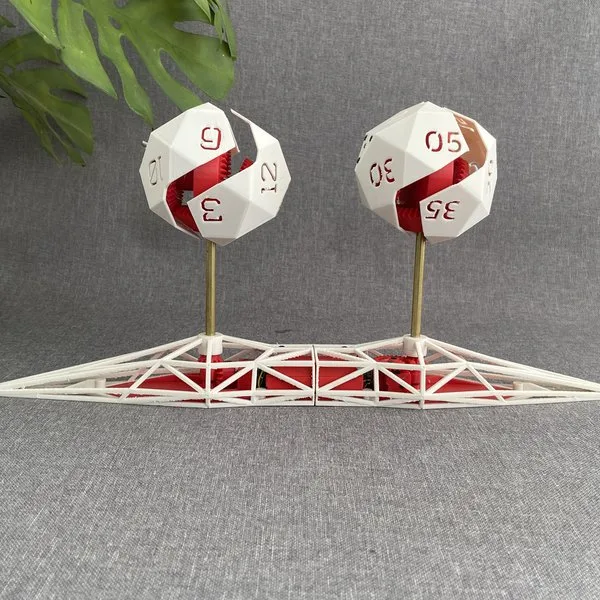
In an era dominated by flat, glowing OLED panels and minimalist digital aesthetics, designer and maker ekaggrat singh kalsi has introduced a mesmerizing antidote to modern screen fatigue. Dubbed OVODYO, this avant-garde desk clock tells time not through silent pixels or standard sweeping hands, but through the hypnotic, organic rolling and flipping of two geometric spheres.
Blending high-precision 3D printing, intricate brass-and-gear kinetics, and embedded electronics, OVODYO transforms the mundane act of checking the time into a captivating mechanical performance. Recently documented on Hackaday.io, this project bridges the gap between functional horology and kinetic sculpture, capturing the imagination of makers, engineers, and design enthusiasts worldwide.
Main Facts: Anatomy of an Unconventional Timekeeper
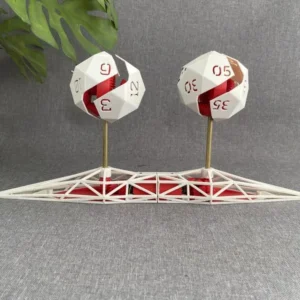
At first glance, OVODYO looks less like a timepiece and more like an art installation resting on a minimalist desk. Measuring 383 mm in length, 78 mm in width, and 163 mm in height, the clock commands attention through its unusual geometry and deliberate structural layout.
The core time-display mechanism relies on two 3D-printed icosahedral spheres (twenty-faced polyhedra) mounted on elegant brass support shafts.
- The Hours Sphere: Features 12 distinct faces, each carrying one hour of the 12-hour cycle.
- The Minutes Sphere: Displays 12 faces representing time increments at strict 5-minute intervals.
Rather than spinning continuously on a single axis, these spheres continuously tumble, roll, and flip. A sophisticated internal transmission system ensures that as the spheres rotate, only one set of numbers remains perfectly upright and legible to the observer at any given moment.
To bridge the gap between those 5-minute jumps, the clock incorporates an intuitive secondary display: six vibrant RGB LEDs positioned centrally on the chassis. These lights illuminate in sequence and blink to indicate intermediate minutes, resetting dynamically each time the primary minute sphere advances.
Powering this intricate ballet is an embedded ecosystem driven by an ATmega8 microcontroller, paired with a DRV8833 dual H-bridge motor driver, precision stepper motors, and magnetic Hall effect sensors for exact positional calibration.
Chronology: From Concept to Kinetic Reality
The realization of OVODYO was neither accidental nor instantaneous; it represents a meticulous journey of prototyping, mechanical iteration, and firmware refinement by ekaggrat singh kalsi.
Phase 1: Conceptualization and Geometric Design
The project began with a fundamental design question: How can multi-sided polygons be utilized to display chronological data dynamically? Kalsi selected the icosahedron because its 12 faces naturally align with standard clock metrics—specifically a 12-hour format and 12 five-minute intervals within an hour. The challenge, however, was engineering a mechanism capable of rotating a 78 mm multi-faced polyhedron around dual axes without causing mechanical binding or visual drift.
Phase 2: Mechanical Prototyping and Gear Trains
Developing the internal transmission required extensive trial and error. Kalsi designed a central drive shaft running directly through the heart of the supporting brass column. This shaft engages a specialized layout of bevel gears.
- The primary central gear drives a 90-degree bevel gear at a 1:1 ratio.
- This secondary motion forces an inclined bevel gear to interact with the main gear structure, successfully executing the complex tumbling motion required to flip the icosahedron.
Phase 3: Integrating Electronics and Homing Logic
Once the physical framework was established, the electronics were integrated into a tri-part chassis. Because stepper motors can occasionally lose steps or drift over prolonged operation, Kalsi implemented a closed-loop homing system. Using a permanent magnet paired with a 3144 Hall effect sensor, the firmware establishes a definitive zero-point reference during every full rotation cycle. This ensures that the numbers on the spheres always halt in a perfectly upright, readable position.
Supporting Data: Engineering Specifications and Mechanics
Building a kinetic clock of this caliber requires an uncompromising approach to mechanical tolerance and electrical balance. A breakdown of OVODYO’s technical specifications reveals the complexity under the hood:
| Component Category | Specification / Part | Function |
|---|---|---|
| Microcontroller | ATmega8 | Core processing unit running Arduino-environment firmware |
| Motor Drivers | DRV8833 Dual H-Bridge | Translates microcontroller signals into precise motor movements |
| Actuators | Compact Stepper Motors with Gearboxes | Provides high torque in a compact housing to drive the spheres |
| Position Sensors | 3144 Hall Effect Sensor + Magnet | Calibrates starting positions and prevents rotational drift |
| Lighting | 6x RGB LEDs | Indicates intermediate minute increments between 5-minute intervals |
| Structural Shells | 3D-Printed Icosahedra (78 mm diameter) | Displays the hour and minute numerals |
| Overall Dimensions | 383 x 78 x 163 mm | Total footprint of the assembled desk clock |
The Mechanics of Cadence
One of the most fascinating engineering triumphs of OVODYO is the differing cadence of its two primary displays. The hours and minutes do not move at the same speed or rhythm:
- The Minutes Sphere: Stops every 90 degrees (equivalent to a quarter turn), updating its face every five minutes.
- The Hours Sphere: Moves at a much slower, more deliberate pace, stopping every one-and-a-quarter turns (equal to 450 degrees) to advance to the next hour.
This contrast creates a dynamic visual hierarchy. The frantic, frequent updates of the minute sphere keep the user anchored to short-term time progression, while the slow, momentous shift of the hour sphere feels monumental and deliberate.
Official Responses and Maker Community Impact
The maker community has responded to OVODYO with immense enthusiasm. Platforms like Hackaday.io have served as a focal point for discussion, with engineers and hobbyists dissecting the intricacies of Kalsi’s bevel gear transmission and firmware architecture.
In project logs and community forums, fellow makers have praised the clean modularity of the base design. By dividing the chassis into three distinct compartments—the left and right housings for the motors and drive shafts, and the central bay reserved entirely for electronics and wiring—maintenance is drastically simplified. Builders can troubleshoot or service the motor drivers and wiring harnesses without needing to dismantle the delicate icosahedral spheres or realign the gear trains.
However, community feedback also highlights the steep skill barrier required to replicate the build. Seasoned fabricators have noted that OVODYO is not an entry-level weekend project.
Implications: The Challenges of Replication and the Future of Kinetic Art
For those inspired by Kalsi’s creation and looking to build their own version of OVODYO, the project serves as both an exciting challenge and a cautionary tale in mechanical precision.
The Fine Line of Mechanical Tolerance
According to maker documentation, the single most delicate phase of assembly is the alignment of the bevel gears. In a gear train of this complexity, any microscopic mechanical play (backlash) compounds exponentially along the chain. If the gears are misaligned by even a fraction of a millimeter, the numbers on the icosahedral faces will skew, failing to settle in the required upright position.
Furthermore, the internal drive shaft must maintain absolute concentricity inside the supporting brass shaft. If the shaft wobbles, the entire 78 mm sphere oscillates off-axis, ruining the crisp aesthetic and placing unnecessary strain on the stepper motors.
Component Selection and Sourcing
Replicating the project requires careful hardware selection. Builders must source compact stepper motors equipped with integrated gearboxes to deliver sufficient torque without increasing the physical footprint of the brass supports. For makers eager to adapt the design, pairing these mechanical assemblies with modular components—such as standard NEMA-class mini steppers and programmable RGB LED lighting strips—offers a reliable path to customization.
A Revival of Physical Computing
OVODYO arrives at a time when consumer electronics have become entirely sanitized, sealed, and untouchable. Devices are glued shut, screens are flush, and mechanical feedback has been replaced by haptic buzzing on glass surfaces.
By celebrating the raw beauty of rotating gears, clicking teeth, tumbling polygons, and visible wiring, projects like OVODYO remind us why physical computing and kinetic art continue to thrive. They inject personality, wonder, and tangible physics back into our workspaces, proving that even something as rigid as telling time can be rendered fluid, artistic, and endlessly fascinating.