Bringing Aperture Science to Life: Maker Recreates the Portal Linked-Gateway Illusion Using Arduino, Flywheel Physics, and High-Speed Sensors
By Tech & Innovation Desk
Published: September 2026
Main Facts: The Physics of an Instantaneous Illusion
For nearly two decades, video game enthusiasts have marveled at the premise of Valve’s critically acclaimed puzzle-platformer, Portal. The mechanic is deceptively simple yet fundamentally impossible in the physical world: toss an object into an orange gateway, and it instantaneously emerges from a blue gateway across the room, preserving its momentum, trajectory, and angle without a millisecond of digital lag.
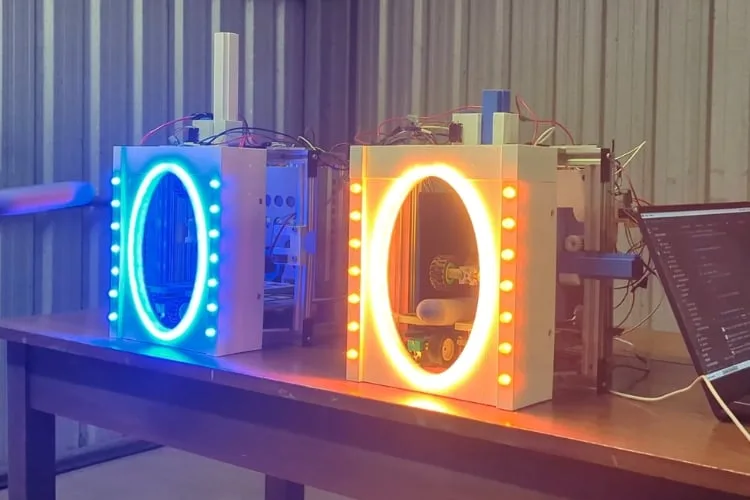
Now, moving boldly from the realm of virtual reality into tangible engineering, a creator known in the maker community as James’ Programming has brought this iconic sci-fi illusion into physical reality. Utilizing a custom-built hardware setup anchored by an Arduino Uno R4 WiFi, Time-of-Flight (ToF) laser distance sensors, and a high-speed mechanical flywheel launcher, the project successfully replicates the linked-portal phenomenon without any camera trickery or video editing.
When an observer throws a lightweight replica object into the first 3D-printed portal frame, an identical projectile is instantly shot out of the second facing frame. The effect relies on a delicate, highly synchronized interplay between rapid sensor data processing, trajectory forecasting, and mechanical actuators.
At the core of the build is the Arduino Uno R4 WiFi, which acts as the central nervous system. It orchestrates incoming sensor data, manages addressable LED rings that cast the signature glowing blue and orange hues of the game, and triggers the physical launch sequence. However, achieving this seamless illusion required solving formidable engineering hurdles spanning nine months of trial, error, and mechanical recalibration.
Chronology: A Nine-Month Journey from Concept to Execution
The path to realizing a functional physical portal was far from straightforward. The project evolved significantly over a nine-month development cycle, marked by major pivots in sensor architecture and mechanical design.
Phase 1: Conceptualization and the 16-Sensor Dead End
In the early stages of development, James set out to map the entire three-dimensional space directly in front of the portal frame. The initial hypothesis was straightforward: more data equals better precision. To achieve this, the prototype was outfitted with an array of 16 Time-of-Flight (ToF) distance sensors.
The theory was that a dense grid of sensors would capture every conceivable angle of an approaching object. In practice, however, the approach resulted in a catastrophic processing bottleneck. The Arduino was overwhelmed by the sheer volume of I2C polling requests required to query 16 distinct sensors sequentially. The cumulative read time introduced a latency so severe that by the time the system registered an object entering the frame, the projectile had already hit the floor. The multi-sensor array was abandoned.
Phase 2: Streamlining and the Two-Sensor Breakthrough
Recognizing that data bloat was killing the illusion, the architecture underwent a radical simplification. James stripped away 14 sensors, reducing the array to just two strategic ToF sensors.
This minimalist approach fundamentally changed the performance of the system. By drastically reducing the polling overhead, the Arduino Uno R4 could process distance changes almost instantaneously. Rather than trying to create a comprehensive 3D map of the space, the two sensors were tasked with a singular, highly optimized objective: detecting the precise velocity and vector of an object crossing a designated threshold.
Phase 3: Solving the Mechanical Lag Barrier
Even with lightning-fast electronic detection, a massive physical obstacle remained: mechanical inertia. Unlike digital pixels that render instantly on a screen, physical objects require time to accelerate. A flywheel launcher—the same mechanism utilized in modern hobbyist toy blasters—relies on rapidly spinning electric motors to grip and propel a projectile.
This creates an unavoidable mechanical delay between the firing command and the object actually clearing the muzzle. To overcome this, James programmed the system to pre-trigger. By analyzing the trajectory data captured by the ToF sensors during the object’s mid-air flight toward the first portal, the firmware calculates the exact flight path and anticipates when the object will arrive. The flywheel is spun up and fired fractions of a second before the object even crosses the physical plane of the input portal, creating the illusion of instantaneous transfer.
Phase 4: Automation and Self-Resetting Mechanics
A portal that only works for a single throw offers limited entertainment value. To make the installation repeatable without constant human intervention, James integrated a servo-assisted alignment and resetting mechanism.
Once a replica object is fired from the output portal, pneumatic or servo-driven guides gently recenter and reposition the objects, returning them to their ready-to-launch states. Addressable LED rings lining the 3D-printed portal frames dynamically shift states to indicate system readiness, completing the immersive aesthetic.
Supporting Data: Technical Specifications and Hardware Architecture
Replicating a video game mechanic in the physical world requires a precise bill of materials. The project relies on a combination of consumer-grade microcontrollers, advanced optical sensors, and custom 3D-printed mechanical assemblies.
Key Hardware Components
- Microcontroller: Arduino Uno R4 WiFi. Chosen for its processing headroom, reliability, and integrated connectivity features which allow for future expansions or remote telemetry tracking.
- Proximity & Distance Sensing: VL53L3CX-based ToF (Time-of-Flight) laser distance sensors. These components use infrared laser light to measure distances independently of target reflectance, providing millimeter-accurate trajectory tracking.
- Actuation & Propulsion: High-RPM DC motor-driven flywheel launcher. Adapted from high-speed hobbyist launcher designs, it grips and accelerates projectiles through friction.
- Visual Feedback: Custom-engineered, addressable RGB LED rings diffused through 3D-printed housing to mimic the iconic glowing event horizons from Portal.
- Structural Elements: Custom CAD-designed, 3D-printed portal frames and mechanical chassis optimized for weight reduction and rigidity.
Performance Metrics and Operating Limits
While the video demonstration of the project looks seamless, transparent engineering logs reveal the harsh realities of physical prototyping:
- Development Timeline: ~9 months of iterative design, coding, and fabrication.
- Success Rate: Approximately 1 in 20 attempts (5%).
- Primary Source of Failure: The compounding tolerances of real-world physics. Variations in how a user throws an object (spin, velocity, angle) occasionally mismatch the predictive algorithms, resulting in mistimed flywheel engagement or physical jams within the self-alignment servo tracks.
Official Responses and Maker Community Reactions
The release of the project documentation and demonstration video on platforms like Circuit Digest and maker forums has sparked widespread discussion across the global engineering and gaming communities.
James’ transparent documentation of the project’s high failure rate has been particularly well-received by fellow creators. In a community often saturated polished, heavily edited project showcases, the candid admission that the automated loop only succeeds five percent of the time has been praised as a refreshing dose of engineering realism.
"The hardest part of building sci-fi in the real world isn’t writing the code or soldering the boards," noted one prominent robotics hobbyist on a popular maker forum. "It’s fighting the unyielding laws of kinetic friction and mechanical latency. Getting a flywheel to sync up with an incoming throw within a window of milliseconds is an incredible feat of predictive programming, regardless of the success rate."
Educators have also taken notice, pointing to the project as an exceptional, highly engaging case study for students learning about control systems, sensor polling limits, and predictive algorithms. By bridging pop culture with hard STEM concepts, the project demonstrates how abstract physics principles—such as momentum, velocity vectors, and mechanical delay compensation—can be translated into tangible, hands-on learning experiences.
Implications: The Future of Mixed-Reality Physical Interactions
While James’ linked-portal illusion is currently confined to a hobbyist workbench, the underlying engineering principles point toward fascinating broader implications in human-computer interaction, robotics, and interactive entertainment.
1. Predictive Automation and Latency Compensation
The core challenge faced by this project—compensating for mechanical delay through predictive sensor tracking—is the exact same problem facing autonomous vehicles, high-speed industrial robotics, and remote surgery platforms. As machines interact more closely with unpredictable physical environments, the ability of microcontrollers like the Arduino Uno R4 to ingest sparse, high-speed data points (like the two ToF sensors) and forecast outcomes in real time will become increasingly vital.
2. The Evolution of Immersive Entertainment
Location-based entertainment and escape rooms are constantly seeking new ways to blend digital fantasy with physical reality. While fully functional, instantaneous wormholes remain strictly within the domain of theoretical physics and science fiction, electromechanical illusions of this caliber demonstrate how far experiential designers can push visitor immersion. By leveraging smart sensors and automated staging, physical environments can react dynamically to user inputs in ways that feel genuinely magical.
3. Open-Source Innovation in Maker Spaces
The decision to publish the complete build log, code architecture, and sensor schematics underscores the collaborative spirit of the modern maker movement. By providing a blueprint—complete with its flaws, dead ends, and performance limits—creators empower others to iterate upon their work. It is entirely possible that future iterations by community builders will refine the mechanical alignment and push that 5% success rate significantly higher.
For now, the project stands as a brilliant testament to human ingenuity: a tangible bridge built between a digital masterpiece and the stubborn, rewarding laws of the physical universe.