Bridging the Gap: How ‘Prop For That’ is Revolutionizing CSS-JavaScript Interoperability
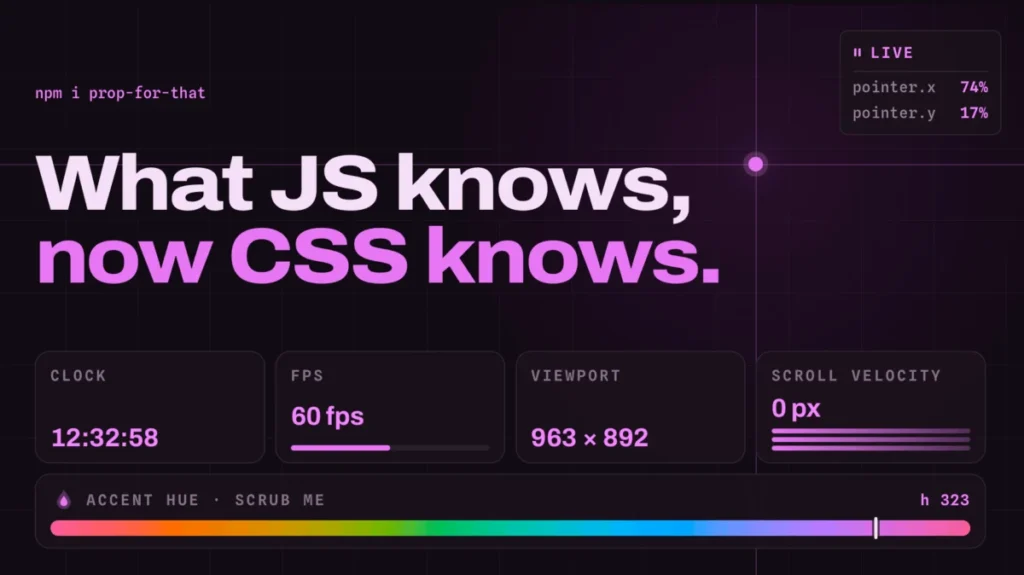
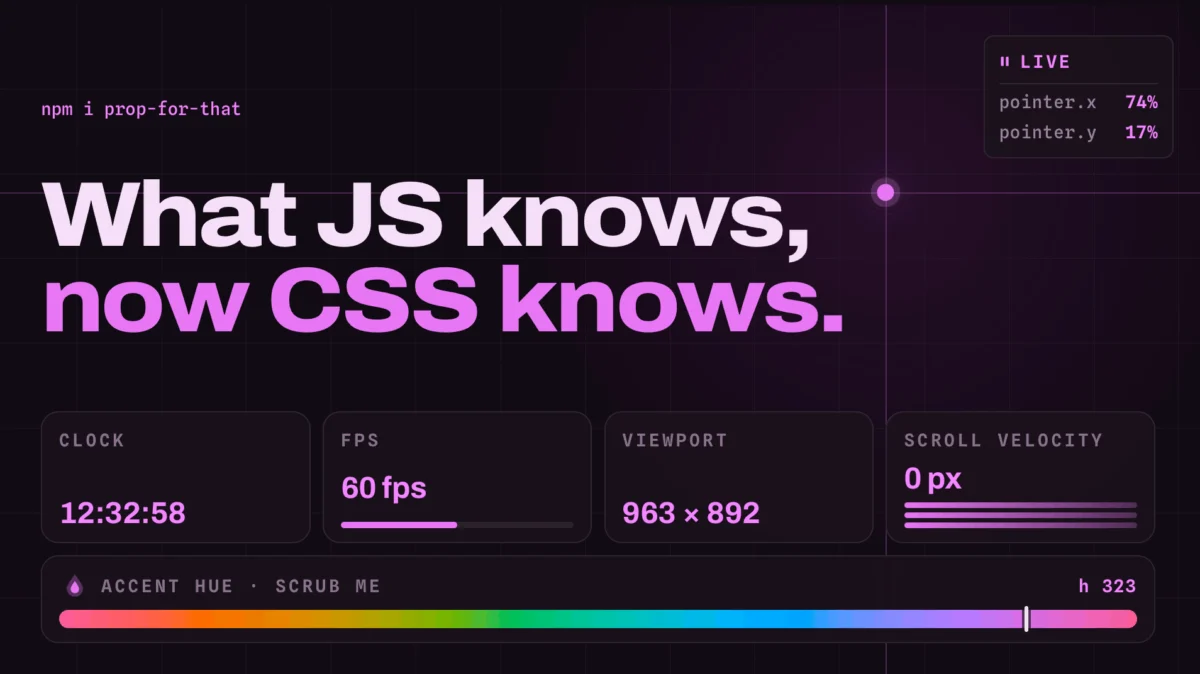
The web development landscape has long been defined by a clear, often frustrating, boundary: the wall between declarative CSS and imperative JavaScript. While CSS has evolved from a simple styling language into a sophisticated engine capable of complex animations, grid layouts, and variable management, it remains fundamentally "blind" to certain real-time environmental data. Developers have traditionally relied on cumbersome JavaScript event listeners to bridge this gap, manually updating inline styles or CSS custom properties to react to user inputs.
Enter Adam Argyle—a developer whose name has become synonymous with the modernization of CSS—and his latest project, Prop For That. Following the massive success of Open Props, his collection of preconfigured design tokens, Argyle has launched a new utility that promises to fundamentally change how we build reactive interfaces. By abstracting the "glue code" that links browser environmental data to CSS variables, Prop For That allows developers to treat complex browser states as native design tokens.
The Chronology of CSS Evolution: From Static to Dynamic
To understand the significance of Prop For That, one must look at the historical trajectory of web styling. In the early days, CSS was strictly static. If you wanted an element to move with the mouse, you wrote a mousemove event listener in JavaScript that directly manipulated the element’s top and left properties. This was not only performant-heavy but also broke the separation of concerns.
The Rise of CSS Custom Properties
The introduction of CSS Custom Properties (CSS variables) was a watershed moment. It allowed developers to define values once and reuse them throughout a stylesheet. However, these variables were still largely static or updated via brittle JavaScript logic.
The Era of Open Props
A few years ago, Argyle introduced Open Props, a library that provided a vast suite of standardized CSS variables for color, spacing, shadows, and typography. It effectively gave developers a "design system in a box." While Open Props solved the problem of consistency, it didn’t solve the problem of reactivity.
The Birth of Prop For That
Prop For That is the natural evolution of this philosophy. If Open Props provided the static variables, Prop For That provides the dynamic ones. Recognizing that developers were repeatedly writing the same boilerplate code to track scroll positions, cursor coordinates, and form states, Argyle developed a lightweight, plugin-based architecture that handles the data fetching automatically. It is the culmination of years of observing the "missing links" between browser APIs and the CSSOM (CSS Object Model).
Decoding the Mechanics: How It Works
At its core, Prop For That operates on a simple premise: declarative HTML attributes should drive complex JavaScript-powered state.
The Implementation Strategy
Unlike traditional libraries that require deep integration into a build step or a specific framework, Prop For That is designed to be "drop-in." The process is intentionally minimalist:
- Import: Include the library script in the document head or footer.
- Declare: Add a
data-props-forattribute to the HTML element you wish to track. - Consume: Use the resulting CSS variables (e.g.,
--live-pointer-x) directly within your stylesheet.
This approach effectively treats the browser environment as a data stream. For instance, by adding data-props-for="pointer" to a container, the library initializes an internal event listener that captures the clientX and clientY coordinates of the user’s cursor. These are then injected as CSS custom properties on the element, allowing for high-performance visual updates using calc() and standard CSS transitions.
Performance and the DOM
A common concern for developers is the impact of excessive JavaScript listeners on page performance. Prop For That addresses this by using a centralized, plugin-based engine. Rather than spawning a listener for every individual element, the library uses event delegation and efficient RAF (RequestAnimationFrame) loops, ensuring that updates occur only when necessary and minimizing layout thrashing.
Supporting Data: Use Cases and Implementation Demos
The power of Prop For That is best illustrated through its diverse range of plugins. The project currently supports a variety of metrics that were previously difficult to capture without significant custom code.
1. Pointer Tracking
As demonstrated in Argyle’s documentation, tracking the cursor is the "Hello World" of this library. By binding data-props-for="pointer", developers gain immediate access to --live-pointer-x and --live-pointer-y. This allows for complex parallax effects or follow-the-cursor animations that remain completely defined in the CSS layer.
2. Scroll Velocity and Progress
Tracking how fast a user scrolls or how far down a page they have traveled has historically required complex IntersectionObserver or onScroll logic. Prop For That simplifies this to a single attribute, allowing developers to create progress bars or scroll-triggered animations that feel fluid and native.
3. Form States
Perhaps the most ambitious aspect of the library is its ability to tap into form states. By observing input validity, focus, and value changes, Prop For That allows developers to create custom validation feedback loops without writing a single line of state-management JavaScript.
Implications for the Future of Web Development
The release of Prop For That signals a broader shift toward "CSS-first" development. By moving the interaction logic into the styling layer, we are seeing a return to the original promise of the web: a separation of content (HTML), presentation (CSS), and behavior (JS).
Implications for Frameworks
Modern frameworks like React, Vue, and Svelte often handle state management with significant overhead. Prop For That offers a compelling alternative for simple UI reactivity. By delegating the heavy lifting of state observation to a specialized utility, developers can reduce their reliance on framework-specific hooks, leading to cleaner, more portable codebases.
The Professional Developer’s Perspective
For the professional front-end engineer, this library represents a significant gain in productivity. "Boilerplate fatigue" is a real issue in modern web development. When a developer can replace 50 lines of complex JS logic with a single data- attribute, the impact on maintainability is profound. It allows teams to focus on the design of the interaction rather than the plumbing of the data.
Accessibility and Browser Support
Because the library relies on CSS Custom Properties and standard DOM attributes, it is inherently accessible. The values passed to CSS are just numbers, which can be easily used to inform aria attributes or other accessibility-focused styling. Furthermore, the reliance on standard APIs ensures that the library remains future-proof, even as browsers introduce new native CSS features like the scroll-driven-animations specification.
Official Responses and Community Reception
The developer community has reacted with significant enthusiasm. Since its launch, GitHub discussions and social media threads have been filled with developers experimenting with the library to build everything from interactive art installations to complex, data-driven dashboards.
Adam Argyle’s Vision
In his documentation, Argyle emphasizes that the project is not intended to replace JavaScript, but rather to "unblock" CSS. His philosophy is that the browser should provide the data, and CSS should be free to consume it in the most performant way possible. By standardizing the way we capture browser states, he hopes to create a common language for designers and developers to describe interactive experiences.
Addressing Potential Criticisms
Some critics argue that using data- attributes to trigger JavaScript behavior mimics the "bad old days" of jQuery-style plugins. However, supporters of the library point out that the implementation is fundamentally different; it is not modifying the DOM structure, but rather feeding the CSS layer with real-time data, which is a key distinction in modern architectural patterns.
Conclusion: A New Standard for Interaction
Prop For That is more than just a utility library; it is a proof of concept for a more integrated, responsive web. By bridging the gap between browser environmental data and CSS custom properties, it empowers developers to build interfaces that feel alive, responsive, and deeply integrated with the user’s context.
As we look toward the future, it is likely that we will see more browser-native APIs that provide this functionality out of the box. Until then, projects like Prop For That serve as a vital bridge, pushing the boundaries of what is possible in the browser and reminding us that the most elegant solutions are often those that simplify the complex. Whether you are building a simple portfolio or a complex web application, the ability to effortlessly tap into browser states is a tool that belongs in every developer’s kit.