Court-Ordered Seizure of Radaris.com Exposes the Global Shell Game of the People-Search Industry

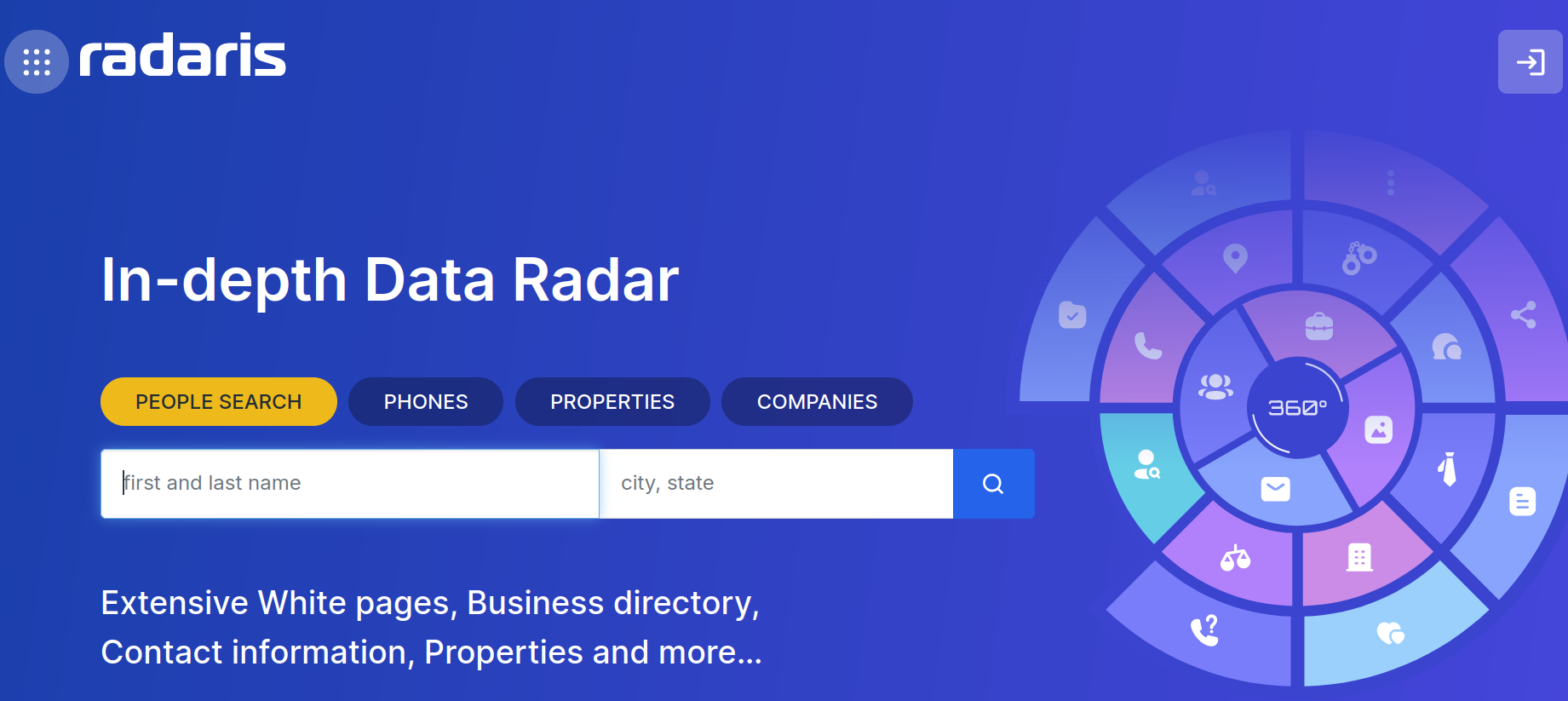
In a landmark legal development that has sent shockwaves through the multi-billion-dollar consumer data broker industry, the high-traffic people-search giant Radaris.com has been stripped of its domain name. Following a series of aggressive legal maneuvers and years of alleged stonewalling, a New Jersey state judge ordered the transfer of radaris.com and over a dozen affiliated data broker domains directly to plaintiffs associated with Atlas Data Privacy Corp.
The extraordinary forfeiture stems from Radaris’s repeated violations of Daniel’s Law, a stringent New Jersey statute designed to shield law enforcement personnel, judges, and government officials from targeted harassment and safety threats by forcing data brokers to permanently scrub their personal information.
While the domain radaris.com now redirects to a public notice detailing the court-ordered transfer rather than offering detailed personal dossiers on millions of Americans, the case has exposed a labyrinthine corporate shell game spanning multiple continents, fake executives, and a network of interconnected tracking operations.
The Anatomy of the Judgment
The legal reckoning for Radaris began in February 2024 when Atlas Data Privacy Corp filed a lawsuit in New Jersey alleging that Radaris persistently flouted Daniel’s Law. Enacted following a family tragedy involving a federal judge, the statute empowers designated public officials to demand the complete removal of their personal details from commercial people-search platforms. Crucially, the law imposes severe penalties for non-compliance, levying fines of up to $1,000 per statutory violation against companies that ignore removal requests.
Radaris, known industry-wide for ignoring or obstructing opt-out and removal requests, quickly reverted to an established playbook of procedural delay. According to Matt Adkisson, president and CEO of Atlas, the company played an intricate shell game, constantly altering its corporate structures, privacy policies, and country of registration to evade accountability.
“We refer to this period as their island-hopping phase,” Adkisson explained. “Privacy policies changed constantly, and new entities kept appearing from places like the Marshall Islands, the British Virgin Islands, and Seychelles.”
When Atlas expanded its litigation in June 2025 to encompass a broader family of interconnected data broker sites, Radaris’s defense attorneys continually challenged service of process, claiming that the true owners—purportedly foreign entities—had not been properly reached. However, after persistent litigation and the accumulation of thousands of internal corporate documents, the New Jersey court determined that the defendants had been granted ample opportunity to defend themselves and repeatedly failed to do so. On August 26, the court ordered the wholesale transfer of the domains to the plaintiffs.
A Chronology of Evasion: From Boston to the Marshall Islands
To understand how Radaris operated for over a decade, investigators and legal teams had to piece together a complex timeline of corporate camouflage, pseudonymous executives, and shifting offshore ownership.
- 2017: Radaris temporarily lost a major class-action lawsuit (Huebner v. Radaris, LLC) after failing to mount a defense. When plaintiffs attempted to collect a $7.5 million default judgment, a judge ordered Verisign to transfer the radaris.com domain. Radaris’s longtime attorney, Val Gurvits of the Boston Law Group, successfully appealed, arguing that the domain was actually owned by a Cyprus-registered firm called Bitseller Expert Limited, thereby violating due process. The domain transfer was halted.
- October 2020: Shortly after the 2017 legal battle stalled, Radaris shifted its operational entity from Bitseller to Andtop Company, an entity newly incorporated in the Marshall Islands. Investigators later discovered that when terms of service pointed to newly conjured Marshall Islands management firms, those entities frequently did not legally exist.
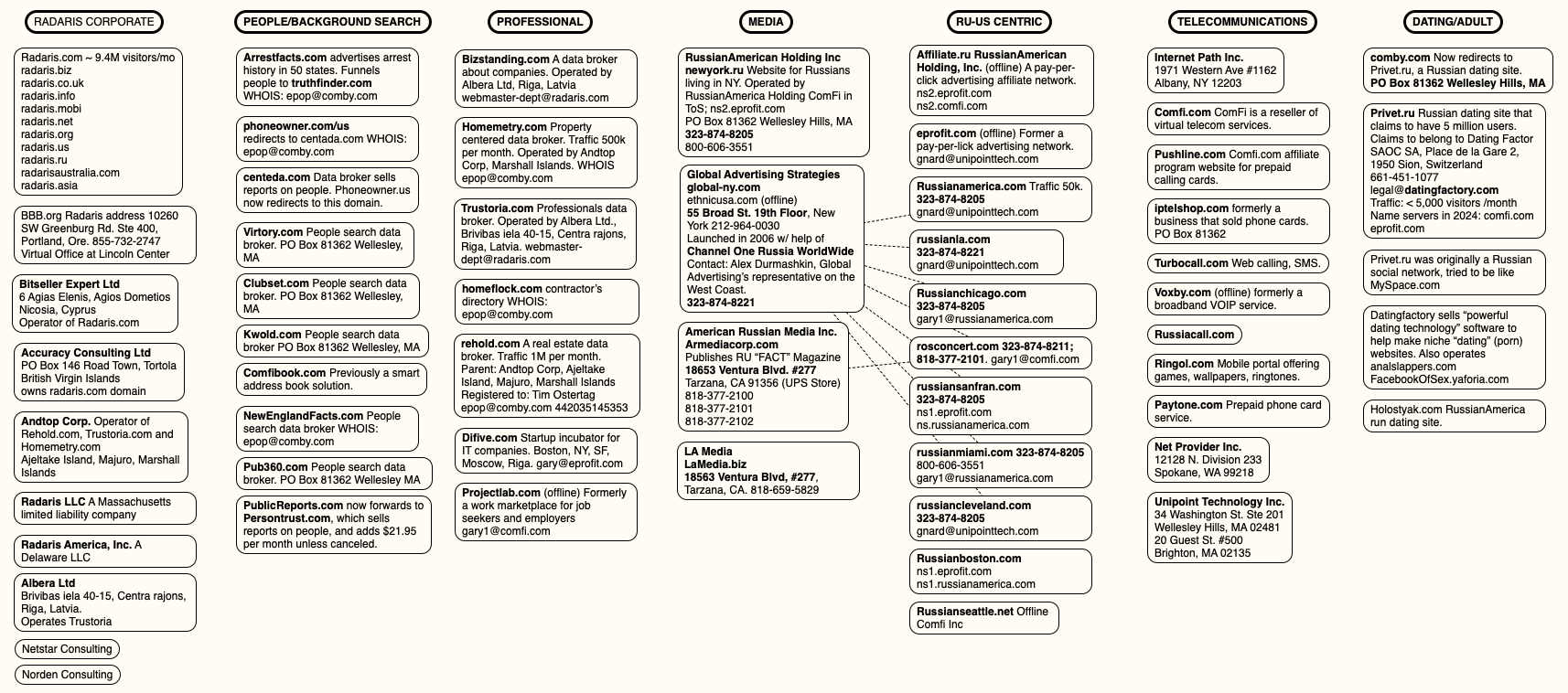
- Early 2024: Atlas filed its Daniel’s Law lawsuit against Radaris. Concurrently, investigative reporting by KrebsOnSecurity unmasked the true masterminds behind the operation: Igor and Dmitry Lubarsky (also known as Gary Lybarsky), Russian-born brothers living in Massachusetts who control an expansive web of people-search engines, affiliate networks, and Russian-language dating sites.
- March–June 2024: Confronted with investigative findings, attorneys for the Lubarsky brothers threatened defamation lawsuits, insisting the true owners were Ukrainian nationals. Subsequent investigations revealed that Radaris had utilized a fictitious CEO named “Gary Norden” in marketing materials and investor pitches—a fabrication later admitted by their legal counsel.
- June 2025: Atlas re-filed and expanded its lawsuit, sweeping in dozens of related corporate entities.
- August 2025: Finding the defendants in default for failing to mount a substantive defense, the New Jersey court ordered the immediate transfer of radaris.com and 13 sister domains to Atlas.
Supporting Data: Unmasking the Network
Through the course of discovery, Atlas obtained more than 10,000 internal emails and corporate documents. According to litigation summaries, this evidentiary cache completely dismantles the illusion of a decentralized, foreign-owned enterprise.
The records demonstrate that nominal legal vehicles—including Radaris America, Inc., Bitseller Expert Limited, Digital Orbit Corp, Core Solutions Group Inc, Lucky Solutions Inc, Virtura Corp, Veripages Inc., Nuform Solutions Inc., Growth Data Advisors Inc., and Property Experts, Inc.—are in reality administered by the exact same small cadre of individuals out of the Boston area. These companies share payment card accounts, banking channels, virtual office addresses, and administrative backend infrastructure rooted in mail domains such as difive.com, centerex.com, and pub360.com.
Furthermore, the documents quantify the vast commercial revenues generated by these coordinated people-search operations:
- Radaris.com reportedly pulled in approximately $42,000 per month.
- Veripages.com generated roughly $45,000 monthly, heavily bolstered by data-sharing partnerships with marketing and advertising entities such as the Lifetime Value Company (operator of PeopleLooker, PeopleSmart, NumberGuru, and car history site Bumper).
- Additional revenue streams—yielding up to $25,000 monthly—were tied to partnerships with privacy removal services like Onerep, highlighting a circular industry dynamic where data brokers frequently intersect with companies claiming to clean up consumer footprints.
Official Responses and Legal Posturing
The defense maintains that the New Jersey court’s actions are legally flawed and subject to reversal. Attorney Victor Worms, who stepped in to represent aspects of the defense, argued that the default judgment and subsequent domain transfer targeted Radaris.com as if it were a legal entity, which he contends is a legal impossibility.

“We have made a motion to vacate that default judgment on the grounds that it is void since a non-entity has no legal capacity to sue or be sued,” Worms stated, adding that the defense intends to pursue appeals based on constitutional challenges regarding asset forfeiture.
Meanwhile, Raj Parikh, a partner at PEM Law in New Jersey who handles Daniel’s Law litigation for Atlas, noted that Radaris survived for a decade by leveraging a strategy of attrition.
“In the past, they won by attrition. Plaintiffs’ attorneys tired of the procedural games and just gave up,” Parikh said. “That strategy worked for a decade, and it probably would have worked in this case too… But we were acutely aware of the threat this website posed to law enforcement officers and other public officials in New Jersey, and decided early on to commit whatever time and resources were necessary to remove that threat.”
Broader Implications: Daniel’s Law Under Fire and the Federal Vacuum
The seizure of Radaris domains represents a massive tactical victory for privacy advocates and public safety officials in New Jersey, but the broader war over data broker transparency is intensifying on multiple fronts.
The Constitutional Battleground
While Daniel’s Law has proven a potent weapon in New Jersey, the statute faces a sweeping constitutional challenge. Backed by the broader data broker industry, approximately 70 similar lawsuits filed by Atlas have been removed to federal court. Critics of the law argue it is overly broad and infringes upon First Amendment protections regarding the publication of public records. The U.S. Court of Appeals for the Third Circuit is currently reviewing these challenges, with industry watchers anticipating the dispute will ultimately reach the U.S. Supreme Court.
State-level momentum remains mixed. While at least 14 other states have introduced legislation modeled after Daniel’s Law, federal courts have pushed back in other jurisdictions; notably, a federal district court ruled West Virginia’s version of Daniel’s Law facially unconstitutional under the First Amendment in August 2025.
The 21st-Century Privacy Void
Privacy experts point out that state-level carve-outs and the absence of comprehensive federal privacy legislation continue to leave consumers vulnerable. Because state laws routinely exempt records classified as "public" or "government" documents—such as voting registries, property deeds, marriage licenses, and motor vehicle databases—people-search engines can easily reconstruct individual dossiers even after basic opt-out requests are honored.
Justin Sherman, a privacy expert and author of the forthcoming book The Middlemen, notes that powerful technology lobbying forces—spanning social media giants, cryptocurrency firms, and artificial intelligence proponents—consistently block meaningful federal data protection reforms under the guise of economic necessity.
“The average person can look at Daniel’s Law and have a perfectly normal reaction, which is that everyone should be covered, not just police and judges,” Sherman observed. “But we don’t need more wake-up calls. We’ve had eight million wake-up calls already on the need for better privacy laws. The lack of comprehensive federal privacy law is not for a lack of knowledge, and anyone claiming otherwise is either not reading the news or kidding themselves.”
As the legal battles over radaris.com grind through appellate courts and federal dockets, the case stands as a watershed moment—proving that even the most entrenched, globally insulated data brokers can be held accountable when plaintiffs possess the resolve to pierce through corporate shell games.