TensorFlow v2 Brings Native Distributed Fast Fourier Transform Support to Machine Learning via DTensor
SAN FRANCISCO — In a significant development for high-performance scientific computing and machine learning, the TensorFlow team has officially announced native support for Distributed Fast Fourier Transform (FFT) in TensorFlow v2. Spearheaded by Google intern Ruijiao Sun from the DTensor team, this new capability bridges a crucial gap for researchers working with massive, image-like datasets that routinely exceed the memory capacity of a single hardware accelerator.
By leveraging TensorFlow’s modern distribution API, known as DTensor, machine learning engineers and data scientists can now seamlessly scale complex signal processing pipelines across multiple GPUs and TPUs without rewriting core model architectures. The announcement promises to unlock new frontiers in fields ranging from medical imaging and seismic data processing to ultra-high-resolution computer vision.
Main Facts: What is Distributed FFT and Why Does It Matter?
The Fast Fourier Transform (FFT) is a cornerstone algorithm of modern digital signal processing. In the realm of machine learning, FFTs are deployed extensively for a variety of tasks:
- Speeding up convolutions: Converting spatial-domain operations into the frequency domain to drastically reduce computational complexity.
- Feature extraction: Identifying dominant frequencies, periodic patterns, and textural attributes in high-dimensional inputs.
- Model regularization: Applying spectral constraints to stabilize training and prevent overfitting in deep neural networks.
However, as deep learning models scale to ingest higher-resolution inputs—such as multi-gigapixel satellite imagery, 3D volumetric medical scans, or massive climate simulation grids—a critical bottleneck emerges. A standard, single-device FFT requires the entire dataset or intermediate tensor to reside simultaneously within the memory of a single accelerator (such as a GPU or TPU). When datasets outgrow physical device memory, training grinds to a halt with Out-Of-Memory (OOM) errors.
Distributed Fast Fourier Transform solves this dilemma by partitioning tensors across a mesh of multiple computing devices. Instead of relying on a single processor, the workload is distributed, allowing clusters of hardware to collectively compute Fourier transforms on datasets that would otherwise be intractable.
While a proof-of-concept Distributed FFT library was previously implemented for legacy TensorFlow v1—stemming from seminal Google Research work detailed in the paper "Large-Scale Discrete Fourier Transform on TPUs" by Tianjian Lu—TensorFlow v2 lacked native, out-of-the-box integration. The latest update rectifies this, baking distributed signal processing directly into the framework via DTensor.
Chronology: The Evolution from Legacy Research to TensorFlow v2 Native Integration
The journey toward native Distributed FFT in TensorFlow v2 is the result of years of iterative engineering, bridging academic research with enterprise-grade framework design.
Phase 1: The Research Foundation (TensorFlow v1 Era)
The theoretical framework for scaling Fourier transforms on accelerators was established during the TensorFlow v1 lifecycle. As deep learning workloads expanded into specialized domains like weather forecasting and high-resolution physics simulations, standard single-device memory limits became an acute pain point.

Google Research tackled this by developing specialized algorithms capable of executing discrete Fourier transforms across distributed TPU pods. This work culminated in the foundational research paper, "Large-Scale Discrete Fourier Transform on TPUs" by Tianjian Lu. While successful in demonstrating feasibility, the implementation existed as an isolated library rather than an integrated framework feature, requiring specialized boilerplate code and restricting widespread adoption among everyday TensorFlow v1 users.
Phase 2: The Birth of DTensor and Synchronous Distributed Computing
As TensorFlow transitioned to v2, the core development team prioritized a unified approach to distributed training. This led to the creation of DTensor, an extension designed for synchronous distributed computing.
DTensor introduced a paradigm shift through a procedure called Single Program, Multiple Data (SPMD) extension. Unlike older paradigms that forced developers to manually manage device placements and inter-device communication tensors, DTensor provided a uniform API capable of handling traditional data parallelism and model parallelism patterns seamlessly. By abstracting the underlying hardware topology into configurable "meshes," DTensor laid the structural groundwork required to implement complex mathematical operations—like multi-dimensional FFTs—across distributed clusters.
Phase 3: Integration into TensorFlow v2
Building upon the DTensor architecture, the development team—highlighted by recent contributions from Ruijiao Sun—successfully integrated native Distributed FFT capabilities into TensorFlow v2.
Rather than inventing an entirely new API surface, the engineering team prioritized developer ergonomics. The new distributed FFT interface is identical to TensorFlow’s native, legacy FFT functions. Developers simply pass a sharded tensor—a tensor whose components are distributed across a device mesh—into existing operations such as tf.signal.fft2d. The system automatically handles the orchestration, layout adjustments, and distributed execution, returning a similarly sharded output tensor.
Supporting Data: Performance Analysis, Trade-offs, and Profiling
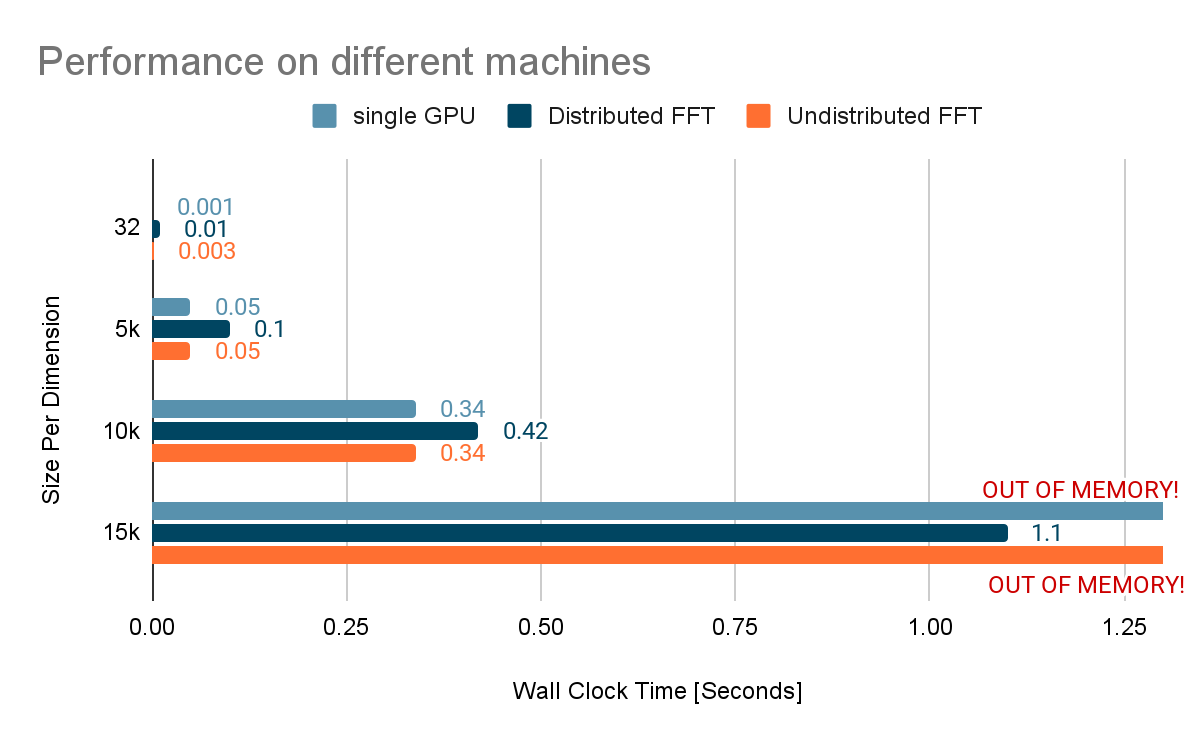
While Distributed FFT shatters historical memory barriers, systems engineering is rarely without trade-offs. Comprehensive profiling conducted by the Google team on an 8x V100 GPU system sheds light on the performance characteristics, bottlenecks, and efficiency metrics of the new DTensor implementation.
The Memory vs. Latency Trade-off
The primary advantage of Distributed FFT is undeniable: it enables computations on datasets that are physically impossible to process on a single device. By pooling memory across multiple GPUs or TPUs, the system can scale to massive dimensional sizes.
However, this capability comes with a computational tax. Distributing a tensor across multiple accelerators requires continuous inter-device communication. Data must be transposed and shuffled across the network fabric, introducing communication overhead that slows down raw wall-clock calculation speed compared to running an undistributed FFT on a small dataset that fits comfortably in a single device’s memory.

Micro-Profiling the 10K x 10K FFT Experiment
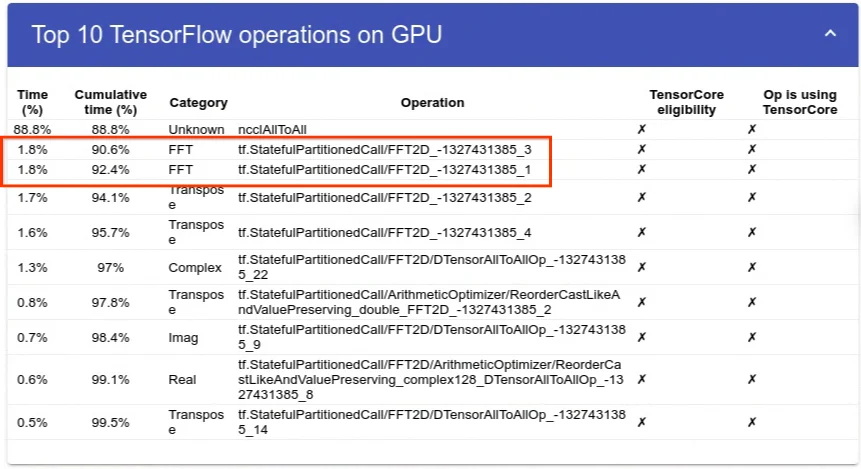
To understand where execution time is consumed, the TensorFlow team profiled a 10K x 10K distributed FFT experiment running on an 8-GPU V100 cluster.
The current implementation of distributed FFT in TensorFlow adopts a straightforward shuffle + local FFT methodology—a classic approach shared by widely respected distributed mathematical libraries such as FFTW (Fastest Fourier Transform in the West) and PFFT (Parallel Fast Fourier Transform).
The profiling data revealed striking insights into operational efficiency:
- Minimal Compute Time: The actual local FFT operations accounted for merely 3.6% of the total execution time (clocking in at an impressive 15 milliseconds). Remarkably, this local computation phase executed in roughly one-third of the time required by a non-distributed
fft2doperation on comparable local slices. - The Communication Bottleneck: The vast majority of the execution time was consumed not by mathematical computation, but by data shuffling. Specifically, the
ncclAllToAllcommunication primitive dominated the runtime profile, as tensors were redistributed across the device mesh to align with the requirements of multi-dimensional Fourier transformations.
These profiling results validate the underlying math while pointing a clear directional arrow toward future performance optimizations.
Official Implementation Guide and Code Example
Adopting Distributed FFT in TensorFlow v2 requires setting up a device mesh via DTensor, initializing the accelerator system, and passing sharded inputs into standard signal processing ops. Below is the reference implementation provided by the development team:
import tensorflow as tf
from tensorflow.experimental import dtensor

# 1. Set up and configure computing devices (CPU or GPU)
device_type = dtensor.preferred_device_type()

if device_type == 'CPU':
    cpu = tf.config.list_physical_devices(device_type)
    tf.config.set_logical_device_configuration(
        cpu[0], [tf.config.LogicalDeviceConfiguration()] * 8
    )
elif device_type == 'GPU':
    gpu = tf.config.list_physical_devices(device_type)
    tf.config.set_logical_device_configuration(
        gpu[0], [tf.config.LogicalDeviceConfiguration(memory_limit=1000)] * 8
    )

dtensor.initialize_accelerator_system()

# 2. Create a distributed device mesh (e.g., 3D mesh mapping x, y, z axes)
mesh = dtensor.create_distributed_mesh(
    mesh_dims=[('x', 1), ('y', 2), ('z', 4)],
    device_type=device_type
)

# 3. Set up a distributed input Tensor using stateless random initialization
input_tensor = tf.complex(
    tf.random.stateless_normal(shape=(2, 2, 4), seed=(1, 2), dtype=tf.float32),
    tf.random.stateless_normal(shape=(2, 2, 4), seed=(2, 4), dtype=tf.float32)
)

init_layout = dtensor.Layout(['x', 'y', 'z'], mesh)
d_input = dtensor.relayout(input_tensor, layout=init_layout)

# 4. Execute distributed fft2d.
# DTensor automatically determines the most efficient layout for d_output.
d_output = tf.signal.fft2d(d_input)
print("Distributed FFT output successfully computed:", d_output)
Implications: What This Means for AI Research and Industry
The introduction of native Distributed FFT via DTensor carries profound implications across multiple scientific and industrial domains where deep learning intersects with high-performance computing (HPC).
1. Democratizing Ultra-High-Resolution Computer Vision
In fields such as satellite Earth observation, autonomous vehicle perception, and industrial quality inspection, input resolutions are skyrocketing. Traditional deep learning architectures have often been forced to crop or downsample high-resolution images to fit within GPU memory limits, discarding valuable high-frequency details. With distributed FFT support, models can process full-resolution spectral features natively, enhancing anomaly detection, geospatial analysis, and fine-grained feature recognition.
2. Accelerating Scientific Machine Learning (SciML)
Scientific machine learning—covering computational fluid dynamics, weather prediction, seismic imaging, and molecular modeling—relies heavily on spectral methods. Partial differential equations (PDEs) are frequently solved in the frequency domain. By natively supporting distributed FFTs within a mainstream deep learning framework like TensorFlow v2, researchers can build hybrid physics-informed neural networks (PINNs) that scale effortlessly across large enterprise clusters and supercomputing nodes, bridging traditional HPC simulations with modern AI accelerators.
3. Streamlining Framework Usability
Historically, scaling custom mathematical operations across distributed clusters required deep expertise in low-level communication libraries (like MPI or NCCL) and manual memory management. By abstracting these complexities behind DTensor’s SPMD paradigm, Google is lowering the barrier to entry for advanced distributed computing. Machine learning engineers do not need to rewrite signal processing algorithms from scratch; they simply wrap existing code in a distributed mesh context.
Next Steps and Community Engagement
While the current release of Distributed FFT provides a robust and functional foundation, the TensorFlow team emphasizes that this is merely the first iteration. Because the initial rollout relies on a straightforward shuffle-plus-local-FFT algorithm, engineering efforts are already underway to fine-tune performance and mitigate communication bottlenecks.
Potential future optimization pathways include:
- Overlapping Communication and Computation: Hiding
ncclAllToAlllatency by pipelining data transfers alongside local kernel execution. - Algorithmic Refinement: Exploring specialized multi-dimensional communication reduction strategies tailored specifically to TPU interconnect topologies (such as torus and mesh topologies).
- Advanced Layout Optimization: Enhancing DTensor’s automatic layout analysis to minimize unnecessary tensor transposes during complex, multi-step signal processing pipelines.
The TensorFlow team has opened the feature for public evaluation and encourages the global developer community to test the new capabilities. Feedback, bug reports, and performance optimization proposals are actively being welcomed on the official TensorFlow Forum.
As machine learning models continue to scale into ever-larger data regimes, innovations like native Distributed FFT ensure that TensorFlow remains at the cutting edge of both artificial intelligence and high-performance scientific computing.