NEW YORK — The crisp, energetic shift of mid-September in New York City—marked by bustling streets, changing foliage, and the frantic pace of the professional calendar—is mirrored this week insideAmazon Web Services (AWS). As the city returns to full operational speed, the AWS launch pipeline is matching stride, headlined by one of the most significant artificial intelligence integrations of the decade.
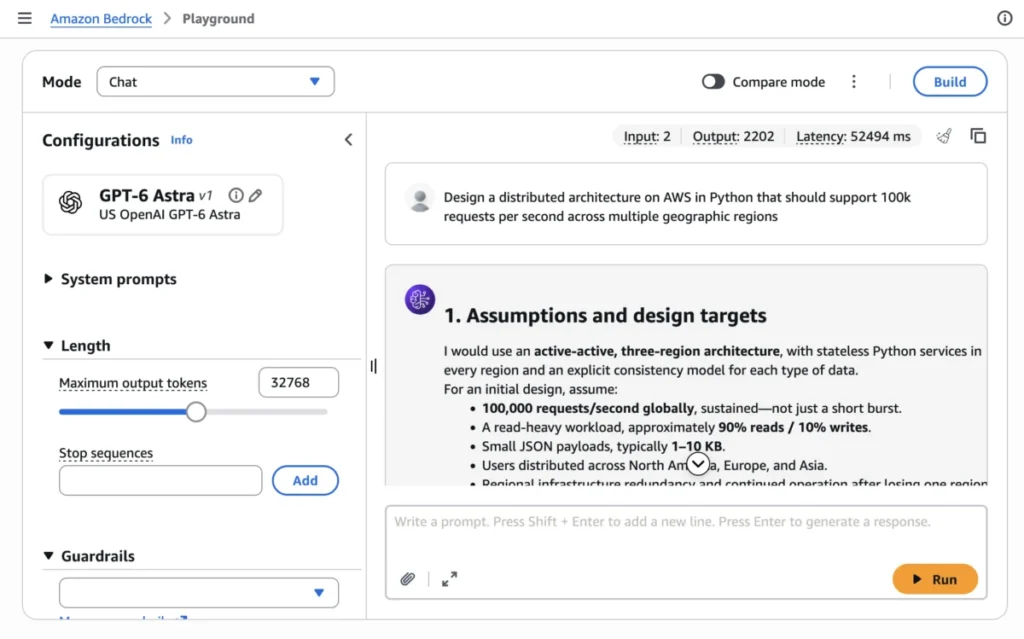
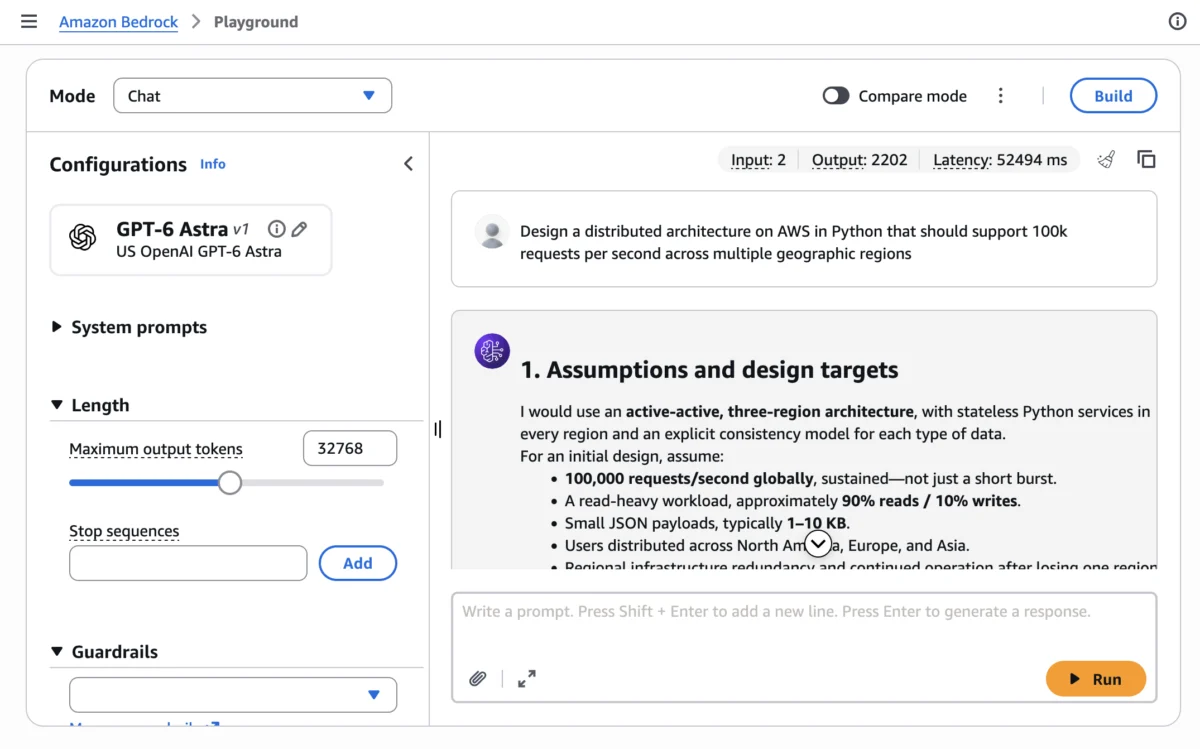
For enterprise technologists, developers, and business leaders, the big news this week is the official arrival of OpenAI’s flagship model, GPT-6 Astra, now generally available on Amazon Bedrock. This milestone deployment bridges the gap between state-of-the-art foundation model capabilities and the rigorous security, compliance, and scalability frameworks demanded by global enterprise organizations.
Alongside the Bedrock integration, AWS continues to roll out productivity enhancements, such as a dedicated desktop application for Amazon Quick, while reinforcing a broader cultural shift within the developer community: the realization that the most profound productivity gains with AI agents require not just superior tools, but fundamentally reimagined workflows.
Main Facts: GPT-6 Astra Lands on Amazon Bedrock
The centerpiece of this week’s announcements is the integration of OpenAI’s GPT-6 Astra into Amazon Bedrock. Representing OpenAI’s most advanced and capable foundation model to date, GPT-6 Astra is designed to handle exceptionally complex business workflows that require deep reasoning, professional-grade writing and graphic design, and advanced computer- and browser-use capabilities.
Key Technical Specifications and Capabilities:
Massive Context Window: The model supports an expansive context window of up to 1 million input tokens. This immense capacity allows engineering and legal teams to feed entire codebases, multi-volume corporate contracts, or extensive archives of technical documentation directly into the model for comprehensive analysis, cross-referencing, and reconciliation.
Advanced Reasoning and Judgment: Moving beyond pattern matching, GPT-6 Astra features enhanced cognitive architectures designed to reconcile competing inputs, evaluate edge cases, and execute multi-step problem-solving.
Enterprise Integration and Tooling: Organizations can invoke GPT-6 Astra seamlessly through standard, supported Amazon Bedrock APIs. Furthermore, developers can configure tools like ChatGPT Work and Codex to leverage the model directly within their existing AWS architectures.
Enterprise-Grade Security: Operating on Amazon Bedrock ensures that customers retain full command over their data. Established AWS security controls govern user access, secure workloads, and audit model invocation activity. Critically, AWS and OpenAI enforce a strict privacy policy: customer inference data is never used to train underlying model weights.
Concurrently with the Bedrock rollout, OpenAI is introducing a suite of new enterprise plugins for ChatGPT Work. These plugins extend Astra’s native browser-use capabilities directly across common business applications, allowing autonomous agents to interact securely with software-as-a-service (SaaS) platforms, enterprise resource planning (ERP) systems, and custom web applications.
Chronology: The Road to GPT-6 Astra on Bedrock
The deployment of a frontier model of this magnitude does not happen overnight. It represents the culmination of extensive architectural alignment between AWS and OpenAI, alongside continuous enhancements to the Amazon Bedrock managed service ecosystem.
Phase 1: Foundation and Early Collaboration (Late 2024 – 2025)
As generative AI transitioned from a conversational novelty to core enterprise infrastructure, the demand for choice in foundation models became paramount. AWS positioned Amazon Bedrock as a multi-model hub, allowing enterprises to access leading models from Anthropic, Meta, Mistral, and others within a unified, secure control plane. Discussions between AWS and OpenAI laid the groundwork for integrating future-generation models into managed enterprise environments where data governance is non-negotiable.
Phase 2: Technical Integration and Safety Protocols (Early 2026)
Throughout the first half of 2026, engineering teams focused on bridging OpenAI’s advanced agentic workflows—particularly browser-use and complex multi-modal reasoning—with AWS’s robust Identity and Access Management (IAM), AWS CloudTrail auditing, and Virtual Private Cloud (VPC) isolation layers. Ensuring that a model with 1 million token capacity could run efficiently without compromising latency or data sovereignty required significant backend optimization.
Phase 3: General Availability and Ecosystem Rollout (Mid-September 2026)
The partnership reached its current apex in mid-September 2026 with the formal announcement in New York. General availability means that enterprises no longer need to rely on siloed, consumer-grade endpoints or manage complex, high-overhead self-hosted GPU clusters to utilize OpenAI’s best technology. They can deploy GPT-6 Astra natively through Amazon Bedrock APIs, marrying bleeding-edge intelligence with trusted cloud infrastructure.
Supporting Data & Architectural Infrastructure
To fully appreciate the scope of this deployment, one must examine the supporting infrastructure that makes running a 1-million-token context model feasible for everyday enterprise operations.
Amazon Bedrock abstracts the heavy lifting of managing infrastructure for large language models (LLMs). When an enterprise calls GPT-6 Astra via Bedrock, the request flows through a secure, serverless architecture:
Ingestion & Tokenization: Up to 1 million tokens of input data (e.g., a massive legacy software repository) are securely transmitted via TLS encryption.
Access Control & Governance: AWS IAM policies verify user permissions, while AWS CloudTrail logs every prompt invocation for compliance and auditing.
Inference Execution: The request is processed by high-performance accelerators optimized for large-context models.
Data Isolation: In accordance with AWS privacy guarantees, input prompts and generated completions are discarded after inference; they are never retained or utilized for training subsequent iterations of OpenAI models.
Developer Productivity Metrics
Internal AWS case studies and partner feedback highlighted in recent developer roundtables indicate a profound shift in productivity metrics for teams leveraging advanced agentic models:
Contextual Efficiency: Teams utilizing models with multi-hundred-thousand-to-million token windows report a 40% reduction in context-switching time, as they no longer need to manually segment large documents or codebases into bite-sized prompts.
Workflow Automation: With browser-use and computer-use capabilities embedded via enterprise plugins, routine data-entry and cross-platform verification tasks that previously consumed hours of manual labor are now executed autonomously by agents in seconds.
Official Responses and Industry Perspectives
The release has drawn widespread commentary from cloud architects, enterprise executives, and industry analysts, all of whom recognize the strategic importance of bringing OpenAI’s frontier model into the AWS ecosystem.
"Enterprises have moved past the experimentation phase of generative AI. They are no longer asking what models can do in a sandbox; they are demanding to know how models can be integrated into mission-critical, highly regulated workflows without compromising data privacy or operational security," noted a senior cloud solutions architect during this week’s AWS briefing. "By making GPT-6 Astra generally available on Amazon Bedrock, we are giving builders the absolute pinnacle of reasoning and context length, backed by the governance controls enterprises trust."
OpenAI leadership has similarly emphasized the collaborative nature of the launch, pointing out that true AI adoption requires meeting businesses where their data already lives.
"Our goal with GPT-6 Astra was to build a model that doesn’t just answer questions, but acts as a true cognitive partner capable of navigating complex software environments, reasoning through competing inputs, and executing multi-step business logic," an OpenAI spokesperson stated. "Partnering with AWS to bring this capability to Amazon Bedrock ensures that organizations can harness this power safely, securely, and at global scale."
Developer communities have also rallied around the news. Through platforms like the AWS Builder Center, engineers are already sharing early experiments involving automated codebase refactoring, autonomous multi-app data synchronization, and large-scale legal document reconciliation powered by Astra’s 1-million-token context window.
Implications for the Enterprise and Developer Ecosystem
The arrival of GPT-6 Astra on Amazon Bedrock signals several profound shifts for the technology landscape:
1. The Death of the "Context Bottleneck"
For years, developers have wrestled with context window limitations, forcing them to build complex Retrieval-Augmented Generation (RAG) pipelines or manually summarize documents before feeding them to an LLM. While RAG remains vital for massive, dynamic knowledge bases, a 1-million-token context window allows models to ingest entire operational histories, complete code architectures, or voluminous financial audits in a single pass. This reduces hallucinations caused by fragmented data retrieval and vastly improves the nuance of AI-generated insights.
2. Autonomous Agents Move from Theory to Practice
With advanced browser-use and computer-use features built into the enterprise ecosystem, AI is transitioning from a conversational chatbot into an active participant in workflows. Agents can now navigate web apps, pull reports from legacy databases, cross-reference data against corporate policies, and draft final deliverables with minimal human intervention. For businesses, this promises unprecedented operational leverage, though it also places a premium on robust auditing and access control—areas where AWS’s native governance tools play a vital role.
3. Accelerated Multi-Model Strategies
By housing GPT-6 Astra alongside models from Anthropic, Meta, and other industry leaders within Amazon Bedrock, AWS continues to champion a multi-model paradigm. Enterprises are no longer locked into a single AI vendor. Instead, they can route specific tasks—such as code generation, creative writing, or complex logical reasoning—to the exact model best suited for the job, all while maintaining a unified security and billing posture.
Looking Ahead
As mid-September transitions into the heart of the autumn deployment season, the AWS launch calendar shows no signs of slowing down. Developers and IT leaders are encouraged to monitor the official What’s New with AWS page and explore upcoming virtual and in-person developer events through the AWS Builder Center.
For organizations ready to tackle their most ambitious automation and reasoning challenges, GPT-6 Astra on Amazon Bedrock is available today.
Check back next Monday for another comprehensive Weekly Roundup of news, announcements, and architectural insights from across the AWS ecosystem.