Precision Parking in the Modern Era: Engineers Develop an Advanced ToF-Based Garage Assistant to Combat Expanding Vehicle Dimensions
MUNICH — In an era where modern automobiles offer unprecedented cabin comfort at the cost of significantly bloated footprints, residential parking has quietly turned into a daily exercise in spatial anxiety. Modern sedans and SUVs frequently outstrip the design specs of residential garages constructed decades ago, leaving drivers to navigate tight bounds with millimeter-precision.
Addressing this contemporary nuisance, electronics designers have unveiled an intelligent, wall-mounted parking assistant. By leveraging cutting-edge Time-of-Flight (ToF) laser technology paired with an intuitive, color-shifting annular LED display, the system brings industrial-grade proximity sensing directly to the home garage—effectively acting as a stationary equivalent to factory-installed automotive parking sensors.
Main Facts: The Anatomy of the ToF Parking System
At its core, the newly developed garage assistant solves a physical geometry problem using solid-state photonics. Designed to be mounted on the back wall of a garage or carport at standard bumper height, the unit measures a vehicle’s approach in real-time.

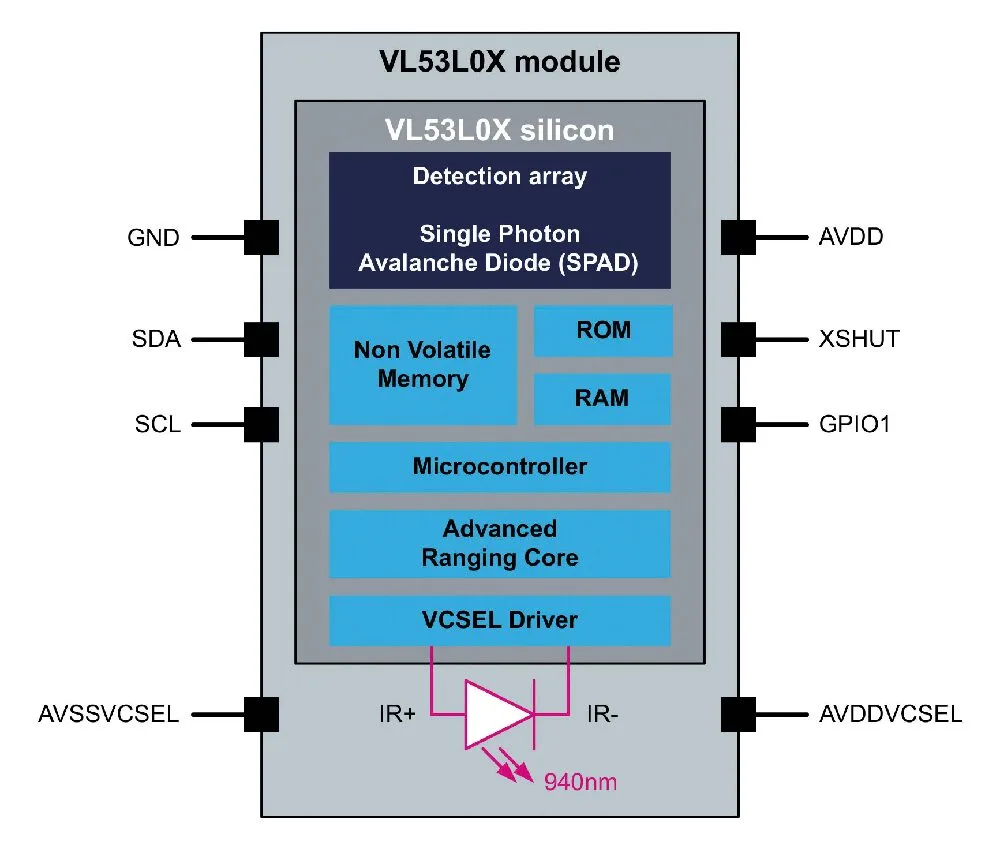
Unlike traditional infrared sensors that gauge distance by evaluating the intensity of reflected light—a method easily fooled by dark paint, dirty surfaces, or varying ambient lighting—this system relies on STMicroelectronics’ FlightSense™ technology. It emits a 940 nm class 1 Vertical Cavity Surface-Emitting Laser (VCSEL) pulse and calculates distance using the exact speed of light.
The visual interface utilizes an Adafruit NeoPixel ring comprising 16 smart RGB LEDs. As a vehicle creeps forward, the ring dynamically transitions through a color-coded warning spectrum:
- Green: Safe approach zone.
- Yellow: Caution zone, indicating the vehicle is nearing its target stop point.
- Red: Critical zone, signaling an immediate halt.
- Flashing Red: Absolute stop limit reached.
The hardware architecture centers around a compact Arduino Beetle microcontroller communicating via an I²C bus with a custom breakout board housing the VL53L0X sensor, an LDO voltage regulator, and a MOSFET-based level shifter.

Chronology: From Concept to Garage-Ready Hardware
The evolution of this project bridges the gap between industrial optical metrology and accessible DIY electronics.
- April 2017: Initial foundational experiments regarding Time-of-Flight laser principles were established, laying the theoretical groundwork for measuring round-trip photon propagation times.
- Component Selection & Prototyping: Engineers targeted the STMicroelectronics VL53L0X chip for its high accuracy (within a few millimeters) and integrated ambient light rejection capabilities.
- Logic Integration: Because the VL53L0X operates natively on a 2.8 V logic level while standard microcontrollers utilize 5 V TTL levels, a bidirectional MOSFET level-shifting circuit was engineered to stabilize the I²C communication clock (SCL) and data (SDA) lines.
- Firmware Development: Programmers wrote the
VL53L0X_Garage_v2sketch, incorporating multi-stage filtering algorithms (DATO_OK) to eliminate optical noise, along with an automatic sleep timer (MAX_ON) to cut power consumption after 30 seconds of static positioning. - Enclosure Engineering: Moving from raw breadboards to a finished product, designers drafted a modular 3D-printed PLA enclosure connected via a rectangular PVC electrical conduit. The upper module houses the NeoPixel display ring and microcontroller for high visibility, while the lower module houses the sensor assembly precisely aligned with vehicle bumper heights.
Supporting Data: Technical Specifications and Physics
The mathematical backbone of the system relies on the classical time-of-flight equation:
$$textd = fracv times t2$$

Where $v$ represents the speed of light in air (approximately $300,000text km/s$) and $t$ represents the total round-trip travel time of the laser pulse.
Key Component Metrics
- Sensor Range: Optimized for indoor use up to $1.2text meters$ by default (extendable to $2text meters$ via Long Range firmware configuration, though environmental IR noise increases slightly outdoors).
- Voltage Regulator: Micrel MIC5504-2.8YM5-TR Low Drop-Out (LDO) regulator delivering up to $500text mA$ with a minimal $160text mV$ dropout voltage.
- Photon Detection: Utilizes a Single Photon Avalanche Diode (SPAD) array operating in reverse-bias near its breakdown voltage to register individual photon impacts with hyper-fast response times.
- Power Efficiency: Incorporates a software-driven timeout loop (
MAX_ON = 200cycles at a $50text ms$ delay), ensuring the system powers down the LED array if a vehicle remains parked in a static position for more than approximately 30 seconds.
Official Responses and Developer Insights
Engineering leads behind the project emphasize that consumer feedback heavily influenced the design choices, particularly regarding reliability and ease of assembly.
"Drivers are tired of taping old tennis balls to garage ceilings or relying on frayed strips of foam that do nothing to prevent cosmetic body damage," noted the lead hardware developer during technical documentation releases. "We wanted a solution that provides the exact telemetry of a modern luxury car, but inverted—placed on the wall to watch over the vehicle."

Discussing the choice of the VL53L0X sensor over cheaper ultrasonic or standard IR alternatives, the development team highlighted environmental stability: "Ultrasonic sensors suffer from thermal drift and wide beam spreads that can trigger false positives on garage clutter. Standard IR sensors fail when a car has matte black paint or heavy road grime. Time-of-Flight optics bypass these variables entirely by counting the literal transit time of light packets."
Implications: The Future of Smart Residential Infrastructure
As private vehicles continue to expand in physical dimensions relative to legacy urban infrastructure, the deployment of smart, retrofitted garage assistants highlights a growing market for accessible Internet of Things (IoT) safety devices in residential settings.
Practical Benefits
- Structural Preservation: Eliminates accidental impacts against drywall, storage shelving, and brickwork.
- Precision Parking: Maximizes remaining garage space behind the vehicle, allowing homeowners easier access to walk around parked cars or close overhead garage doors securely.
- Low-Cost Scalability: Built using open-source libraries and off-the-shelf components, the entire system can be assembled by hobbyists and technicians alike, pointing toward a future where smart infrastructure elements are retrofitted into existing homes rather than built from scratch.
By fusing aerospace-grade optical telemetry with straightforward micro-controller programming, the ToF garage parking assistant transforms a mundane household annoyance into an automated exercise in precision engineering.