Revolutionizing Hospitality: Inside "Lumina Desk," the Raspberry Pi-Powered Voice-Ordering Restaurant Table
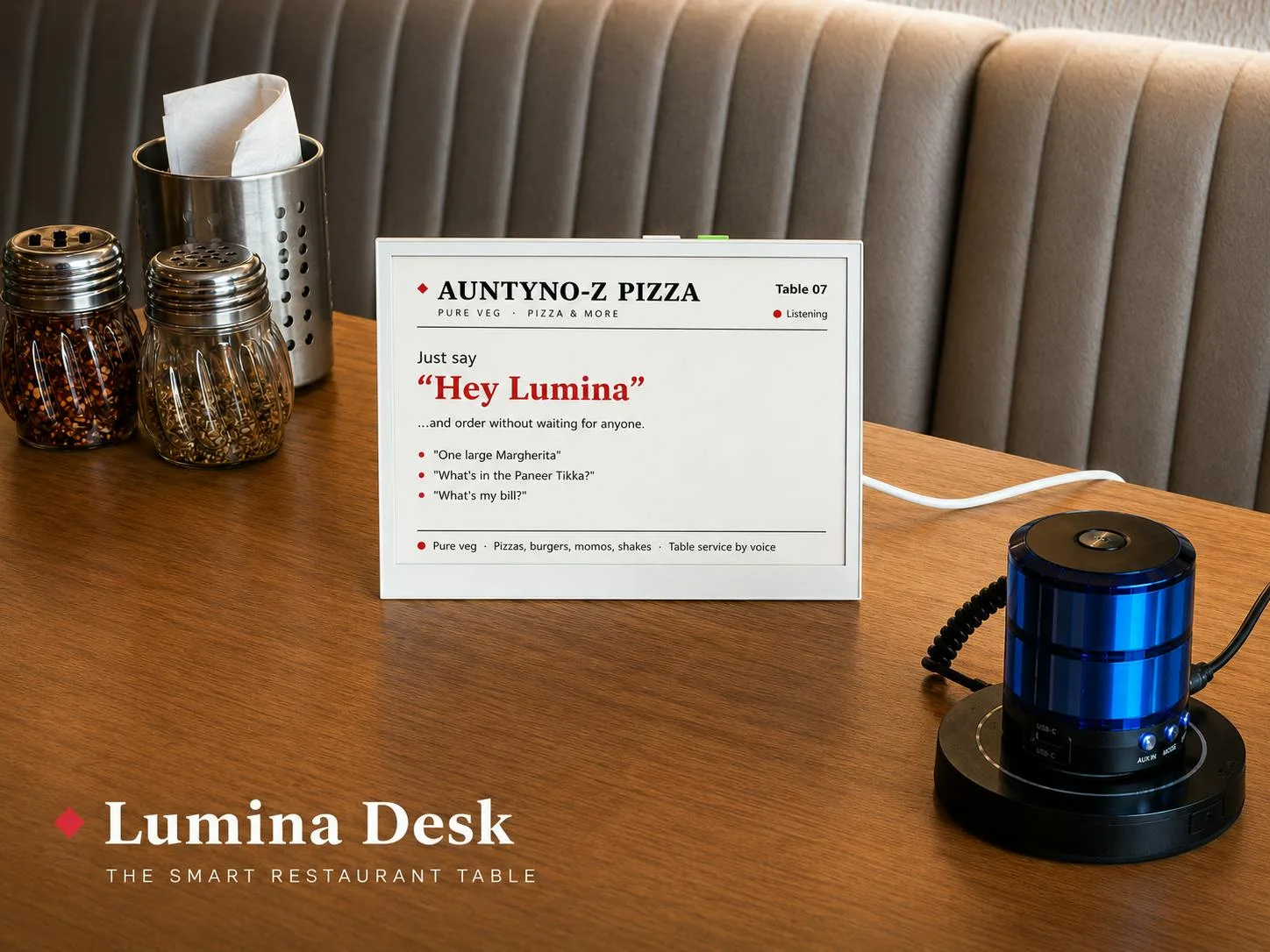
In the fast-paced world of modern dining, technology is frequently blamed for alienating the customer. The rise of friction-heavy applications, confusing QR code menus that require smartphones, and impersonal digital kiosks have often stripped away the warmth of traditional hospitality. Yet, a new open-source innovation threatens to upend this dynamic by marrying the intimacy of human speech with the silent, tireless efficiency of edge computing.
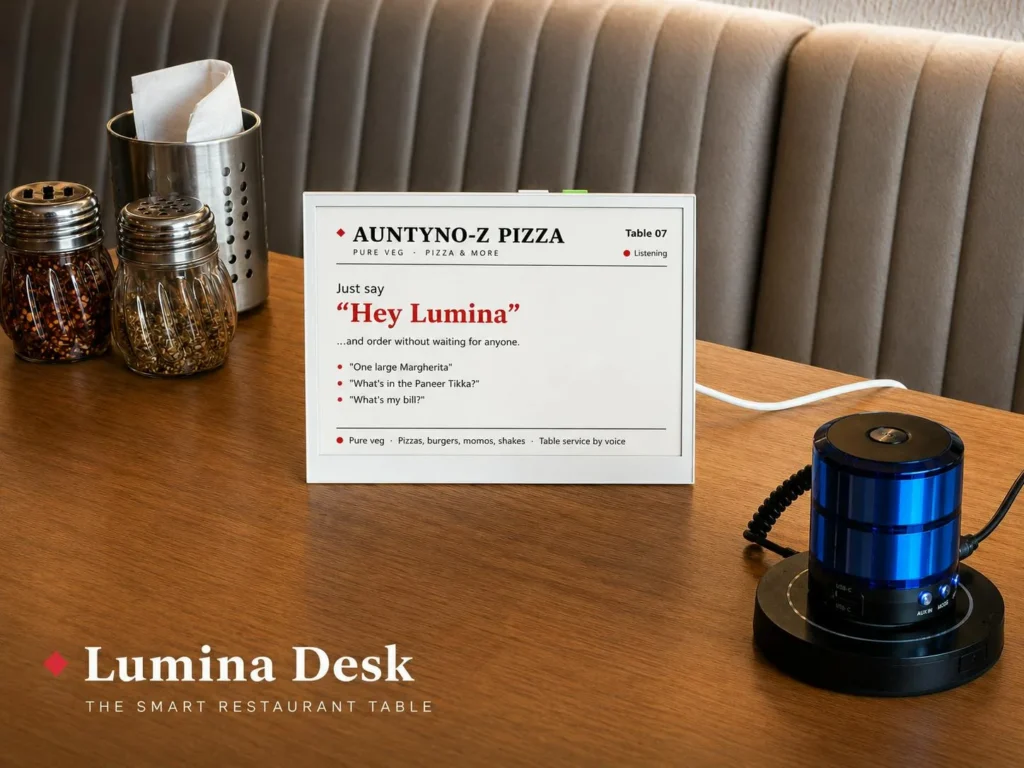
Meet Lumina Desk, an ingenious restaurant table system that handles voice orders autonomously—requiring no smartphone apps, no QR-code browsing, and no waiting staff for initial order-taking. Developed by maker and software engineer Shubhjaiswal408, this self-contained, voice-activated ecosystem runs entirely on a single Raspberry Pi. Equipped with a microphone, speaker, and an ePaper display, Lumina Desk manages the complete dining lifecycle: guests simply speak their desires, the system transcribes and interprets the request, displays the order in real-time, dispatches it straight to the kitchen, and facilitates digital payment via a dynamic UPI QR code.
Far from being a fragile proof-of-concept trapped in a laboratory, Lumina Desk has been stress-tested against the real-world operational chaos of Auntyno-Z Pizza, a bustling restaurant located in Ghodasar. Handling a massive menu of 189 distinct dishes—including 66 variations of pizza—Lumina Desk proves that local, edge-driven AI is ready to graduate from hobbyist forums to the commercial hospitality frontlines.
Main Facts: The Anatomy of Lumina Desk
At its core, Lumina Desk is a masterclass in localized artificial intelligence, modular system design, and hardware-software optimization. Rather than relying entirely on heavy, cloud-based architectures prone to latency and privacy concerns, the system leverages a hybrid model that intelligently splits tasks between fast local rule-parsing, cloud intelligence when available, and offline fallback frameworks.
Hardware Infrastructure
The entire physical operation sits comfortably at the diner’s table, anchored by a modest yet capable Raspberry Pi (fully compatible with the Raspberry Pi 5 with 2 GB of RAM, though built with earlier iterations in mind). Peripheral hardware includes:
- Microphone & Speaker: A sensitive audio pickup capable of capturing ambient table conversation and a 2 W, 66 mm loudspeaker that outputs crisp, short voice confirmations using Piper, a lightweight text-to-speech (TTS) engine.
- ePaper Display: An 800×480 pixel electronic paper screen that provides a low-power, glare-free, highly legible visual summary of the guest’s active order.
The AI and Processing Pipeline
When a guest approaches the table, the system utilizes an on-device open-source wake-word model to listen exclusively for the phrase "Hey Lumina." Once triggered, the processing pipeline branches dynamically depending on connectivity:
- Online Mode (High Performance): Voice audio is transcribed via Groq Whisper (
whisper-large-v3-turbo) for lightning-fast accuracy, and intents are interpreted using advanced large language models like GPT-OSS-20B. - Offline Mode (Resilience): If the internet drops—a frequent hazard in crowded, signal-blocked dining rooms—the system seamlessly transitions to local processing. Transcription is handled by Vosk, while intent interpretation falls to the LFM2-700M model running locally via Ollama on the Raspberry Pi’s CPU.
Crucially, pricing, wait times, and allergen information are never hallucinated by the LLM. Instead, these critical metrics are strictly calculated via deterministic Python scripts pulled directly from the restaurant’s official menu database.
Chronology: From Concept to Commercial Stress-Test
The evolution of Lumina Desk represents a pragmatic journey of engineering constraints, iterative prototyping, and real-world deployment.
Phase 1: Conceptualization and Hardware Constraints
The project originated from a desire to eliminate the friction points of modern dining. Traditional ordering apps demand that users download software, connect to spotty guest Wi-Fi, and stare down at their personal mobile screens rather than engaging with their dining companions. Physical menus, on the other hand, are static and expensive to update. Shubhjaiswal408 envisioned a zero-friction, ambient computing interface. However, early designs faced immediate hurdles: how to process natural human speech accurately in a noisy restaurant environment without incurring massive cloud-hosting costs or suffering from crippling internet latency.
Phase 2: Integrating Hybrid Intelligence and Rule Parsers
Developers quickly realized that running an LLM for every single interaction—such as asking for the bill or ordering a simple beverage—was computationally inefficient and painfully slow. To solve this, a dual-layer processing architecture was engineered.
- A lightweight rule parser was implemented to intercept high-frequency requests (e.g., "I’d like a margherita pizza" or "Can I get the bill?").
- This rule parser classifies intent in under 5 milliseconds, completely bypassing the LLM for standard orders.
- Complex, multi-part, or ambiguous culinary queries are passed along to the larger language models, optimizing both system responsiveness and resource allocation.
Phase 3: Deployment at Auntyno-Z Pizza
Moving past bench tests, the system faced its ultimate trial at Auntyno-Z Pizza in Ghodasar. Integrating a voice assistant into a live kitchen environment required rigorous testing against background music, clattering silverware, overlapping human voices, and diverse linguistic accents. The menu—spanning nearly 190 items—demanded a robust database backend. By successfully managing this heavy operational load, Lumina Desk transitioned from an experimental Python script into a hardened, field-tested hospitality tool.
Supporting Data: Under the Hood of the Codebase
For developers and restaurant owners looking to replicate or inspect the architecture, the entire project is open-sourced under Shubhjaiswal408’s GitHub repository (lumina-desk-smart-restaurant). The system’s architecture relies on clean separation of concerns, orchestrated primarily through an MQTT message broker.
The Data Flow and MQTT Brokerage
Once an order is captured and parsed, the data state is instantly published to an internal MQTT bus. Two distinct micro-services subscribe to this channel:

- The Visual Interface Service: Pulls the order data, uses the Python Pillow library to dynamically render an 800×480 pixel image summary, and pushes it to the table’s ePaper screen.
- The Kitchen Dashboard: Receives the structured order instantaneously, formatting it for kitchen staff preparation without human intermediary transcription errors.
Managing Offline Computational Bottlenecks
While cloud processing yields near-instantaneous results, running models locally on edge hardware introduces hard mathematical trade-offs. In offline mode, the 700-million-parameter LFM2-700M model executing on the Raspberry Pi’s CPU requires approximately 9 seconds to process complex intents.
While 9 seconds is an eternity in digital interactions, the implementation of the rapid-fire rule parser ensures that over 80% of routine interactions bypass the LLM entirely. Consequently, customers experience a snappy, conversational interface for daily operations, while the heavy lifting of the local CPU is strictly reserved for edge-case questions.
Automated Payment Reconciliation
Billing is handled without physical card readers or POS hardware handoffs. Lumina Desk generates a dynamic UPI QR code directly on the ePaper display, mapping precisely to the calculated bill total.
- Once the customer scans and settles the payment via their preferred UPI app, the system does not rely on manual server verification.
- Instead, payment confirmation is read directly from the merchant’s incoming notification emails via IMAP.
- Upon detecting the payment receipt, the Raspberry Pi triggers a confirmation voice prompt via Piper, resets the table state, and preps the system for the next incoming party.
Official Responses and Developer Insights
The open-source community has responded with immense enthusiasm to the release of the Lumina Desk repository. Restaurant automation traditionally requires proprietary, enterprise-grade hardware suites costing thousands of dollars per table—featuring closed ecosystems that lock small business owners into high SaaS subscription fees and mandatory vendor maintenance.
Shubhjaiswal408’s project democratizes this space. By building upon ubiquitous, inexpensive single-board computers like the Raspberry Pi, small-to-medium restaurant owners can deploy enterprise-level voice automation at a fraction of traditional costs.
Industry analysts note that projects like Lumina Desk highlight an important philosophical shift in edge AI deployment: intelligent automation does not require massive server clusters if the software architecture is designed with pragmatic constraints in mind. By intelligently pairing ultra-fast local rule-based parsing with fallback LLMs, the system avoids the technological trap of over-engineering.
Implications: The Future of Frictionless Dining
The deployment and open-sourcing of Lumina Desk carry profound implications for the future of the restaurant, hospitality, and edge-computing industries.
1. Reclaiming Human Hospitality
Critics of restaurant automation often argue that technology dehumanizes the dining experience. However, Lumina Desk argues the exact opposite. By automating repetitive administrative tasks—such as reciting menu items, checking basic allergen matrices, taking initial orders, and processing bill payments—waitstaff are liberated from the tyranny of the notepad. Servers can redirect their energy toward genuine hospitality: checking on guest satisfaction, recommending wine pairings, creating a welcoming atmosphere, and delivering elevated customer service.
2. Democratizing Advanced Tech for Independent Eateries
High-end dining chains routinely invest in custom-built IoT and automated ordering systems. Independent restaurants, family-owned pizzerias like Auntyno-Z, and local cafes are often priced out of these innovations. Because Lumina Desk relies on off-the-shelf hardware components (a Raspberry Pi, an inexpensive ePaper display, a standard microphone, and a 2W speaker) and freely available open-source code, it levels the playing field. Local establishments can now compete on technological convenience without surrendering their profit margins to third-party food delivery monopolies or exorbitant software licensing fees.
3. Edge AI Resilience and Data Privacy
In an era dominated by cloud-tethered smart devices, Lumina Desk’s offline-first resilience is a masterclass in privacy and reliability. Because voice transcription (via Vosk) and intent interpretation (via Ollama) can run entirely offline on local hardware, sensitive customer data and audio snippets do not necessarily have to traverse third-party cloud servers. Furthermore, restaurant owners retain absolute ownership of their menu data, transaction records, and operational telemetry.
4. The Path Forward for Open-Source Hardware
As models like LFM2-700M and libraries like Piper and Groq Whisper continue to mature, the performance gap between cloud and edge computing will inevitably narrow. Systems like Lumina Desk serve as vital stepping stones toward a future where ambient intelligence is seamlessly integrated into physical furniture and everyday objects.
Conclusion
Lumina Desk is far more than a clever weekend maker project; it is a fully realized blueprint for the future of autonomous hospitality. By harmonizing hardware simplicity with sophisticated hybrid AI orchestration, Shubhjaiswal408 has proven that the next great technological leap in dining doesn’t live on a smartphone screen—it sits quietly right on the table, waiting for you to say, "Hey Lumina."
For developers, makers, and restaurateurs wishing to explore, deploy, or build upon this groundbreaking infrastructure, the complete source code, wiring schematics, and configuration instructions are freely available on the official GitHub repository.