The Lensless Revolution: How an Open-Source Project Uses a Strip of Scotch Tape and Computational Math to Capture 3D Imagery
In the rapidly evolving world of computer vision and digital imaging, the standard formula for capturing the world has remained remarkably consistent for centuries: a complex arrangement of glass elements, precision-ground lenses, and mechanical apertures focusing light onto a solid-state sensor. Whether inside a professional cinema camera or a smartphone in your pocket, optics dictate form.
However, a groundbreaking open-source initiative known as the okooptics project is challenging these foundational assumptions. By stripping away the glass lens from a standard Raspberry Pi camera module, replacing it with an ordinary strip of household Scotch tape, and applying advanced computational mathematics, the project’s creators have demonstrated something extraordinary. They can capture not just a flat image, but genuine three-dimensional spatial data—all without a single traditional optical element.
This article provides an in-depth examination of this lensless imaging technique. We will explore the core technology, trace its development chronologically, analyze the underlying data and hardware requirements, review expert responses regarding its potential and limitations, and evaluate the broader implications for consumer electronics, robotics, and computational photography.
1. Main Facts: Redefining Digital Imaging Through Diffusers
At its core, the okooptics project introduces a radical departure from conventional optics known as diffuser-based computational imaging. Instead of using refraction to bend light rays into a sharp focus on an image sensor, the system relies on a translucent barrier—in this case, ordinary adhesive office tape—to intentionally scramble the incoming light in a predictable, repeatable manner.
The Anatomy of a Lensless Camera
The hardware setup is deceptively simple:
- The Sensor: A standard digital camera module, such as a 5-megapixel Raspberry Pi camera carrying the OmniVision OV5647 sensor, serves as the capture medium.
- The Modifier: The factory-installed lens assembly is completely removed, exposing the raw silicon sensor. A single, thin layer of Scotch tape is placed directly over the surface.
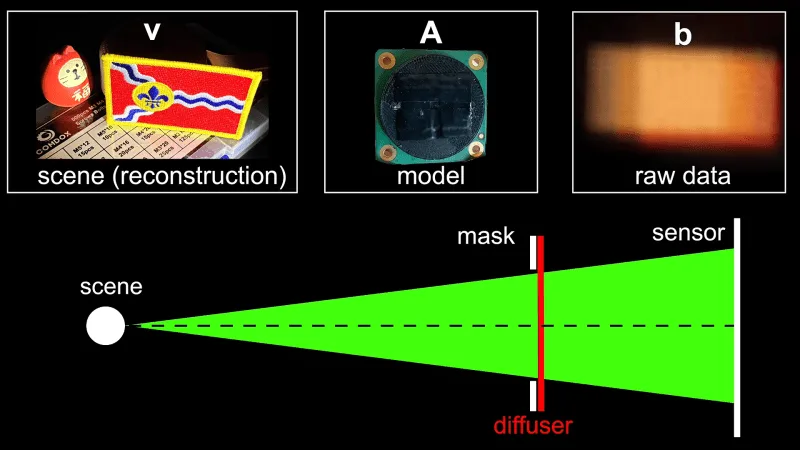
- The Physics: Rather than forming a recognizable image, the tape acts as an optical diffuser. As light passes through the microscopic imperfections, adhesive residues, and cellulose fibers of the tape, it scatters across the sensor. Every distinct point of light in the physical environment creates a characteristic, predictable blur pattern known as a Point Spread Function (PSF).
From Blur to Image via Deconvolution
If you looked at the raw capture from this setup, you would see nothing more than an unintelligible, milky blur. The magic happens in the software layer through a mathematical process called deconvolution.
Because the Point Spread Function of the tape can be mathematically modeled and calibrated, a computer can reverse the scattering process. By feeding the blurry raw capture and the known diffuser function into a linear algebra algorithm, the system estimates and reconstructs the original visual scene.
The Leap to 3D and Virtual Viewpoints
What elevates the okooptics project beyond a mere novelty is its ability to produce three-dimensional data. By weighting the Point Spread Function across three dimensions and introducing a directional bias into the computational pipeline, the software achieves something akin to a digital camera-position shift. Users can effectively look around objects in the scene from slightly different angles—simulating physical movement—without the camera ever moving an inch.
2. Chronology: The Evolution of Computational Lensless Photography
While the okooptics project brings this technology into the realm of accessible maker hardware, the journey toward lensless, diffuser-based imaging has deep roots in academic research and computational optics.
Academic Beginnings and DiffuserCam (2018–2020)
The theoretical framework underpinning this project largely stems from computational imaging laboratories—most notably work pioneered at institutions like UC Berkeley and Stanford University. Researchers began asking whether glass lenses were strictly necessary for image formation. Early academic prototypes, such as "DiffuserCam," proved that high-resolution 2D and 3D images could be reconstructed from scatter plates using compressive sensing and deconvolution algorithms. However, these systems were often restricted to high-end laboratory environments, expensive specialized sensors, or heavy desktop computing resources.
The Democratization of Hardware (2021–2025)
As low-cost single-board computers (like the Raspberry Pi family) grew exponentially in processing power, and as high-density CMOS sensors became ubiquitous and inexpensive, open-source developers began experimenting with consumer-grade components. The barrier to entry dropped from thousands of dollars in specialized lab equipment to less than twenty dollars in off-the-shelf maker parts.
The Breakthrough of the okooptics Project (Late 2025–2026)
The okooptics initiative represents a culmination of this democratization trend. By explicitly pairing ultra-cheap, accessible materials (Scotch tape) with optimized deconvolution routines and directional weighting, the project successfully bridged the gap between abstract academic papers and reproducible, hands-on maker engineering. The release of documentation and source code on platforms like Hackaday.io allowed hobbyists worldwide to replicate and modify the lensless 3D camera setup in their own homes.
3. Supporting Data and Hardware Specifications
To successfully build and operate a diffuser-based lensless camera system, understanding the interplay between hardware capabilities and computational overhead is essential.
Recommended Hardware Stack
Replicating or expanding upon the okooptics project requires a carefully balanced hardware ecosystem:
| Component | Recommended Model | Technical Specifications / Purpose |
|---|---|---|
| Image Sensor | Raspberry Pi Camera Module (5 MP) | Utilizes the OmniVision OV5647 sensor; provides raw Bayer-pattern access essential for accurate deconvolution. |
| Edge Processing Board | Raspberry Pi 5 (2 GB or 8 GB RAM) | Powered by a Broadcom BCM2712 quad-core processor at 2.4 GHz (Arm Cortex-A76 architecture), offering enough muscle for onboard real-time or near-real-time deconvolution. |
| Optical Modifier | Standard Office Scotch Tape | Acts as an inexpensive, high-entropy phase mask / optical diffuser, creating a unique Point Spread Function. |
| Lighting / Environment | Controlled / Bright Indoor Lighting | Essential to mitigate the signal-to-noise ratio penalties introduced by mathematical deconvolution. |
Computational Demands and Linear Algebra
The mathematical engine driving the camera relies heavily on matrix operations. Deconvolution is computationally intensive. When processing an image, the algorithm must solve large systems of linear equations to invert the convolution operation.
On lower-end microcontrollers or older single-board computers (such as the Raspberry Pi 3 or Zero), these calculations can take minutes per frame, relegating the setup to capturing static photographs. However, leveraging the quad-core Arm Cortex-A76 architecture found in the Raspberry Pi 5 drastically cuts down processing times, making dynamic scene reconstruction increasingly viable.
4. Official Responses and Expert Perspectives
The maker community and academic circles have greeted the okooptics project with a mixture of fascination and rigorous scientific scrutiny.
Praise from the Open-Source and Maker Communities
On developer forums and platforms like Hackaday, engineers have lauded the project for its ingenuity. By substituting expensive custom-engineered optical phase masks (which often cost hundreds of dollars to manufacture in cleanrooms) with a cents-on-the-dollar strip of household adhesive tape, the project dramatically lowers the barrier to entry for experimentation in computational imaging. Educators have also pointed out its utility as a hands-on teaching tool for linear algebra, Fourier optics, and inverse problems.
Technical Limitations and Real-World Constraints
Despite the excitement, optical engineers and computer vision researchers are quick to highlight the inherent physical limitations of tape-based imaging:
- The Noise Amplification Problem: Deconvolution is an inverse problem that inherently amplifies noise. Any sensor read noise, thermal noise, or photon shot noise present in the raw capture is magnified during the reconstruction phase. Consequently, images captured in dim lighting conditions suffer from severe artifacts and graininess.
- Material Instability: Unlike precision glass or molded polymer optics, Scotch tape is not designed to be an optical component. It is susceptible to temperature fluctuations, humidity, stretching, and adhesive degradation over time. Even microscopic shifts in the tape’s position alter the Point Spread Function, requiring frequent recalibration.
- Calibration Sensitivity: The accuracy of the final reconstructed image depends entirely on how precisely the system knows its Point Spread Function. If the calibration matrix drifts, the deconvolution algorithm produces severe blurring, ringing artifacts, or complete reconstruction failure.
5. Implications: What Lensless Imaging Means for the Future
While a Scotch-tape-covered Raspberry Pi camera is unlikely to replace professional cinema lenses or smartphone camera arrays anytime soon, the underlying principles explored by the okooptics project carry profound implications for several industries.
Ultra-Thin and Flexible Form Factors
Traditional cameras require physical depth—a "back focal length"—to allow light rays to converge through glass lenses before hitting the sensor. This is the primary reason smartphones feature unsightly camera bumps. Lensless, diffuser-based cameras eliminate the need for physical depth. By decoupling image formation from optical refraction, future devices could theoretically feature image sensors embedded flush inside flat surfaces, flexible displays, or smart clothing without any protruding hardware.
Cost Reduction in IoT and Edge Devices
For Internet of Things (IoT) devices, environmental sensors, and industrial automation, the cost of optical assemblies represents a significant manufacturing expense. Ultra-low-cost, lensless vision systems could enable mass deployment of smart visual sensors in environments where traditional cameras are too expensive, fragile, or bulky.
Privacy-Preserving Computer Vision
Interestingly, diffuser-based systems offer unique privacy advantages. Because raw captures are completely scrambled and unintelligible without the specific deconvolution software and calibration keys, a compromised raw data stream leaks no recognizable visual information. This could inspire new paradigms in privacy-respecting ambient monitoring for smart homes and public spaces.
Conclusion
The okooptics project serves as a brilliant reminder of the power of open-source experimentation and computational thinking. By trading expensive glass for clever mathematics and office supplies, it democratizes access to advanced 3D imaging concepts. As edge computing power continues to grow and algorithms become more robust, the boundary between physical optics and digital computation will continue to blur—paving the way for a truly lensless future.