The $20 Linux Handheld: How a Budget 4G Hotspot is Redefining DIY Computing
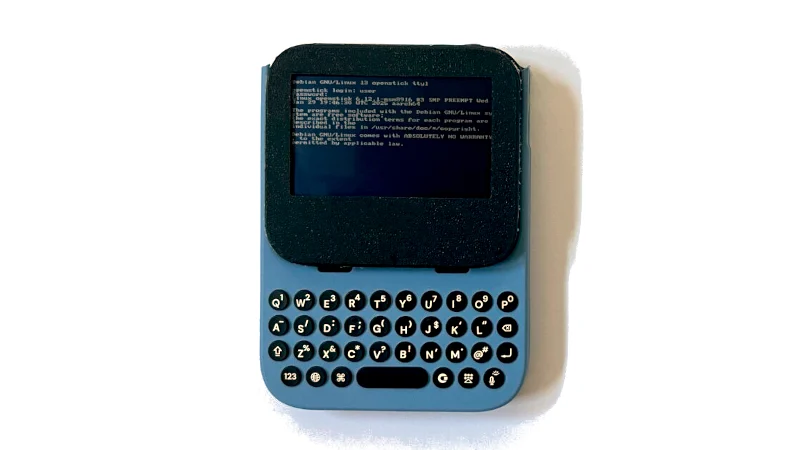
In the world of DIY electronics and single-board computing, the quest for the ultimate portable Linux machine has historically been an expensive endeavor. Enthusiasts looking for a pocket-sized Linux experience often find themselves gravitating toward established ecosystems like the Raspberry Pi or specialized handheld platforms. While these are reliable, the total bill of materials—including the board, display, battery, and enclosure—frequently pushes costs well into the triple digits.
However, a clever project recently surfaced from developer [bkovac], proving that the barrier to entry for handheld Linux computing can be drastically lowered. By repurposing a humble 4G wireless hotspot, [bkovac] has demonstrated that with enough ingenuity, a functional, portable Linux terminal can be assembled for the price of a takeout meal.
Main Facts: The Anatomy of a Budget Linux Device
The core of this project is the MF800, a generic 4G wireless hotspot frequently found on platforms like AliExpress for approximately $20. At first glance, it is a throwaway piece of networking gear, but beneath its plastic shell lies the Qualcomm MSM8916—better known as the Snapdragon 410.
While the Snapdragon 410 might seem archaic by today’s standards, having powered entry-level smartphones in the early 2010s, it possesses a hidden advantage: it is exceptionally well-supported by the mainline Linux kernel. This allows it to function as a viable, albeit modest, computer. [bkovac] paired this "brain" with a vintage-style iPhone USB keyboard case accessory and a high-end Adafruit Sharp Memory Display, creating a stark contrast between the low-cost donor hardware and the high-performance peripheral.
The project is not a simple "plug and play" affair. It requires significant modifications to the hotspot’s PCB, custom power management circuitry, and a deep dive into the Linux kernel to ensure the display and input peripherals communicate effectively with the ARM-based processor.
Chronology: From Network Utility to Portable Terminal
The evolution of the MF800 project highlights the iterative nature of modern hardware hacking. The process began with the identification of the device’s capabilities.
Phase 1: Procurement and Kernel Verification
The initial stage involved sourcing the MF800 and verifying that it could boot a custom kernel. Because the device is designed to act as a modem, its firmware is locked down. [bkovac] had to bypass these restrictions to gain access to the underlying hardware, confirming that the Snapdragon 410 could run a lightweight Linux distribution.
Phase 2: Hardware Integration
Once the software environment was established, the physical integration commenced. The challenge was fitting the components—the modem board, the custom power board, and the keyboard interface—into the repurposed iPhone keyboard case. This involved precision Dremel work to carve out space for the components and soldering tiny connections to the modem’s PCB to bypass the original, limited SPI display.
Phase 3: Software Optimization
With the hardware assembled, the focus shifted to the software. Getting a desktop-like environment running on a processor not intended for general-purpose computing is the most labor-intensive part of the build. The Sharp Memory Display, chosen for its ultra-low power consumption and high visibility, required a custom driver implementation within the Linux stack to handle the refresh rates and color depth constraints.
Supporting Data: Technical Specifications and Performance
The performance of the MF800 as a computer is, by modern standards, limited. However, it is important to contextualize this against the project’s goal: accessibility and upcycling.
- Processor: Qualcomm Snapdragon 410 (MSM8916), Quad-core ARM Cortex-A53.
- Cost of Core Unit: ~$20 USD.
- Display: Adafruit Sharp Memory Display (replacing the stock, low-resolution unit).
- Input: USB-HID via the iPhone keyboard case accessory.
- Operating System: Mainline Linux (various lightweight distributions tested).
The choice of the Sharp Memory Display is particularly notable. Unlike standard LCDs or OLEDs, this display technology uses minimal power, making it ideal for a battery-operated handheld. While the frame rate is significantly lower than a modern smartphone screen, it is perfect for text-based interfaces, terminal sessions, and basic command-line utilities.
Official Responses and Community Impact
The project has garnered significant attention within the "Hackaday" community and other open-source hardware forums. Responses from the community have been largely celebratory, drawing parallels to the "golden era" of router hacking, where enthusiasts would install OpenWrt on discarded networking hardware to transform them into web servers or media controllers.
"This is exactly what the spirit of hardware hacking is about," one community member noted in a forum discussion. "We have been conditioned to buy expensive, purpose-built boards, but there is a mountain of hardware out there that is perfectly capable of running Linux if we are willing to put in the time to understand the silicon."
While there has been no official comment from the manufacturers of the MF800—as they likely view the device solely as a modem—the project has sparked a renewed interest in "e-waste hacking." By diverting these units from landfills and repurposing them as educational tools, [bkovac] has demonstrated an alternative path to sustainable computing.
Implications: The Future of "Trash-to-Treasure" Computing
The implications of this build extend far beyond the convenience of having a $20 Linux handheld. It highlights three critical shifts in the hobbyist landscape:
1. The Death of Proprietary Limitations
As mainline Linux support continues to grow for mobile chipsets, the era of "bricked" hardware is slowly coming to an end. The ability to flash a generic Linux kernel onto a $20 device means that the barrier to learning embedded systems is lower than ever. Students and hobbyists in developing nations or those on limited budgets can now experiment with ARM-based Linux development without the high cost of a development kit.
2. Sustainability Through Upcycling
Electronic waste is a growing global crisis. By repurposing 4G modems, which are produced in the millions, developers are preventing these devices from contributing to toxic landfill waste. If a 4G modem can be turned into a terminal, it raises the question: what other "disposable" electronics are sitting in our drawers that could be given a second life?
3. The Return of the "Hacker" Mindset
In recent years, the maker community has become increasingly reliant on "ecosystem" boards like the Raspberry Pi, which are essentially plug-and-play. While this has broadened the hobby, it has also simplified the process to the point of losing the underlying technical challenge. Projects like the MF800 handheld force the user to interface with raw PCB traces, power regulation, and kernel-level drivers. It is a return to the roots of computing, where the user is a participant in the machine’s functionality rather than a consumer of it.
Conclusion
[bkovac]’s project is a testament to the fact that computing power is not just about raw gigahertz or megabytes of RAM; it is about the ability to command hardware to perform a task. By turning a $20 modem into a functional, portable Linux device, this build serves as a powerful reminder of what is possible when curiosity outweighs convenience.
While this device will not be replacing your laptop for video editing or heavy coding, that was never the point. Its true value lies in its existence as a proof-of-concept for low-cost, accessible computing. As we continue to move toward an era of increasingly locked-down, proprietary hardware, these pockets of open-source innovation are essential for maintaining the ethos of the DIY community. The MF800 is not just a handheld; it is a signal that with a bit of code and a steady soldering iron, the world of computing remains open to those who know where to look.