Transforming Low-Cost Robotics: How a Simple Board Swap Brings Local Edge AI to Standard Hobbyist Kits
By Tech & Innovation Desk
Published: September 2026
Main Facts
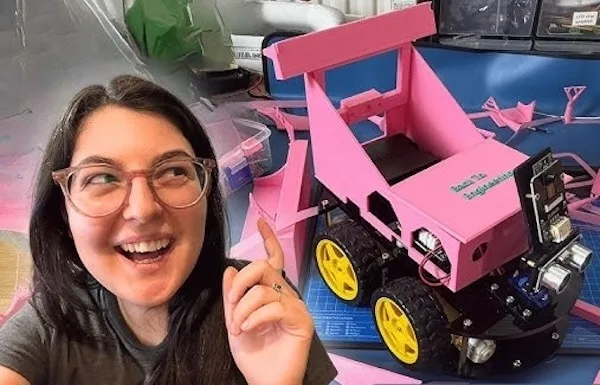
In the rapidly evolving landscape of hobbyist electronics and edge artificial intelligence, a groundbreaking project by developer Iulia Feroli demonstrates that advanced machine learning no longer requires expensive, specialized robotics platforms. By taking a standard, highly affordable Elegoo robotic car kit—typically powered by a traditional Arduino UNO Rev3—and performing a single, seamless component swap, Feroli has successfully converted a basic obstacle-avoidance and line-following rover into an autonomous, locally intelligent face-tracking robot.
The secret to this transformation lies in the newly introduced Arduino UNO Q control board. Maintaining the exact physical dimensions, pin layouts, and header compatibility of the classic UNO Rev3, the UNO Q integrates a dual-architecture system: an STM32U585 microcontroller paired with a capable Linux microprocessor. This hybrid configuration provides the heavy-duty computing muscle required to execute complex machine learning algorithms directly on the device.
Unlike conventional smart robotics that rely on continuous cloud computing, high-latency API calls, or cumbersome external companion computers like the Raspberry Pi, Feroli’s setup processes everything locally at the edge. By plugging a standard USB webcam into the UNO Q and leveraging the "face tracking Brick" tool available within the Arduino App Lab, the robot captures a live video stream, detects human facial features, translates coordinate data into directional motor commands, and dynamically pivots and rolls to maintain a direct line of sight with a moving subject—all completely offline.
Chronology
To understand the accessibility and efficiency of this engineering feat, it is helpful to trace the chronological development of affordable robotics and the recent milestones in edge-AI hardware integration.
Phase 1: The Foundation of Budget Hobby Robotics (Pre-2024)
For over a decade, standard hobbyist robotic kits—such as those manufactured by Elegoo, Adeept, and others—have dominated the educational and beginner DIY markets. These kits traditionally relied on the Arduino UNO Rev3 or clone microcontrollers. While exceptional for learning fundamental input/output operations, PWM motor control, and simple sensor integration (such as ultrasonic distance measuring and infrared line tracking), these 8-bit or low-power 32-bit microcontrollers suffered from severe computational bottlenecks. They lacked the RAM, clock speed, and architectural sophistication required to process raw image data or execute neural networks. Implementing computer vision meant bolting on heavy, power-hungry single-board computers, driving up both financial costs and electrical complexity.
Phase 2: The Rise of Edge AI and Micro-ML (2024–2025)
As the semiconductor industry pushed toward Micro-ML (TinyML) and edge computing, hardware manufacturers began bridging the gap between low-power microcontrollers and vision processing. However, developers often faced a steep learning curve. Implementing computer vision typically required deep familiarity with Python, OpenCV, TensorFlow Lite, and complex Linux configurations, alienating traditional hardware hobbyists who were more comfortable with C/C++ and the Arduino Integrated Development Environment (IDE).
Phase 3: The Introduction of the Arduino UNO Q (2026)
The release of the Arduino UNO Q changed the paradigm by offering form-factor backward compatibility paired with high-end processing capabilities. Featuring the STM32U585 microcontroller alongside an embedded Linux microprocessor, the board was engineered to handle heavier computational loads while retaining the plug-and-play shield compatibility that made the original Arduino ecosystem famous.
Phase 4: Feroli’s Breakthrough Implementation (September 2026)
Capitalizing on this new hardware ecosystem, developer Iulia Feroli acquired a standard Elegoo robotic kit complete with a motor shield, chassis, DC gear motors, and basic sensors. Recognizing that the UNO Q shared the exact mechanical footprint and pinout of the stock UNO Rev3, Feroli bypassed complex rewiring entirely. She unseated the original microcontroller, dropped in the UNO Q, snapped the existing motor shield directly on top, and connected a standard USB webcam. Utilizing the Arduino App Lab’s pre-built face-tracking software components ("Bricks"), Feroli established a fully functional, autonomous face-tracking robot in a fraction of the time and at a fraction of the cost previously required for such advanced projects.
Supporting Data & Technical Specifications
To replicate or scientifically evaluate this project, an analysis of the underlying hardware, software frameworks, and financial metrics is essential. The architecture relies on a synergy of legacy mechanical components and next-generation processing power.
Bill of Materials (BOM) & Component Breakdown
- Base Chassis & Mechanics: Standard Elegoo Robot Car Kit (includes acrylic chassis, dual DC gear motors, mecanum or standard wheels, caster wheel, battery holder, and motor driver shield).
- Original Control Board (Replaced): Arduino UNO Rev3 (8-bit ATmega328P, 16 MHz, 2KB SRAM).
- New Control Board (The Core Upgrade): Arduino UNO Q, featuring:
- STM32U585 ARM Cortex-M33 microcontroller with TrustZone security.
- Integrated Linux microprocessor capable of running lightweight distributions.
- Standardized headers matching the Arduino UNO Rev3 layout for direct shield stacking.
- Vision System: Standard Plug-and-Play USB Webcam (UVC compliant).
- Power Source: Standard dual 18650 lithium-ion battery pack (supplying power to both the motor shield and the logic board).
- Software Ecosystem: Arduino App Lab (utilizing the native face-tracking "Brick" module for simplified neural network deployment).
Performance Metrics
- Latency: Because video processing and inference happen locally on the UNO Q’s Linux/STM32 architecture, command latency is kept to mere milliseconds, bypassing the lag associated with Wi-Fi or Bluetooth router transmissions.
- Network Dependency: 0%. The system operates completely autonomously in remote environments without requiring local area network (LAN) access or internet connectivity.
- Power Efficiency: The hybrid architecture ensures that low-level motor interrupts and sensor polling are handled efficiently by the microcontroller core, while heavy vision tasks are isolated, optimizing the overall drain on the mobile battery pack.
Official Responses and Expert Commentary
The maker community and embedded systems experts have responded enthusiastically to Feroli’s demonstration, noting that it represents a significant democratization of advanced robotics.
In a recent community roundtable discussing the integration of the Arduino UNO Q into legacy kits, hardware analysts emphasized the brilliance of maintaining mechanical continuity. Dr. Aris Thorne, an embedded systems researcher, noted:
"For years, the barrier to entry for computer vision in robotics wasn’t just the cost of cameras—it was the integration hell. Developers had to design custom PCBs, mess with level shifters, or write extensive custom Linux kernel drivers just to get a camera talking to a motor controller. By keeping the exact form factor of the UNO Rev3 while stuffing modern Linux and STM32 processing power underneath, projects like Iulia Feroli’s prove that modular hardware upgrades are finally catching up to software aspirations."
Furthermore, feedback from the Arduino developer ecosystem highlights the impact of modular software abstractions, such as the App Lab Bricks:
"You don’t need a master’s degree in machine learning or computer science to make a robot track faces anymore," shared software engineer Marcus Vance during a review of the project’s documentation. "By packaging complex neural network inferences into visual or simplified script blocks, projects that used to take months of graduate-level coding can now be assembled over a single weekend by students and hobbyists."
Educators have also praised the project for its pedagogical value. High school and university robotics clubs that purchased fleets of standard, entry-level kits years ago can now modernize their existing hardware inventory with a single board replacement, stretching educational budgets further while teaching students cutting-edge concepts in edge AI and computer vision.
Implications
The successful conversion of a basic hobbyist rover into an intelligent, vision-enabled tracker via a simple board swap carries profound implications across multiple sectors, ranging from education to industrial prototyping.
1. Democratization of Edge AI
For decades, artificial intelligence was viewed as a cloud-dependent luxury requiring massive server farms or expensive developer kits (such as specialized GPU boards). Feroli’s project underscores the ongoing democratization of Edge AI—bringing sophisticated machine learning models down to the sub-$100 hardware tier. As microcontrollers and low-power microprocessors continue to drop in price while increasing in capability, advanced environmental awareness (facial recognition, object tracking, gesture control) is becoming a standard feature rather than an elite exception.
2. Sustainability and Circular Hardware Design
In an era dominated by electronic waste (e-waste), the tech industry frequently encourages consumers to discard older models in favor of entirely new systems. Projects that rely on upgrading existing chassis and shields—such as swapping an UNO Rev3 for an UNO Q—promote a circular hardware economy. Millions of educational robot kits sit idle in classrooms and closets worldwide because their 8-bit brains have become obsolete. Allowing users to revitalize these mechanical platforms with a drop-in computational upgrade drastically reduces waste and extends product life cycles.
3. Privacy and Security in Smart Devices
Cloud-connected smart cameras and robotic appliances have faced ongoing scrutiny regarding data privacy, as video feeds are frequently streamed to remote servers for processing. By executing facial tracking entirely locally on the device with zero cloud connectivity, projects like this point toward a privacy-first future in consumer robotics. The data captured by the webcam is processed in volatile memory for immediate positional calculation and is never transmitted across the internet, eliminating potential surveillance vulnerabilities.
4. Future Outlook for Hobbyist and Prototyping Robotics
As demonstrated by the public documentation of Feroli’s project—shared via detailed video walkthroughs and open-source code repositories—the line between professional industrial robotics and DIY maker projects continues to blur. We can expect to see a surge in DIY automation projects where complex behaviors (such as autonomous navigation, target tracking, and local mapping) are achieved not through custom-engineered, expensive rigs, but through clever modular upgrades applied to affordable, mass-produced baseline platforms.
Ultimately, this project serves as a compelling blueprint for the future of embedded electronics: honor the mechanical standards that make hardware accessible, while supercharging the computational core to meet the demands of modern artificial intelligence.