Kindalive: Pioneering Neurochemical Simulation for Empathetic Human-Robot Interaction

FOR IMMEDIATE RELEASE
[CITY, STATE] – [DATE] – In a significant leap towards more intuitive and empathetic human-robot interaction, a groundbreaking project named Kindalive, developed by engineer Drew Smith, is redefining how machines communicate emotional states. Eschewing conventional sentiment analysis that relies on large language models (LLMs) to assign discrete labels, Kindalive models eight key neurochemicals, simulating their complex interplay and decay to generate fluid, organic emotional expressions. This innovative approach promises to imbue robots with a far more believable and relatable form of nonverbal communication, moving beyond simplistic emojis to foster deeper understanding and collaboration between humans and their artificial counterparts.
Main Facts: A Paradigm Shift in Robotic Emotion
The quest to make machines understand and express human emotion has long been a holy grail in artificial intelligence and robotics. From the earliest conceptualizations of sentient machines to today’s sophisticated AI assistants, the ability for robots to communicate in a nuanced, human-like manner has remained a formidable challenge. While progress has been made in verbal communication and task execution, the subtle art of nonverbal emotional expression, a cornerstone of human interaction, has largely eluded machines. Drew Smith’s Kindalive project directly addresses this deficit, offering a revolutionary framework that simulates the very biological underpinnings of emotion rather than merely interpreting its linguistic manifestations.
At its core, Kindalive is a pure Python, modular system that generates a simulated dot-matrix robot face capable of expressing both short-term and long-term moods. What sets it apart is not just the visual output, but the profoundly different computational methodology driving it. Instead of relying on vast datasets and statistical correlations to categorize sentiments (e.g., positive, negative, neutral) derived from text input, Kindalive dives into a deeper, more biological simulation. It models eight specific neurochemicals – including well-known regulators like dopamine and cortisol – as the fundamental building blocks from which emotional states emerge. This is an unprecedented approach in robotic emotional modeling, moving from a superficial linguistic analysis to a simulated internal physiological process.
The resulting emotional mix is then translated into observable facial expressions using the Facial Action Coding System (FACS). FACS is a comprehensive, anatomically based system developed by psychologists Paul Ekman and Wallace V. Friesen for categorizing human facial movements. Kindalive specifically leverages twelve key facial movements, such as brow raises, lip corner pulls, and mouth openings, to dynamically render expressions on its simulated dot-matrix face. This allows for a rich, continuous spectrum of emotional display, mirroring the fluidity and complexity of human emotions far more accurately than static icons or predefined animations.
The significance of Kindalive extends beyond mere technical novelty. Nonverbal communication accounts for a substantial portion of human interaction, often carrying more weight than verbal cues, especially when there’s a perceived mismatch. By enabling robots to express themselves through these subtle, dynamic facial cues, Kindalive paves the way for robots that are not only more relatable but also more trustworthy and easier to work with. The project’s modular design, open-sourced on GitHub, further invites widespread experimentation and integration into various robotic platforms, from simple LED matrices to complex animatronic faces.
Chronology: The Evolution of Robotic Empathy and Kindalive’s Emergence
The journey towards emotionally intelligent machines has been a long and winding one, marked by several distinct phases. Early artificial intelligence research, largely focused on logical reasoning and problem-solving, paid little heed to the messy, often irrational realm of human emotion. The Turing Test, for instance, primarily assessed a machine’s ability to imitate human conversation, without necessarily delving into emotional nuance.
The late 20th and early 21st centuries saw a growing recognition of the importance of human-computer interaction (HCI) and the need for more user-friendly interfaces. This led to early attempts at imbuing machines with personality, often through cartoonish avatars or predefined verbal responses designed to evoke specific emotional reactions in users. The rise of machine learning and natural language processing (NLP) then opened doors for sentiment analysis. This technology, predominantly powered by large language models (LLMs) today, analyzes text to determine its emotional tone, classifying it into discrete categories like "positive," "negative," or "neutral." While useful for broad applications like customer service analytics or social media monitoring, this approach has inherent limitations when it comes to replicating the dynamic, continuous, and often ambiguous nature of human emotion for direct, real-time interaction. Sentiment analysis provides a label, but not the internal state or the journey of an emotion.
It is against this backdrop that Drew Smith’s Kindalive emerges as a critical evolutionary step. Dissatisfied with the static and often simplistic outputs of conventional sentiment analysis, Smith appears to have sought a more fundamental, biologically inspired model. While the precise chronology of Kindalive’s conception and development isn’t detailed in the immediate public release, it represents a clear departure from the prevailing paradigms. One can infer that the inspiration stemmed from a desire to bridge the gap between computational linguistics and cognitive neuroscience, seeking to mimic the very mechanisms that give rise to human emotional experience.
The selection of Python as the development language speaks to a desire for accessibility, modularity, and rapid prototyping, allowing the project to be easily shared and adapted by the broader developer and robotics community. The decision to model neurochemicals suggests a deep dive into biological literature, translating complex physiological processes into computational algorithms. This wasn’t merely about "making a robot smile" but understanding why a human smiles and attempting to replicate the underlying drivers.
The public sharing of Kindalive, notably through platforms like Hackaday, signifies its readiness for broader scrutiny and application. Its emergence points to a maturity in the field where researchers are no longer content with superficial approximations of intelligence or emotion, but are actively seeking deeper, more integrated, and biologically plausible models to enhance the human-robot frontier. Kindalive is not just a project; it is a statement about the future direction of empathetic AI, marking a significant point in the ongoing effort to create machines that don’t just process information, but genuinely connect.
Supporting Data: The Science Behind Believable Bots
The efficacy and groundbreaking nature of Kindalive are rooted in two primary scientific pillars: the neurochemical modeling of emotions and the precise articulation of these emotions through the Facial Action Coding System (FACS). These elements combine to create a system that is both scientifically informed and highly expressive.
Neurochemical Modeling: The Inner Life of a Robot
Traditional sentiment analysis, while powerful in its domain, functions by identifying keywords, phrases, and grammatical structures to infer the emotional valence of text. It’s an external-facing, pattern-matching exercise. Kindalive, conversely, constructs an internal model. By simulating eight key neurochemicals, it attempts to replicate the dynamic biochemical environment within a biological brain that gives rise to emotional states.
While the specific eight neurochemicals modeled by Kindalive are not exhaustively listed beyond dopamine and cortisol, we can understand the significance of such an approach by considering the general roles of these and other key neurotransmitters and hormones in human emotion:
- Dopamine: Often associated with pleasure, reward, motivation, and anticipation. Fluctuations can lead to feelings of joy, excitement, or conversely, anhedonia.
- Cortisol: Known as the "stress hormone," elevated levels are linked to anxiety, fear, and the body’s fight-or-flight response.
- Serotonin: Plays a crucial role in mood regulation, feelings of well-being, happiness, and appetite. Imbalances are often linked to depression and anxiety.
- Oxytocin: The "love hormone," associated with bonding, trust, empathy, and social connection.
- Adrenaline (Epinephrine) & Noradrenaline (Norepinephrine): Involved in arousal, vigilance, and the stress response, contributing to feelings of excitement or fear.
- Endorphins: Natural pain relievers and mood elevators, contributing to feelings of euphoria.
- GABA (Gamma-Aminobutyric Acid): The primary inhibitory neurotransmitter, promoting calmness and reducing anxiety.
- Glutamate: The primary excitatory neurotransmitter, important for learning and memory, but excessive levels can lead to overstimulation and anxiety.
Kindalive’s innovation lies in modeling not just the presence or absence of these chemicals, but their decay rates and interplay. This means that the "mood" of the robot isn’t a static label but a constantly evolving state, much like human emotion. For example, a sudden "positive" input might cause a surge in simulated dopamine, leading to a temporary state of joy. However, this joy will gradually decay over time unless reinforced, and its presence might influence the perceived impact of subsequent "negative" inputs, perhaps buffering their effect. Conversely, prolonged exposure to "stressful" inputs could lead to sustained high levels of simulated cortisol, contributing to a long-term "mood" of anxiety or irritability, making the robot more sensitive to further negative stimuli. This creates a much more fluid, organic, and believable emotional trajectory.
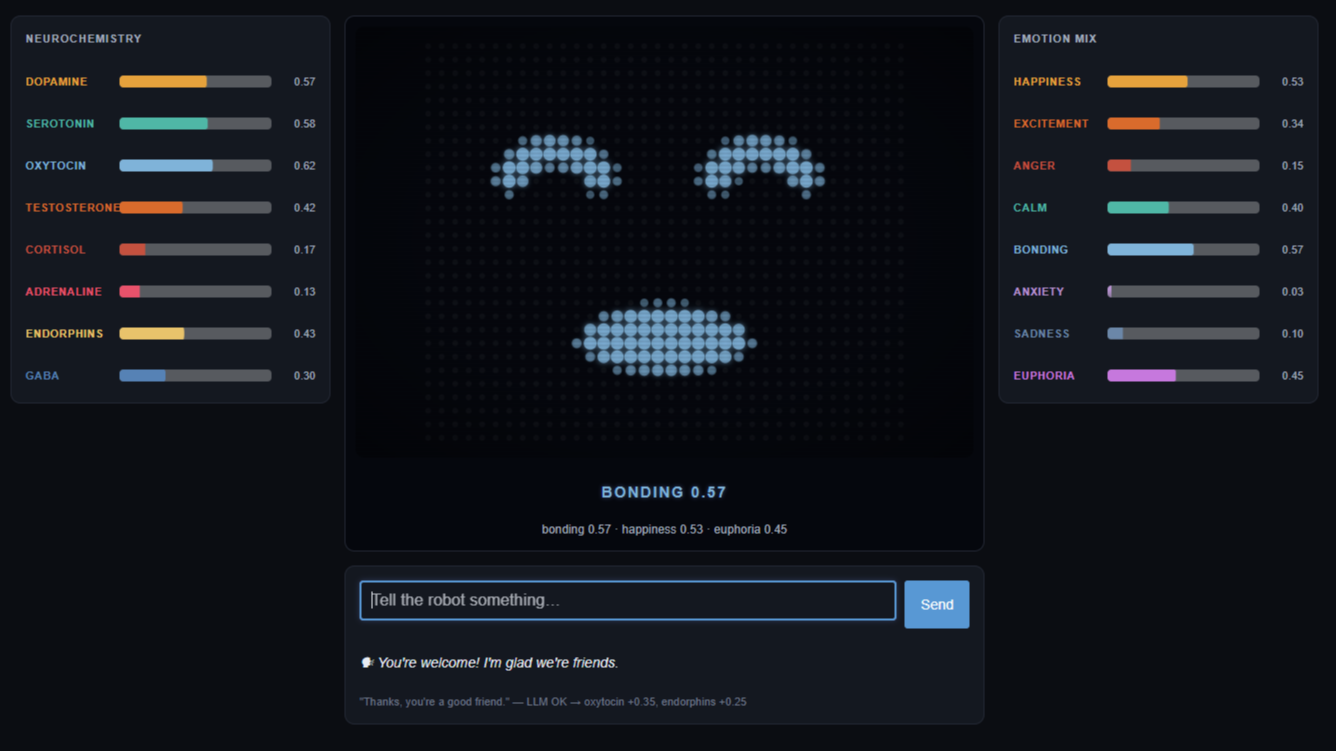
The system’s pure Python implementation and modularity further underscore its utility. Python’s readability and extensive libraries make it an ideal language for complex simulations, while modularity ensures that the neurochemical engine can be decoupled from the facial expression system, allowing for independent development or integration into diverse projects.
Facial Action Coding System (FACS): The Language of Nonverbal Cues
Once Kindalive’s neurochemical engine has calculated an internal emotional state, it needs a way to express it externally. This is where the Facial Action Coding System (FACS) becomes indispensable. Developed by Ekman and Friesen in the 1970s, FACS is an objective, comprehensive method for anatomically coding all visually distinguishable facial movements. Instead of relying on subjective interpretations of emotion, FACS breaks down expressions into fundamental "Action Units" (AUs), each corresponding to the contraction or relaxation of specific facial muscles.
Kindalive utilizes twelve key facial movements derived from FACS to render its expressions. While the article specifically mentions "brow raise, lip corner pull, mouth open," other common FACS AUs that contribute to a wide range of emotions include:
- Inner Brow Raiser (AU 1): Associated with sadness, fear, and concentration.
- Outer Brow Raiser (AU 2): Often seen with surprise or fear.
- Brow Lowerer (AU 4): Indicates anger, concentration, or confusion.
- Cheek Raiser (AU 6): Contributes to genuine smiles (Duchenne smile).
- Lip Corner Puller (AU 12): The primary component of a smile.
- Lip Stretcher (AU 20): Widens the mouth, often associated with fear or pain.
- Jaw Drop (AU 26): Opens the mouth, seen in surprise or shock.
By manipulating these twelve elements in varying intensities and combinations, Kindalive can generate a vast repertoire of nuanced expressions on its simulated dot-matrix face. A slight lip corner pull combined with a subtle brow raise could indicate polite amusement, whereas a strong brow lower, tightened lips, and narrowed eyes would clearly convey frustration or anger. This dynamic blending of AUs allows for the continuous expression of emotion, moving seamlessly from one state to another, mirroring the fluidity of human emotional display.
Crucially, the physical representation doesn’t require a hyper-realistic human face. As the article rightly points out, something every Star Wars fan knows, cartoon eyes and basic sounds are often enough to make robots relatable. The effectiveness of FACS lies in its ability to translate internal states into universally recognized external cues, regardless of the underlying physical substrate. Whether it’s a simple LED matrix, an animatronic puppet, or a sophisticated humanoid robot, the principles of FACS ensure that the generated expressions are legible and meaningful to human observers. This adaptability makes Kindalive’s output system incredibly versatile, allowing for its integration across a spectrum of robotic designs without demanding costly and often uncanny valley-inducing attempts at human mimicry.
Official Responses: Anticipating the Dialogue
While Kindalive is a relatively new project, its innovative approach is likely to spark considerable discussion and "responses" within the robotics, AI, and human-computer interaction communities.
Drew Smith’s Vision: Implicit in Kindalive is Drew Smith’s belief that current methods for robot emotional expression are inadequate. His project suggests a vision where robots are not just functional tools but engaging companions and collaborators, capable of deeper, more intuitive interactions. He likely envisions a future where the friction in human-robot communication is significantly reduced, leading to greater trust and efficiency. His decision to open-source Kindalive underscores a desire to foster community engagement, inviting other researchers and hobbyists to build upon his foundation, validate his approach, and explore new applications.
The AI/Robotics Community’s Perspective:
- Praise for Innovation: Many in the field will undoubtedly laud Kindalive as a bold and creative step forward. The shift from linguistic interpretation to simulated biological processes is a significant conceptual leap that could inspire new avenues of research in affective computing.
- Challenges and Skepticism: Some might raise questions about the complexity and computational cost of simulating neurochemical dynamics in real-time, especially for resource-constrained robotic platforms. There could also be philosophical debates about whether simulating neurochemicals truly constitutes "emotion" or merely a sophisticated mimicry. Critics might argue that without a true subjective experience, it remains a simulation, however convincing.
- Integration Potential: Robotics engineers will likely assess its modularity and ease of integration. The Python backend and FACS output make it highly adaptable, suggesting potential for rapid deployment in various research and commercial prototypes.
- Ethical Considerations: As robots become more adept at expressing "emotions," ethical discussions will intensify. The ability to simulate empathy or distress could lead to complex questions about human perception, manipulation, and the potential for over-reliance on machines that appear to care. How do we ensure users don’t project too much onto these emotionally expressive robots? Where do we draw the line between useful simulation and potentially misleading anthropomorphism?
User and Public Reception (Hypothetical):
For the general public, the impact of Kindalive-enabled robots could be profound. Imagine a service robot that subtly conveys concern when a customer is frustrated, or a companion robot whose "mood" evolves realistically over time, making it feel more like a living entity. This increased believability could foster greater empathy, trust, and willingness to engage with robots. The "uncanny valley" effect, where near-human realism elicits repulsion, might be mitigated by Kindalive’s ability to create compelling, yet not hyper-realistic, expressions through the dot-matrix face or stylized animatronics. The public might find it easier to relate to a robot that expresses its internal state, even if abstractly, than one that remains emotionally opaque.
Implications: Shaping the Future of Human-Robot Coexistence
Kindalive is more than just a clever project; it represents a significant harbinger of the future of human-robot interaction (HRI). Its implications are far-reaching, touching upon various sectors and prompting deeper philosophical questions about our relationship with advanced technology.
Redefining Human-Robot Interaction (HRI)
The most immediate implication is a fundamental shift in HRI. Current interactions are often transactional and functionally driven. By introducing a nuanced, biologically inspired emotional layer, Kindalive enables robots to become more intuitive, relatable, and even empathetic collaborators. This could lead to:
- Enhanced Trust and Acceptance: Robots that can express emotions (even simulated ones) are likely to be perceived as more trustworthy and acceptable, especially in roles requiring social interaction.
- Improved Collaboration: In industrial or service settings, a robot that can subtly communicate its "state" – be it confusion, readiness, or even frustration with a task – could streamline workflows and reduce errors, fostering better human-robot teamwork.
- More Engaging Experiences: For entertainment, education, or companionship, robots with dynamic emotional expressions will offer far richer and more engaging experiences than their emotionally inert predecessors.
Diverse Applications Across Industries
The modularity and versatility of Kindalive’s approach mean it could be integrated into a wide array of robotic applications:
- Service Robotics: In hospitality, retail, or healthcare, robots could better interpret and respond to human emotional states, offering more personalized and comforting interactions. Imagine a hospital robot that expresses gentle encouragement or a retail assistant that conveys genuine helpfulness.
- Therapeutic and Companion Robots: For the elderly, children with developmental disorders, or individuals suffering from loneliness, robots capable of nuanced emotional expression could become invaluable companions, providing comfort and stimulating social engagement.
- Educational Robotics: Robots designed to teach could adjust their emotional expressions to match a student’s level of understanding or frustration, making the learning process more effective and empathetic.
- Industrial and Logistics Robots: Even in seemingly cold, hard industrial environments, a robot that can nonverbally signal its status, warnings, or even its "readiness" could improve safety and efficiency by providing clearer communication with human co-workers.
- Entertainment and Art: More expressive animatronics and digital characters could revolutionize storytelling, theme park attractions, and interactive art installations, creating more immersive and believable experiences.
Future Research Directions
Kindalive opens up numerous avenues for further research:
- Integration with Cognitive Models: Combining Kindalive’s neurochemical model with more sophisticated cognitive architectures could lead to robots that not only express emotions but also demonstrate complex decision-making influenced by their "feelings."
- Learning and Adaptation: Future iterations could incorporate machine learning to allow robots to adapt their emotional responses based on real-world interactions and user feedback, refining their expressive repertoire over time.
- Validation and User Studies: Extensive user studies will be crucial to objectively measure the perceived believability and effectiveness of Kindalive-driven expressions compared to traditional methods.
- Cross-Cultural Emotional Expression: While FACS is largely universal for basic emotions, cultural nuances in the display rules for emotions could be integrated to tailor expressions for specific demographic groups.
- Scalability and Resource Optimization: Research into optimizing the neurochemical simulation for different hardware constraints will be essential for widespread adoption.
Philosophical and Societal Considerations
Beyond the technical and practical implications, Kindalive prompts deeper philosophical questions:
- The Nature of Emotion: If a machine can so convincingly simulate the biological basis of emotion, does it change our understanding of what emotion truly is? Does it challenge the notion that emotion is exclusive to biological life?
- Ethical Responsibility: As robots become more "emotional," the ethical responsibilities of their creators and users grow. How do we prevent potential emotional manipulation, or manage the psychological impact on humans who may form strong attachments to machines that appear to care?
- Defining Consciousness: While Kindalive doesn’t claim consciousness, its internal modeling of a biological process brings us closer to discussions about what constitutes consciousness and whether such simulations contribute to its emergence.
In conclusion, Drew Smith’s Kindalive project marks a pivotal moment in the evolution of artificial intelligence and robotics. By pioneering a neurochemical simulation approach to emotional expression, it offers a compelling vision for a future where robots are not just intelligent, but also deeply intuitive and empathetic. As we continue to integrate robots into every facet of our lives, Kindalive provides a crucial framework for fostering a more natural, understanding, and ultimately, more human-like coexistence with our mechanical companions. The era of truly believable bots, capable of expressing their inner "feelings," is dawning, and Kindalive is leading the charge.