Teradyne Expands UltraFLEXplus Platform with Three Breakthrough Instruments to Power the AI and Data Center Semiconductor Revolution
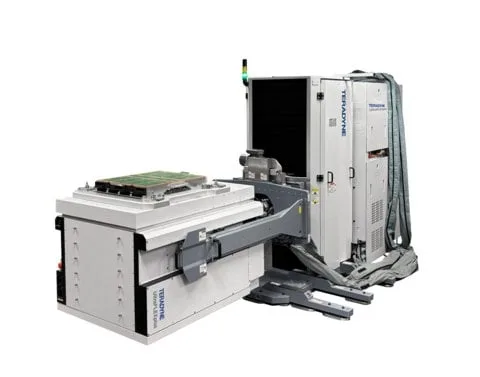
SAN JOSE, Calif. — As the artificial intelligence (AI) boom and hyperscale data center expansion drive semiconductor design into unprecedented realms of complexity, automated test equipment (ATE) leader Teradyne has answered the call. The company has officially announced a major expansion of its flagship UltraFLEXplus testing platform, introducing three advanced instruments—the UltraPin5000-EM, UltraPort-PCIe6, and UltraVS64-HP.
Engineered specifically to tackle the extreme speed, massive computational data sets, intricate I/O protocols, and staggering power management requirements of next-generation AI accelerators and data center processors, this new suite is positioned to redefine semiconductor validation across the entire supply chain. From early-stage wafer probing to final rack-level validation, Teradyne’s latest innovations aim to ensure that the silicon powering tomorrow’s AI infrastructure meets the highest standards of reliability, performance, and yield.
Main Facts
Teradyne’s announcement centers on three purpose-built instruments designed to seamlessly integrate into the existing UltraFLEXplus architecture, protecting customer investments while unlocking radical performance enhancements:
- UltraPin5000-EM: A next-generation digital test instrument built for complex AI and advanced computing devices. It boasts a vector memory up to 80 times greater than competing market solutions, a 10-fold increase in pattern loading speeds, and an innovative "Persistence Mode" for near-instantaneous reloading. It supports data transfer rates of 5 Gbps with pristine signal integrity.
- UltraPort-PCIe6: The industry’s first high-speed Automated Test Equipment (ATE) solution designed to verify PCIe Gen6 interface protocols. It delivers speeds of 64 Gbps (PAM-4) across 32 lanes per instrument, backed by a server-class compute backend scalable up to 2 TB of high-performance memory.
- UltraVS64-HP: Teradyne’s most powerful voltage and current supply instrument to date. It delivers an astonishing 1,280 amperes per instrument, scales to 5,120 amperes in a ganged configuration, and can push over 15,000 amperes in a total test cell setup, operating across a voltage range of up to 16V to accommodate emerging Integrated Voltage Regulator (IVR) architectures.
Together, these solutions provide semiconductor manufacturers with the scalability, precision, and raw power needed to test massive, multi-die advanced packaged chips without compromising manufacturing throughput or device yields.
Chronology and Industry Context
The journey toward this product launch has been dictated by the relentless pace of Moore’s Law evolution combined with the architectural pivot toward heterogeneous integration, chiplets, and advanced 2.5D/3D packaging.
The AI Acceleration Era
Over the past half-decade, the explosive growth of Large Language Models (LLMs), generative AI, and machine learning workloads has forced chip designers to abandon traditional monolithic silicon designs. Companies like NVIDIA, AMD, hyperscale cloud providers, and a wave of custom AI ASIC startups have rushed to market with processors featuring billions—and in some cases, trillions—of transistors.
These devices demand vast memory bandwidth, hyper-fast interconnects, and power distribution systems that strain traditional ATE architectures to their absolute limits. Recognizing this bottleneck, Teradyne has systematically evolved its UltraFLEX platforms to stay ahead of the curve.
Development and Integration Phase
The development of the UltraPin5000-EM, UltraPort-PCIe6, and UltraVS64-HP represents years of engineering focus on the specific pain points voiced by leading semiconductor fabrication plants and fabless design houses. By ensuring backward compatibility with legacy boards like the UltraPin2200, Teradyne structured the rollout to minimize capital expenditure hurdles for its global customer base.
The introduction of these instruments marks a critical milestone: shifting complex functional testing and high-speed I/O verification further up the manufacturing chain—from final packaging back to wafer probe—drastically reducing the financial fallout of assembling defective Known Good Die (KGD) into expensive multi-die configurations.
Supporting Data and Technical Deep-Dive
To truly appreciate the engineering achievement behind Teradyne’s new suite, one must examine the specific performance metrics and architectural breakthroughs associated with each instrument.
UltraPin5000-EM: Conquering Massive Test Patterns
AI processors are notoriously data-hungry, requiring extensive test patterns to verify neural network processing units (NPUs), tensor cores, and complex logic blocks.
- Vector Memory: The UltraPin5000-EM features vector memory up to 80 times larger than competing market alternatives. This allows it to handle the immense pattern depths required by modern AI accelerators without running into memory thrashing or reloading bottlenecks.
- Speed and Efficiency: Pattern loading is up to 10 times faster, fundamentally changing test floor economics. Furthermore, the newly introduced Persistence Mode enables near-instantaneous pattern reloads. This drastically compresses debug and characterization cycles for design engineers while maximizing equipment utilization in high-volume production lines.
- Signal Integrity and Timing: Operating at a robust 5 Gbps data transfer rate, the instrument guarantees stellar signal integrity. Its flexible timing architecture allows independent clock frequencies for every single pin, easily adapting to the heterogeneous nature of modern multi-core processors.
- Real-Time Adaptability: An accelerated scan chain operation delivers per-core results in real time, empowering the test cell to make immediate adaptive test decisions. This slashes structural test times while maintaining rigorous fault coverage.
UltraPort-PCIe6: Redefining High-Speed I/O Verification
As data centers scale out, the interconnects linking accelerators, CPUs, and system memory must handle exponentially higher throughput. Peripheral Component Interconnect Express Generation 6 (PCIe Gen6) is the new battleground for high-speed I/O.
- Bandwidth and Density: The UltraPort-PCIe6 is the industry’s premier high-speed ATE solution capable of verifying PCIe Gen6 interfaces at 64 Gbps (PAM-4) across 32 lanes per instrument.
- Diagnostic Precision: The hardware pairs top-tier signal integrity with a dedicated Power Management Unit (PMU) block for every pin, alongside built-in loopback functionality. This ensures clean signal paths, expanded diagnostic capabilities, and rapid test system configuration.
- Server-Class Compute Backend: To process the colossal sets of test data generated by high-speed I/O sweeps, the instrument features a dedicated backend that scales up to 2 TB of high-performance memory.
- Early-Stage Validation: By supporting mission mode testing and high-speed I/O scanning early in the manufacturing flow, the UltraPort-PCIe6 helps engineers qualify Known Good Die (KGD) prior to assembly, dramatically reducing the costly waste of high-value High Bandwidth Memory (HBM) chips and advanced packaging substrates.
UltraVS64-HP: Unmatched Power Management for Energy-Intensive Silicon
Modern AI processors draw immense amounts of power, often behaving like localized supercomputers on a single silicon interposer. Power delivery and thermal control during testing are monumental challenges.
- Raw Amperage: The UltraVS64-HP is Teradyne’s most advanced power supply instrument to date, outputting an unprecedented 1,280 amperes per instrument. When ganged together, a single power supply configuration can deliver 5,120 amperes, while a full test cell configuration unleashes a staggering over 15,000 amperes.
- Voltage Flexibility: With an exclusive operating range extending up to 16V, the instrument is fully optimized for emerging architectures utilizing Integrated Voltage Regulators (IVR), spanning seamlessly from ultra-low-voltage/high-current states to higher-voltage inputs.
- Dynamic Load Response: An integrated multi-point sense system pairs with superior dynamic load response capabilities. This keeps operational conditions stable even as high-current activity shifts rapidly between full-reticle-sized dies and complex multi-die packages, preserving overall device yield.
- Thermal Safety and Profiling: Advanced power profiling gives engineers deep, single-command visibility into device behavior during testing. Crucially, a dedicated Intelligent Power interface introduces hardware-level fault response, reacting instantly to prevent thermal runaway and protect expensive probe cards and sockets from catastrophic and costly damage.
Official Responses and Industry Perspective
Teradyne’s executive leadership views the launch of these instruments not merely as a product update, but as a strategic alignment with the structural transformation of the entire semiconductor ecosystem.
"With the AI and data center market driving unprecedented growth in semiconductor complexity, Teradyne remains committed to delivering innovative solutions that enable our customers to maintain a competitive advantage in this rapidly evolving market," stated Greg Smith, CEO of Teradyne.
"This new suite of instruments expands the capabilities of our UltraFLEXplus platform, delivering cutting-edge, future-proof solutions for testing next-generation devices."
Industry analysts have echoed these sentiments, noting that as semiconductor manufacturing shifts deeper into the era of advanced packaging (such as TSMC’s CoWoS and Intel’s EMIB technologies), the cost of a single test failure has skyrocketed. Testing can no longer be viewed as a mere manufacturing afterthought; it is a critical gatekeeper of economic viability for chipmakers. By equipping the UltraFLEXplus platform with tools capable of handling 15,000+ amperes of power and 64 Gbps I/O speeds, Teradyne has positioned itself as an indispensable partner in the AI hardware supply chain.
Implications for the Semiconductor Ecosystem
The introduction of the UltraPin5000-EM, UltraPort-PCIe6, and UltraVS64-HP carries wide-ranging implications for designers, manufacturers, and data center operators alike:
- Mitigation of Financial Risk in Advanced Packaging: By pushing rigorous functional, power, and I/O testing earlier into the wafer probe phase, semiconductor companies can weed out flawed chiplets before they are committed to expensive multi-die assemblies. This directly translates to higher margins and improved supply chain resilience.
- Acceleration Time-to-Market: With features like Persistence Mode on the digital side and massive memory backends for I/O diagnostics, design teams can debug and characterize next-gen AI architectures in a fraction of the traditional time, helping them beat competitors to market.
- Future-Proofing Data Center Infrastructure: As hyperscalers demand greater energy efficiency alongside raw compute power, the ability of test cells to accurately profile high-current, low-voltage devices under realistic stress conditions ensures that deployed AI hardware will exhibit high operational reliability in the field.
As artificial intelligence continues to reshape global technology infrastructure, Teradyne’s expanded UltraFLEXplus platform provides the rigorous, high-performance testing foundation required to ensure that the silicon engines of the future are built to last.
For more technical specifications and platform details, visit the official Teradyne UltraFLEXplus product page.